
Cramming IB Computer Science in one week feels like trying to compress a whole syllabus into a single download. Your brain overheats, your confidence drops to 1%, and suddenly you’re negotiating with time like it’s a hostile API.
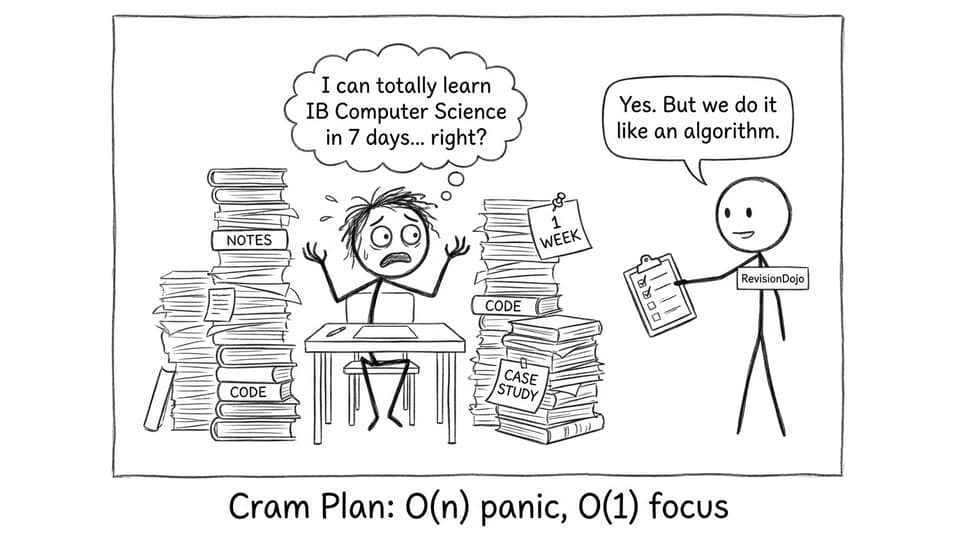
But a week can work, if you stop treating revision like reading and start treating it like execution. The goal isn’t “learn everything.” It’s: collect easy marks, reduce unforced errors, and rehearse exam conditions.
The 1-week IB Computer Science checklist
Before the day-by-day plan, lock these in:
-
Choose your revision hub: the IB Computer Science Resources page is a clean starting point.
-
Build a routine: 2 blocks/day (60-90 min) + 1 short recall block (20 min).
-
Use active tools: Questionbank, Study Notes, Flashcards, AI Chat, and Grading tools to convert knowledge into marks.
-
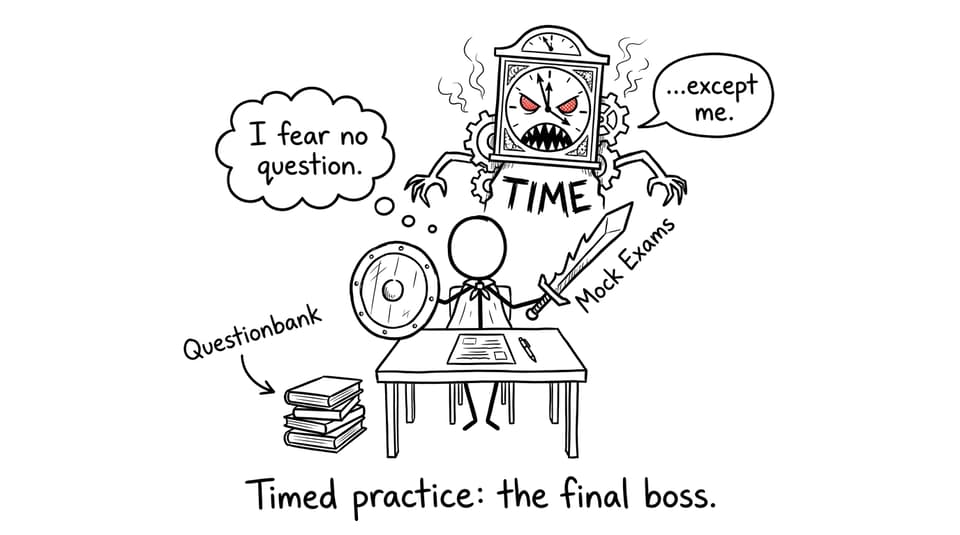
Do timed practice by Day 4. Cramming without timing is just comfort.
Day 1: Systems, data representation, and networks (high-yield foundation)
Start IB Computer Science with the content that shows up everywhere: computer fundamentals and networks.
Focus on:
-
Data representation (binary/hex, ASCII/Unicode, simple conversions)
-
CPU vs memory vs storage (and why examiners care)
-
Network basics: LAN/WAN, client-server vs P2P, protocols like HTTP/FTP, and why layering matters
Use IB Computer Science Notes for fast coverage, then immediately test yourself using RevisionDojo’s Questionbank.
Day 2: Databases + SQL you can actually write
Databases are a “free marks if practiced” zone in IB Computer Science.
Focus on:
-
Keys, relationships, normalization concepts
-
SQL core commands (SELECT, WHERE, JOIN, INSERT, UPDATE, DELETE)
-
Explaining database design choices in plain language
Anchor your study with the syllabus-aligned topic page IB Computer Science: Databases, then drill short SQL questions until the patterns feel automatic.
Day 3: Computational thinking + algorithms (make it exam-shaped)
This is where students often “understand” a concept but can’t earn marks.
Focus on:
-
Abstraction, decomposition, and pattern recognition (with your own examples)
-
Tracing algorithms step-by-step
-
Writing pseudocode clearly (logic > perfect syntax)
RevisionDojo’s AI Chat is ideal here: paste your explanation of, say, abstraction, and ask it to mark your clarity against typical command terms.
Day 4: Programming reps (short problems, many rounds)
In IB Computer Science, programming improves fastest through repetition.
Focus on:
-
Variables, loops, arrays/lists, functions
-
Common tasks: counting, searching, simple validation, reading/writing structured data
-
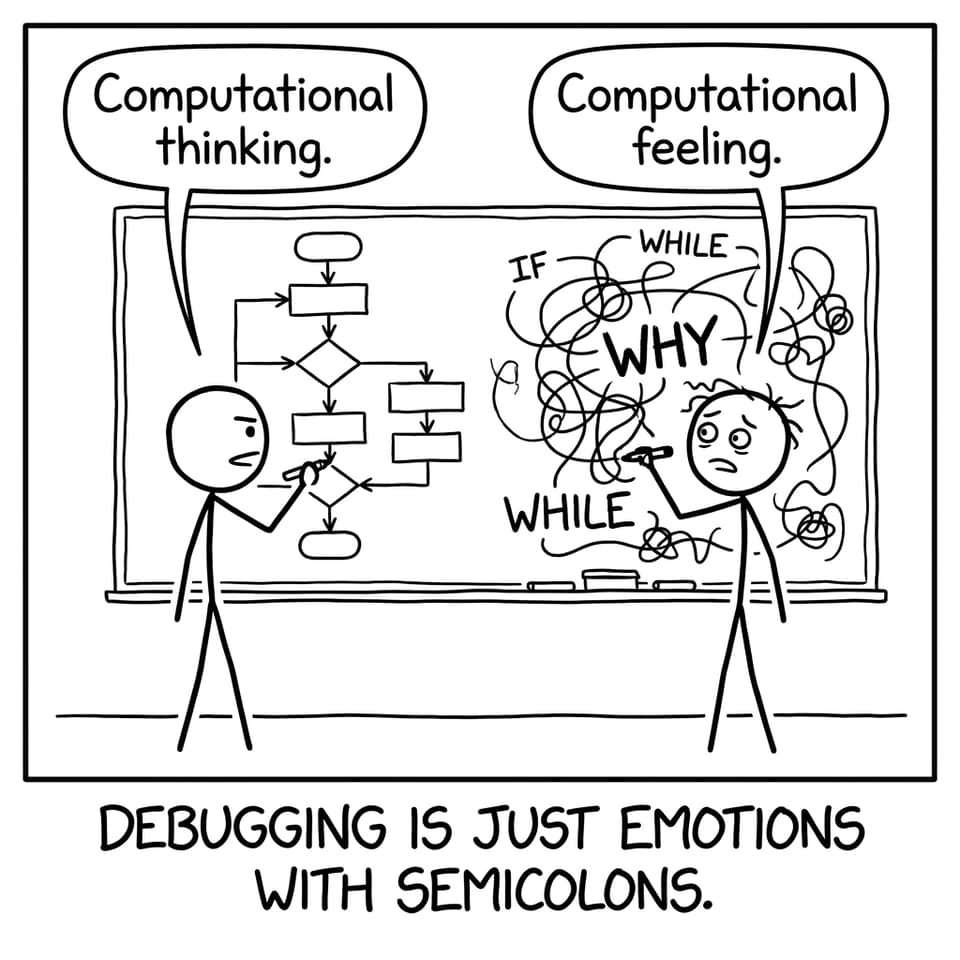
Debugging habits: trace tables, test cases, and explaining fixes
Use the Questionbank for mixed programming items and the Grading tools to see how marks are awarded when your logic is mostly correct but incomplete.
Day 5: OOP + HL extensions (only what pays)
Object-oriented programming is dense when you read it and simple when you apply it.
Focus on:
-
Classes vs objects, encapsulation, inheritance, polymorphism
-
Writing small class diagrams or short snippets that demonstrate the concept
If you’re HL, keep extensions practical: understand what the structures do, when to use them, and how to describe trade-offs. If you’re running out of time, prioritize the content that repeatedly appears in structured questions.
Day 6: Timed mock exam + error log (the turning point)
Today is when cramming becomes control.
Sit a timed paper using IB Computer Science Predicted Papers or the IB Computer Science Predicted Papers hub.
Then make an “error log” with three columns:
-
What I did wrong
-
The rule/pattern I missed
-
One sentence I’ll write next time
This is also the perfect moment to open Mastering IB Computer Science Assessments and align your practice with how you’re actually graded.
Day 7: Patch weaknesses + lock in a 7 strategy
Your final day is not for new content. It’s for tightening.
-
Re-do your worst Questionbank topics.
-
Run Flashcards for definitions and command terms.
-
Do 1 more timed section (not a whole paper) and mark it carefully.
If you want a clean “what separates 6 from 7” framework, read How to Get a 7 in IB Computer Science for 2025 Onward and Fastest Way to Improve from a 5 to a 7 in IB Computer Science. They reinforce the same truth: marks come from precision under time.
Conclusion: Cramming works when it’s disciplined
One week of IB Computer Science revision won’t make you omniscient. But it can make you dangerous in the best way: calm under time, fluent in the patterns, and able to turn understanding into marks.
If you want the most efficient setup, start at RevisionDojo and use it like a tight loop: Study Notes to learn, Flashcards to retain, Questionbank to prove it, Predicted Papers and Mock Exams to simulate pressure, and AI Chat plus Grading tools to fix weak spots fast. That’s how you cram IB Computer Science without turning the week into a blur you can’t remember.