
A comparative essay rarely fails because a student has “no ideas.” It fails because the ideas arrive like uninvited guests: too many, too late, and all talking at once.
In IB English, Paper 2 feels like that moment when you open the exam booklet and realize the question is broad enough to include everything you’ve read… and narrow enough to punish anything unfocused. The skill isn’t knowing two texts. The skill is making them speak to each other, on purpose, under time pressure.
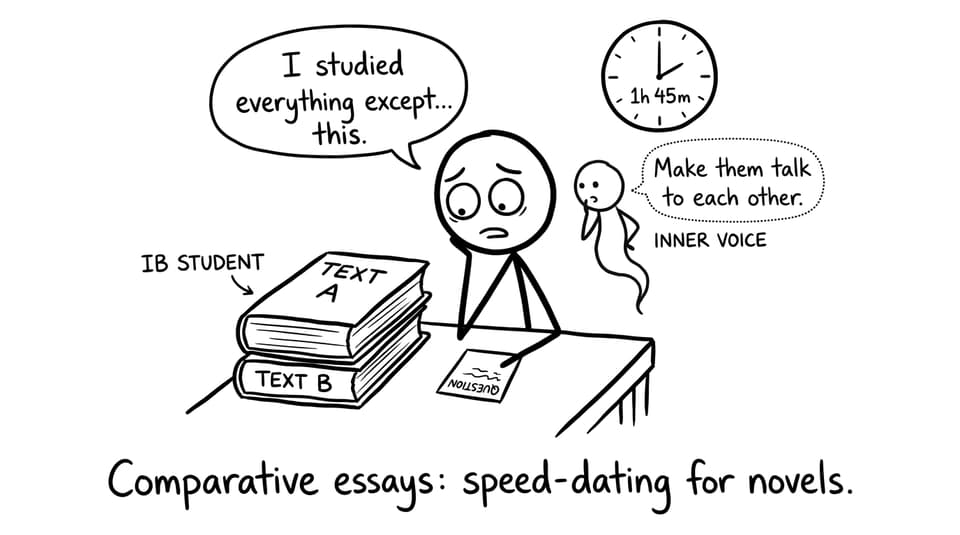
Know what IB English Paper 2 actually demands
Paper 2 gives you 1 hour 45 minutes to choose one question from six and write one comparative essay on at least two studied works. There is no extract to save you. Your marks come from how well you:
-
stay focused on the prompt
-
compare throughout (not in isolated blocks)
-
use precise evidence (short quotes or exact moments)
-
organize an argument that feels inevitable, not accidental
If you want the “rules of the game” in one place, read Structuring Your IB English Paper 2 Essay and How to Compare Texts Effectively in IB English Paper 2. Those guides capture the examiner mindset that separates summary from analysis.
A quick checklist before you write (5-10 minutes)
Use this as your Paper 2 planning ritual in IB English:
-
Pick the question that gives you the cleanest comparison (not the fanciest)
-
Write a thesis that answers the prompt and signals a comparative angle
-
Choose 3 umbrella points (themes, techniques, or tensions)
-
For each point, list one moment from each text + a technique word
-
Add 2-3 linking phrases you will reuse (e.g., “whereas,” “similarly,” “however”)
This is the difference between writing fast and writing in circles.
Build a structure that forces comparison
A strong IB English Paper 2 essay usually lands with 4-6 body paragraphs, but the real win is integration. The paragraph should not feel like “Text A, then Text B.” It should feel like a conversation.
A reliable paragraph shape:
-
Point (comparative claim): what both texts reveal, and how they differ
-
Text 1 evidence + analysis: a short quote or exact moment, then technique
-
Text 2 evidence + analysis: mirror the method
-
Comparative sentence: why the difference matters for the prompt
-
Link back to thesis: remind the examiner you’re steering
For more depth on “integrated comparison,” see How to Structure a Comparative Essay in IB Literature and the companion note set Notes for Structuring Your Points.
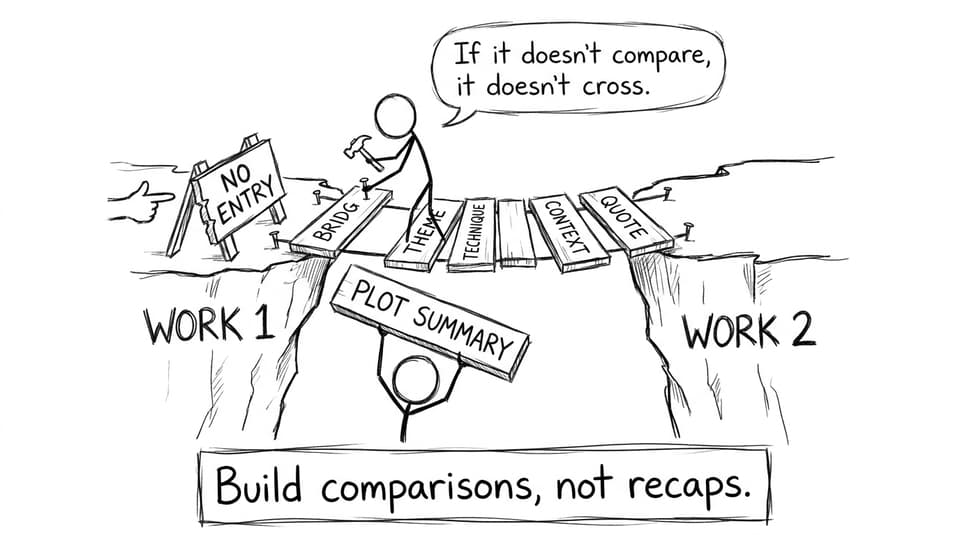
Choose text pairings with “contrast energy”
Good pairings aren’t just similar. They have friction.
When planning for IB English, pick works that let you compare:
-
a shared theme expressed through different forms (play vs novel, dystopia vs realism)
-
similar conflicts with different authorial purposes
-
the same technique used to opposite effects (irony, symbolism, narrative voice)
If you’re unsure what makes a pairing “rich,” build a one-page comparison grid in RevisionDojo, then pressure-test it with practice prompts. You can find Paper 2-aligned practice pathways in English Paper 2 (IB English Literature) and the IB English Paper 2 Questionbank.
Practise like the exam is a decision-making test
Paper 2 isn’t only writing. It’s choosing.
To improve quickly in IB English, practise the parts people skip:
-
10-minute plans (thesis + 3 points) for multiple prompts
-
one paragraph drills using integrated comparison
-
quote banking: flexible lines that fit more than one theme
-
timed full essays with a ruthless review afterward
RevisionDojo makes this loop easier because everything connects: Study Notes to refresh a technique, Flashcards for recall, AI Chat to test thesis strength, Grading tools to check criteria alignment, and Mock Exams plus Predicted Papers to build stamina. When you want examples of what top-band control looks like, use the Coursework Library, and if you need human calibration, add Tutors for targeted feedback.
A practical next step is reading How to Prepare for the IB English Paper 2 Exam Under Time Pressure and How to Score a 7 in IB English Paper 2.
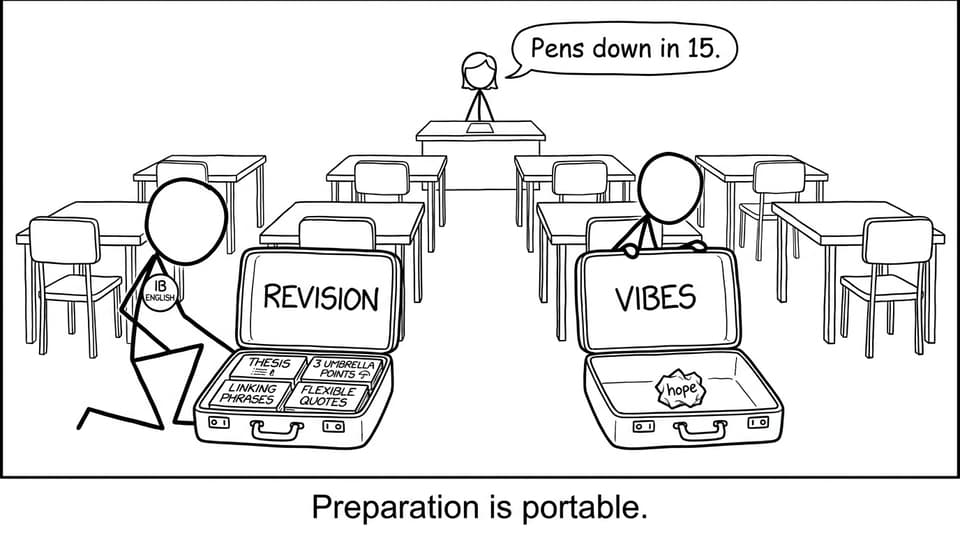
Conclusion: Make the two texts meet on the page
The best IB English Paper 2 essays feel calm because they’re built on a repeatable system: plan quickly, structure for comparison, choose points with real contrast, and practise under time pressure until decisions become automatic.
If you want that system in one place, RevisionDojo is designed for it: a connected Questionbank, clean Study Notes, memory-ready Flashcards, fast feedback via AI Chat and Grading tools, plus Mock Exams, Predicted Papers, a model-rich Coursework Library, and optional Tutors when you need a sharper edge. Start with one timed plan today, then turn it into one integrated paragraph. That’s how control is built in IB English: one deliberate comparison at a time.