

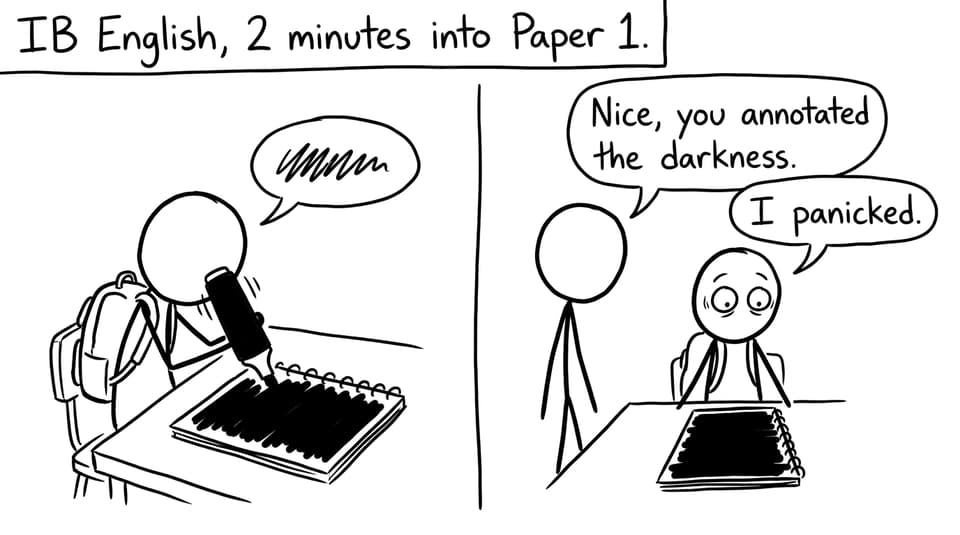
If you have ever left an IB English practice session with a page that looks like a neon crime scene, you already know the problem: you worked hard, but you did not get closer to a better commentary.
Efficient annotation is not about proving you noticed everything. It is about noticing the few things that will run your essay. In IB English, especially in Paper 1, your best annotations behave like signposts: they guide you back to meaning, structure, and effect when the clock starts to feel loud.
This guide gives you a fast, repeatable system you can use for IB English exams without drowning in highlights.
The 60-second IB English annotation checklist
Use this quick loop before you write anything:
-
Read once with no pen: capture gist, mood, and what seems to be at stake.
-
Label the basics: text type, speaker/voice, purpose, audience, context clues.
-
Break the passage into 3-5 logical chunks (beginning, turn, climax, resolution).
-
Annotate only what you can explain: technique + effect + why it matters.
-
Circle 2-3 patterns you can build paragraphs around.
To practice this with real exam-style extracts, build short drills using RevisionDojo’s IB English A: Language & Literature resources and pull targeted prompts from the Questionbank.
Read first, then mark with intention
The strongest IB English students delay the pen by a minute or two. That pause is not laziness; it is strategy.
On your first read, focus on the human layer:
-
What is the tone doing (warm, defensive, ironic, mournful)?
-
Where does it shift?
-
What is the passage trying to make the reader feel or believe?
Then, on the second read, you annotate as if you are collecting evidence for a single claim. If you do not know your claim yet, annotate what seems to be pulling the text in a direction: repeated images, contrasts, and moments of emphasis.
If Paper 1 is your priority, pair this approach with RevisionDojo’s guide on Best ways to prepare for IB English Paper 1 so your reading and writing routines reinforce each other.
A simple annotation code that stays fast under pressure
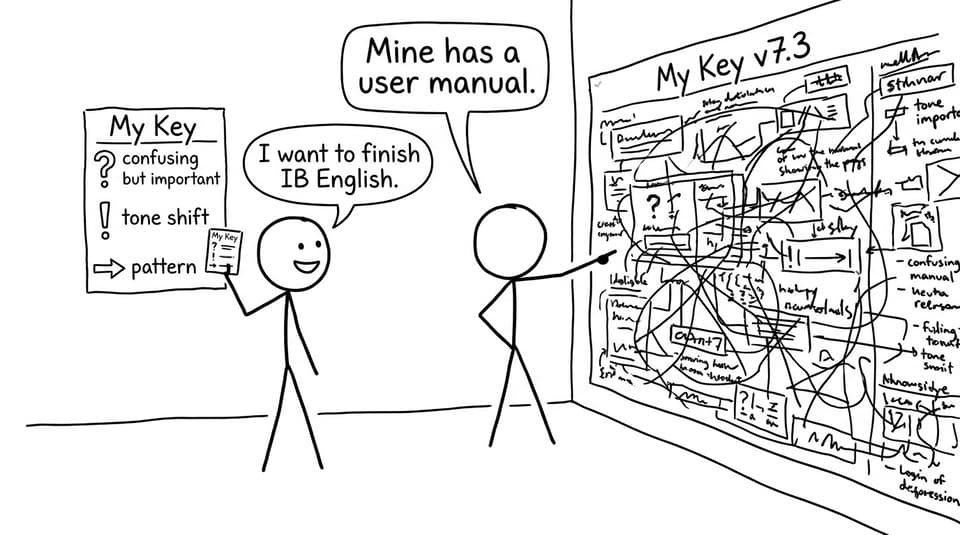
Speed comes from consistency. Create a tiny annotation key you can repeat in every IB English practice.
Here is a minimal system that works:
-
TS = tone shift
-
P = purpose (what the writer wants)
-
A = audience (who is being targeted)
-
S = structure move (contrast, turn, zoom-in, revelation)
-
IMG = recurring image or motif
-
D = diction cluster (words with a shared mood or value)
-
? = unclear but suspiciously important (mark now, return later)
Your margin note should not be “metaphor.” It should be “metaphor makes hardship feel inevitable.” In IB English, naming is cheap; explaining effect is what earns marks.
For a structure-and-technique refresher that aligns with Paper 1 expectations, see How to master Paper 1 (guide notes).
Annotate for patterns, not confetti
A useful mental model for IB English annotation: you are shopping for paragraph ideas.
Patterns are what turn scattered observations into coherent analysis. Look for:
-
Repetition (images, pronouns, sentence openings, sound)
-
Contrast (light/dark, private/public, “we” vs “they”)
-
Escalation (language intensifies, sentences tighten, stakes rise)
-
Structural turning points (a pivot word like “but,” a dash, a new voice)
When you find a pattern, draw a quick link between examples (an arrow, a bracket, a boxed cluster). That single move often becomes a whole body paragraph.
If you want a ready-made lens for fiction and narrative extracts, RevisionDojo’s Prose fiction notes include an annotation framework you can adapt.
Track shifts in tone, voice, and pacing (the examiner loves these)
In IB English, shifts are your shortcuts. They help you show progression: how meaning develops, not just what devices exist.
Mark shifts when you notice:
-
Sentence length changes (from flowing to clipped)
-
A new perspective or a sudden address to “you”
-
A change in register (formal to conversational)
-
A structural break (new stanza, paragraph, or visual interruption)
Then write one line in the margin answering: So what? Example: “TS: irony hardens into accusation; reader pressured to agree.”
To see how this connects to full commentary structure, use Writing a commentary for IB English A: step-by-step.
A timed method that prevents over-annotating
Try this for Paper 1 practice:
-
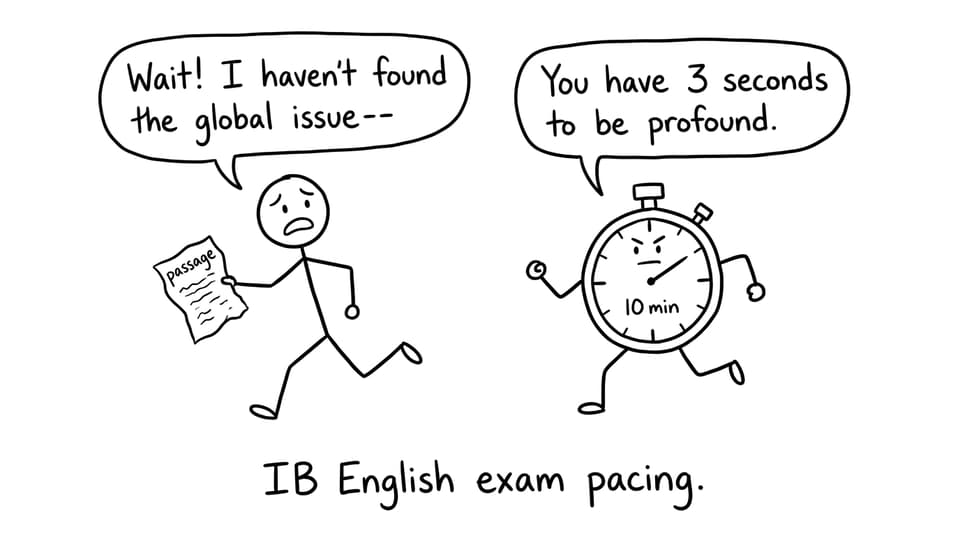
2 minutes: first read, no pen.
-
6 minutes: second read, annotate patterns and shifts only.
-
2 minutes: choose your thesis + 3 paragraph headings.
This is where RevisionDojo becomes practical: you can pull extracts from the Questionbank, draft your response, then use grading tools like the English Language and Literature Paper 1 Grader to see whether your annotations actually produced criterion-relevant analysis.
How RevisionDojo makes IB English annotation easier
Annotation improves fastest when feedback is immediate.
A strong loop looks like this:
-
Use Study Notes and Cheatsheets to refresh what techniques usually do.
-
Drill with the Questionbank and build Mock Exams to simulate pressure.
-
Turn recurring weak spots into Flashcards (tone words, structural moves, commentary verbs).
-
Use AI Chat to test interpretations: “What is another way to explain this effect?”
-
Use grading tools to check whether your commentary matches what the rubric rewards.
If you are building broader skill across genres, explore RevisionDojo’s Effective study techniques for IB English A.
Conclusion: Make IB English annotation serve your writing
Efficient annotation in IB English is a promise to your future self: “When I start writing, I will not have to rediscover the text.” Read first, mark patterns, track shifts, and keep margin notes focused on effect. The page should look like a plan, not a paint spill.
If you want this to become automatic, build a weekly routine on RevisionDojo: practice unseen extracts with the Questionbank, refine with Study Notes and Flashcards, and pressure-test your work with grading tools and mock exam sessions. Your IB English annotations will get smaller, cleaner, and far more powerful, and your essays will feel like they have somewhere to go.