
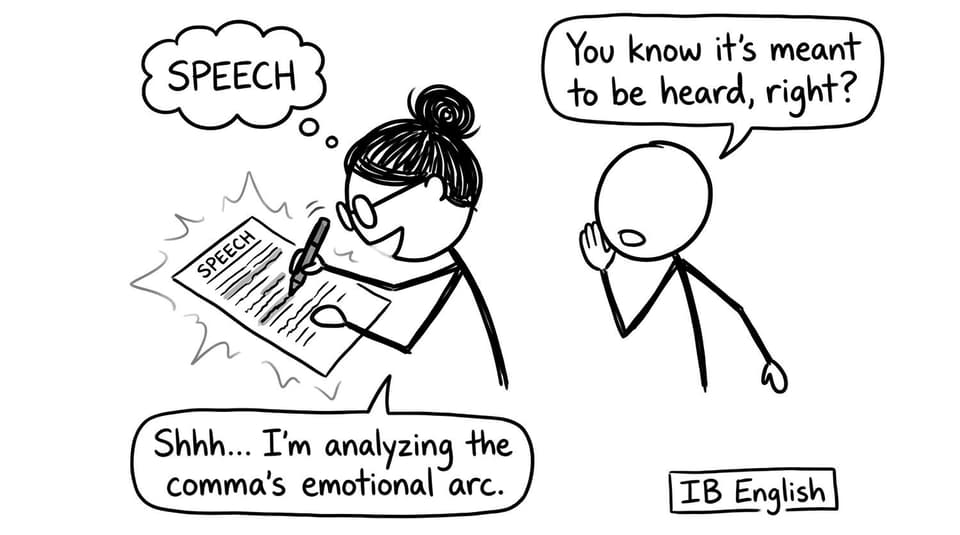
If you have ever read a transcript of a speech and thought, “This looks fine on paper,” then watched it delivered and felt your stomach drop, you already understand the problem.
In IB English, speech and dialogue are never just “what was said.” They are how a voice tries to move another human being: to persuade, comfort, intimidate, entertain, or survive. The best analysis notices the moment a speaker reaches for control, the moment a character dodges a question, and the moment silence becomes a decision.
This guide shows you how to analyze speech and dialogue in a way that fits what examiners reward in IB English A: Language & Literature (and works just as well for Literature). You will get a practical checklist, technique bank, and exam-ready sentence frames you can reuse.
The fast checklist (use this before you write)
When you analyze speech and dialogue in IB English, aim to answer these in your annotations first:
-
Purpose: What does the speaker/character want right now?
-
Audience: Who are they speaking to, and what does that audience expect?
-
Context: What social, political, or personal pressures shape the moment?
-
Voice: What sounds distinctive (register, rhythm, diction, syntax)?
-
Power: Who controls the exchange, and how do we know?
-
Silence: What is avoided, withheld, or implied?
-
Effect: What is the intended impact, and what is the actual impact?
If you want a clear Paper 1 structure to hold all of this, borrow TAPAC and paragraph planning from Mastering IB English Paper 1: A Complete Guide.
What “speech” and “dialogue” mean in IB English analysis
In IB English, “speech” usually refers to a single voice addressing an audience (political address, commemorative speech, interview answer, monologue). Even when you only see a transcript, you should still treat it as a performed text: pacing, pauses, and rhythm matter.
“Dialogue” is an interaction. Meaning is created not only through the words, but through turn-taking: interruptions, evasions, politeness strategies, and the emotional distance between lines.
A useful way to remember the difference:
-
Speech often reveals positioning (How do I want the audience to see me?)
-
Dialogue often reveals relationship (How do we negotiate power and closeness?)
For broader exam prep routines that sharpen these habits, see Best Ways to Prepare for IB English Paper 1.
How to analyze speech in IB English (the “three lens” method)
Purpose and audience: what is the speaker trying to make happen?
Start with the speaker’s job in the moment. Are they trying to unify, shame, inspire, justify, or reframe blame?
Then track how the audience shapes choices:
-
Inclusive pronouns (“we,” “our”) can manufacture belonging.
-
Direct address (“you”) can intensify urgency or confrontation.
-
Ethos cues (credentials, moral certainty, shared values) build authority.
In IB English, your commentary improves when you name the effect with precision: not “it makes it persuasive,” but “it reduces distance between speaker and audience, reframing the issue as collective responsibility.”
Rhetoric and structure: how does the speech build pressure?
Speeches are engineered. Look for the architecture:
-
Anaphora and repetition to create momentum.
-
Parallelism to make ideas feel inevitable.
-
Escalation (images intensify, stakes rise, tone hardens).
-
Pacing via short sentences, strategic pauses, or climactic endings.
A strong IB English move is to track the speech in time: “At first the speaker sounds measured, then the syntax tightens and repetition accelerates, signalling urgency.”
Tone and diction: what attitude does the voice perform?
Tone is the emotional contract between speaker and audience. Diction signals who the speech is “for.”
-
Formal diction can project authority or distance.
-
Colloquial diction can perform authenticity.
-
Emotive diction can recruit empathy or outrage.
Try writing one sentence that includes technique + effect + purpose. If you struggle, use RevisionDojo’s AI Chat to test interpretations, then refine into your own voice.
How to analyze dialogue in IB English (where the real meaning hides)
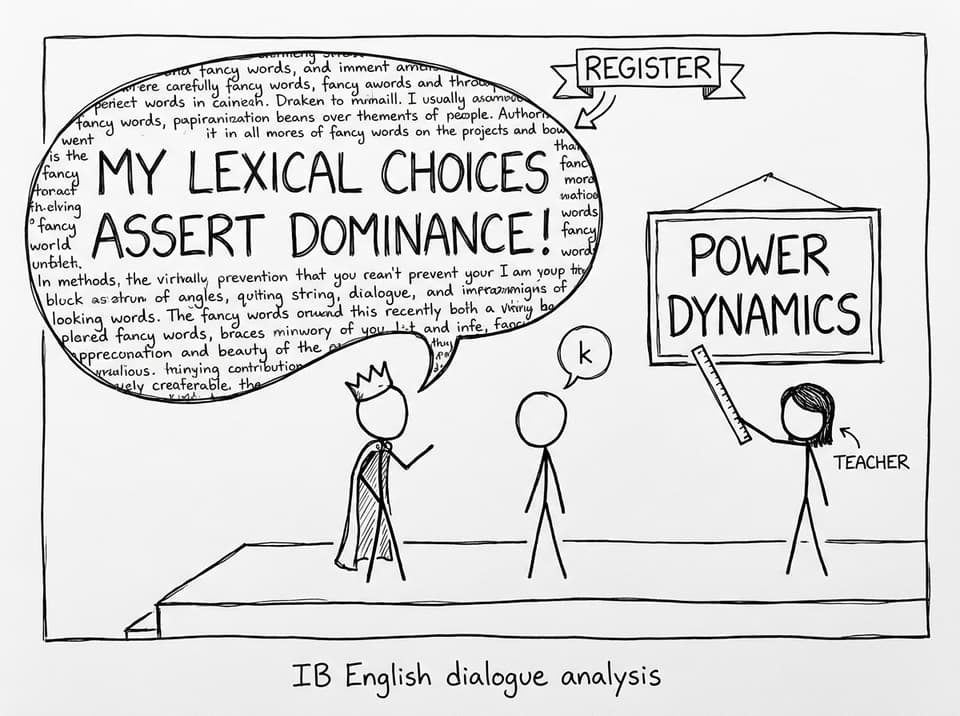
Power dynamics: who controls the conversation?
In dialogue, control shows up in small behaviours:
-
Interruptions and overlaps
-
Who asks questions vs who answers
-
Who changes topic
-
Who speaks in longer turns
In IB English, you are rewarded for linking this to theme: dominance might reinforce patriarchy, social hierarchy, generational conflict, or institutional pressure.
Register and idiolect: how does each voice signal identity?
Two key terms you can use accurately:
-
Register: formality level shaped by context (courtroom vs bedroom vs public stage).
-
Idiolect: a character’s personal speech fingerprint (favourite phrases, sentence length, slang, politeness).
Short, clipped lines can suggest restraint, emotional suppression, or threat. Over-elaborate politeness can suggest fear, deception, or performance.
If you need a bank of precise terminology, RevisionDojo’s English Literature Glossary helps you avoid vague labels.
What is not said: pauses, ellipses, and strategic silence
Some of the strongest dialogue analysis in IB English comes from the gap between lines.
-
Ellipses can show hesitation, censorship, or emotional overload.
-
Stage directions can contradict spoken words.
-
Silence can become refusal, grief, or liberation.
Write it like this: “The pause functions as a boundary; the character withholds language to reclaim control.” That is analysis, not plot.
Technique bank you can reuse (speech + dialogue)
Use these as evidence starters in IB English paragraphs:
-
Repetition, anaphora, parallelism
-
Rhetorical questions and direct address
-
Modality (must/should/might) for certainty vs doubt
-
Sentence fragmentation for urgency or instability
-
Interruptions, overlaps, turn-taking imbalance
-
Politeness strategies (hedging, honorifics, softened commands)
-
Irony, sarcasm, undercutting humour
-
Silence, ellipses, unfinished thoughts
For text-type awareness across Paper 1, revisit How to Handle Different Text Types in IB English Language and Literature.
Applying speech and dialogue analysis to assessments
Paper 1: make it methodical
Paper 1 rewards controlled commentary. Use your annotations to build 3-4 focused analytical claims.
A reliable workflow is outlined in Step-by-Step Guide to Revising IB English Paper 1.
RevisionDojo makes practice more repeatable: build drills from the Questionbank, then use the IB English Language and Literature Paper 1 Grader to check whether your points are truly analytical.
Paper 2 and comparative writing: dialogue as theme evidence
In Paper 2, dialogue becomes your proof of relationships and ideology. One writer might use polite confrontation; another might use brutal interruption. That contrast becomes your argument.
If you are building comparison habits, Thematic Comparisons Across IB Prescribed Texts is a useful framework.
IO: voice as a bridge to the global issue
The IO is where speech and dialogue analysis feels most natural: you are literally speaking about speech.
Use dialogue patterns to connect to global issues like oppression, freedom, representation, or institutional power. Then practise delivery with RevisionDojo’s IO resources and the IB Language A: Individual Oral Grader.
Common mistakes (and the quick fixes)
-
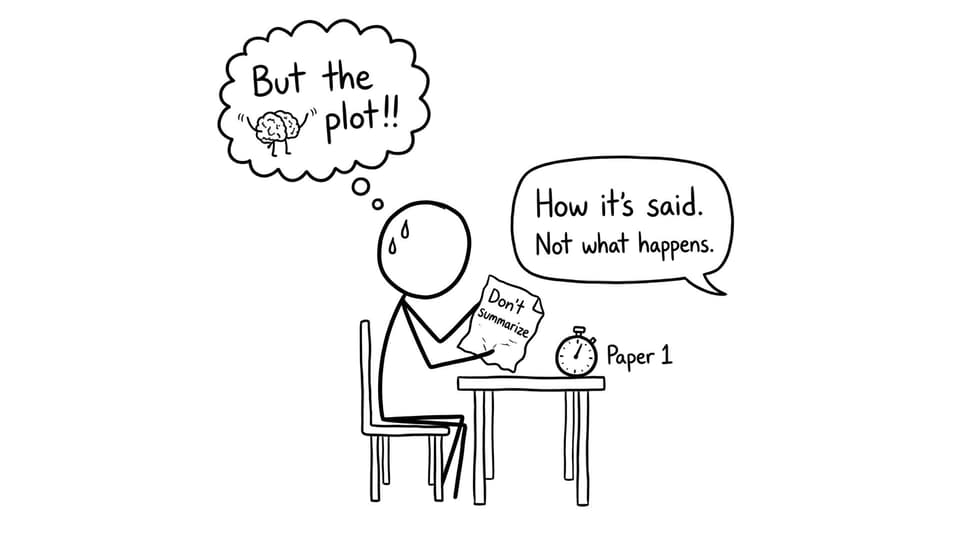
Mistake: summarizing the exchange. Fix: write one sentence beginning with “The effect of…”
-
Mistake: listing techniques. Fix: choose fewer features, explain them deeper.
-
Mistake: ignoring silence. Fix: treat pauses like evidence.
-
Mistake: forgetting audience. Fix: name who is being targeted and why.
Closing: turn “nice quote” into “meaningful choice”
Speech and dialogue are where texts reveal their most human truth: people talk to be seen, to be safe, to win, to hide. In IB English, your job is to show the examiner that you can hear those motives on the page.
If you want a single place to practise that skill across Paper 1, Paper 2, and the IO, RevisionDojo brings it together: Questionbank drills, Study Notes, Flashcards, AI Chat, Grading tools, Predicted Papers, Mock Exams, a Coursework Library, and Tutors when you need another set of expert eyes. Build the habit now, and the next time you meet a speech or a tense exchange in IB English, you will know exactly where the meaning is hiding.