

Gas exchange is one of those IB Biology ideas that feels obvious right until you try to explain it under timed conditions. Oxygen in, carbon dioxide out; simple. Then the exam asks why a fish needs gills, why an insect can skip lungs, or why bigger organisms can’t just “diffuse harder.” Suddenly, the quiet hero of the topic shows up: surface area-to-volume ratio.
In IB Biology, SA:V ratio is the bridge between structure and function. It explains why evolution keeps reinventing the same design: make surfaces bigger, barriers thinner, and gradients steeper.
IB Biology quick checklist: what makes gas exchange efficient?
Use this as a short IB Biology marking-point bank:
-
Large surface area for diffusion (more “doors” for gases)
-
Short diffusion distance (thin membranes)
-
Moist surface so gases dissolve before crossing
-
Steep concentration gradient maintained by ventilation and/or blood flow
For a syllabus-aligned overview, anchor your revision to B3.1 Gas exchange and the companion B3.1 Gas exchange notes.
Why surface area-to-volume ratio matters in IB Biology
SA:V ratio compares how much exchange surface you have versus how much living volume needs oxygen.
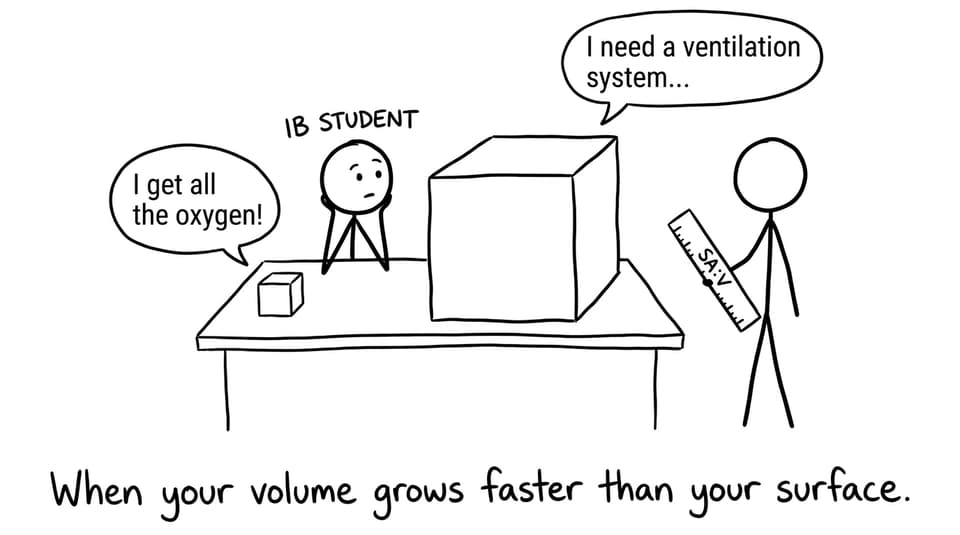
As size increases, volume grows faster than surface area. In IB Biology terms, that means:
-
Demand rises quickly (more respiring cells making CO₂ and needing O₂)
-
Supply capacity lags (not enough membrane surface to keep up)
Small organisms like bacteria often have a high SA:V ratio, so diffusion across a membrane can be enough. Bigger organisms can’t rely on that alone, so they build specialized surfaces.
If you want the cell-size logic behind this, revise Surface area-to-volume ratios and constraints on cell size.
How organisms “hack” SA:V ratio for gas exchange
In IB Biology, the pattern is consistent: increase surface area without massively increasing volume.
Mammals: alveoli as a surface-area factory
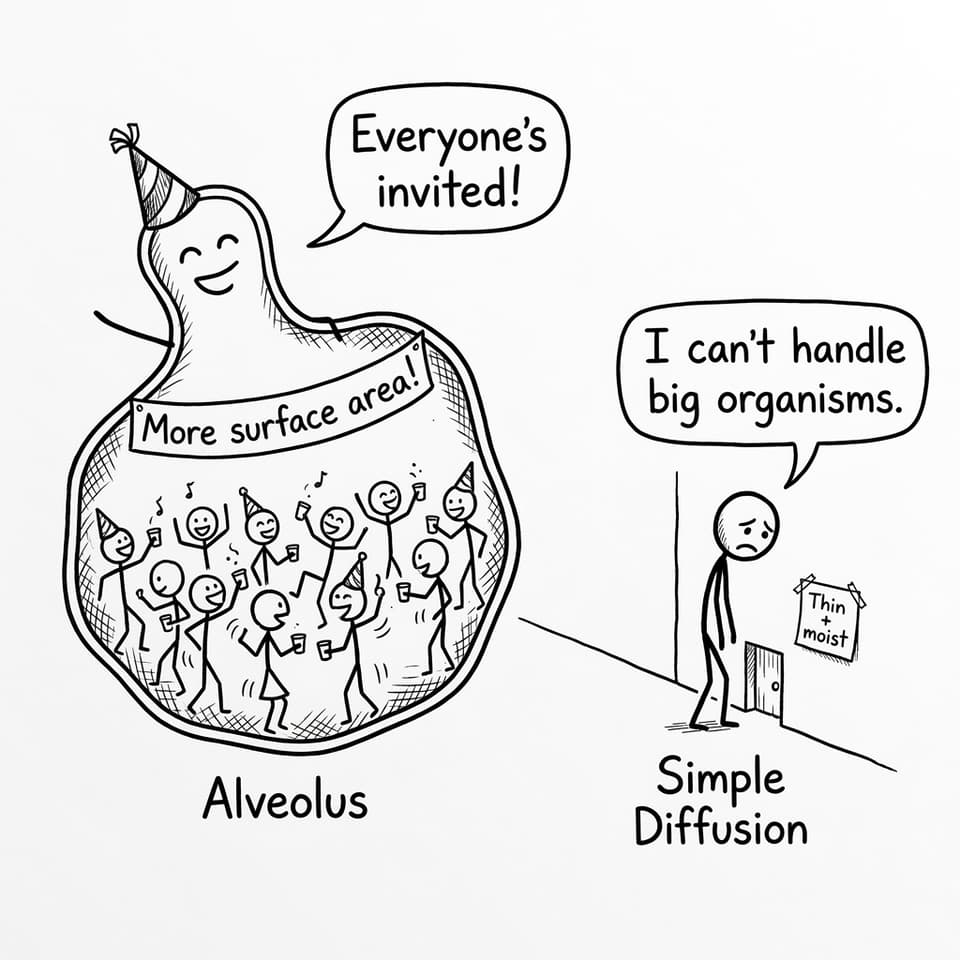
Millions of alveoli create a huge internal surface, with walls about one cell thick, sitting right next to capillaries. That reduces diffusion distance and maintains gradients.
Link your understanding to Adaptations of mammalian lungs for gas exchange.
Fish: gills and (often) counter-current efficiency
Gills use filaments and lamellae to multiply surface area. Continuous water flow keeps fresh oxygen arriving, protecting the concentration gradient.
To consolidate the “properties” that show up across lungs, gills, and leaves, use Properties of gas-exchange surfaces.
Insects and plants: different structures, same SA:V logic
Insects branch tracheoles deep into tissues, cutting diffusion distance. Plants use stomata and internal air spaces to expose lots of moist surface.
This is where IB Biology exam answers score well: you’re not listing facts, you’re explaining why the design makes diffusion faster.
Exam-style framing: the sentence that earns marks
When you see SA:V ratio in IB Biology, try this structure:
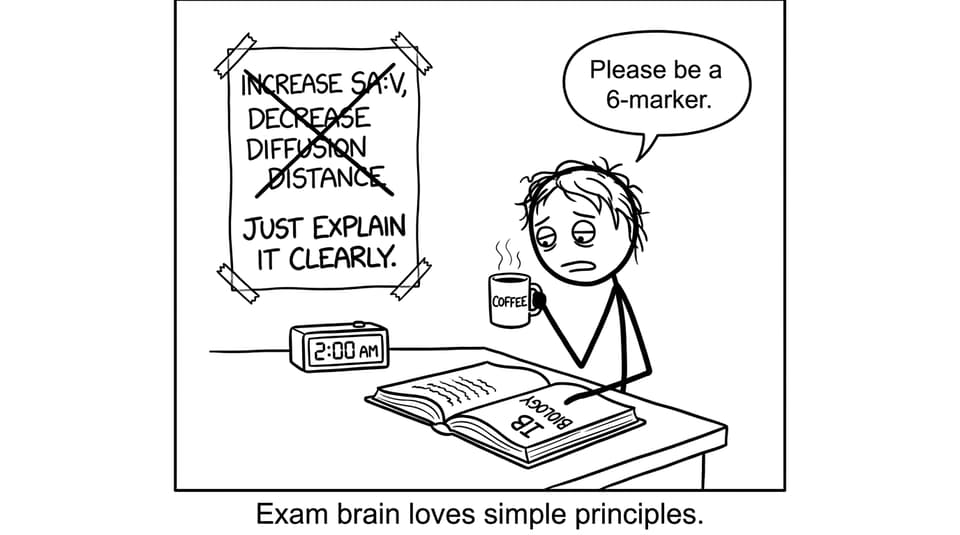
As size increases, SA:V ratio decreases, so diffusion across the body surface is too slow to meet metabolic demand. Organisms compensate with specialized exchange surfaces that increase surface area, reduce diffusion distance, and maintain concentration gradients.
Then add one named example (alveoli, gill lamellae, tracheoles, stomata).
To practise writing this under pressure, use the B3.1 Gas Exchange Questionbank or the broader Questionbank feature page.
Study SA:V ratio and gas exchange with RevisionDojo
If you’re revising IB Biology, treat SA:V ratio as a master key: it unlocks lungs, gills, tracheoles, and stomata with one idea. Build confidence by combining RevisionDojo’s Study Notes with Flashcards for rapid recall, then pressure-test your understanding using the Questionbank and AI Chat. When you want exam realism, add Mock Exams, Predicted Papers, and Grading tools to tighten your explanations. And if you need targeted help, the Tutors and Coursework Library keep you moving when a topic stalls.
Next step: read B3.1 Gas exchange, drill Properties of gas-exchange surfaces, then do 15 minutes in the B3.1 Gas Exchange Questionbank to make the SA:V ratio explanation automatic.