RevisionDojo logoRevisionDojo logo
PricingSchools
  1. Home
  2. /Blog
  3. /IB Design Technology: Revising for Paper 1 (Fast + Smart)

IB Design Technology: Revising for Paper 1 (Fast + Smart)

IB Design Technology
RevisionDojo Team
•Last updated: 19 Jul 2026•7 min read
Jojo holding a cookie

This site uses cookie tracking technologies. Learn more in our Cookie Policy.

/5 from students worldwide
Share
Share on
4.9
X
Share on
Share on
Share on
WhatsApp
LinkedIn
Facebook

Join 650k+ students breezing through the IBReady to breeze through the IB?

Footer

General

  • For parents
  • For schools
  • Pricing
  • Gift RevisionDojo
  • Tutoring
  • IB syllabus
  • MYP syllabus
  • Blog
  • Research

Features

  • Jojo AI
  • Questionbank
  • Notes
  • Flashcards
  • Test builder
  • Exam mode
  • Coursework
  • Coursework grader
  • Coursework examples
  • Predicted papers
  • IB grade calculator
  • Grade boundaries

Research

  • State of learning survey
  • IB Moderation Analysis
  • Jojo AI vs ChatGPT
  • Jojo AI vs Gemini
  • Jojo AI vs Perplexity
  • Jojo AI vs Claude
  • Jojo AI vs Poe

Platform

  • RevisionDojo vs Others
  • Content philosophy
  • Trustpilot
  • Join usWe're hiring
  • Terms and conditions
  • Privacy policy
  • Cookie policy
  • Trust Center

MYP Subjects

  • MYP Biology
  • MYP Chemistry
  • MYP English Lang & Lit
  • MYP Extended Mathematics
  • MYP History
  • MYP Individuals & Societies
  • MYP Physics
  • MYP Standard Mathematics
  • MYP Biology
  • MYP Chemistry
  • MYP English Lang & Lit
RevisionDojo logo

© 2022 - 2026 RevisionDojo (MyDojo Inc)

RevisionDojo was developed independently of the IBO and as such is not endorsed by it in any way.

  • MYP Extended Mathematics
    • MYP History
    • MYP Individuals & Societies
    • MYP Physics
    • MYP Standard Mathematics

    IB Subjects

    • Arabic ab initio
    • Arabic B
    • Biology
    • Business Management
    • Chemistry
    • Chinese A Lang & Lit
    • Chinese B
    • Computer Science (CS)
    • Computer Science (First Exam 2027)
    • Design Technology (DT)
    • Design Technology (First Exam 2027)
    • Digital Society (DS)
    • Economics
    • English A Lang & Lit
    • English A Lit
    • English B
    • Environmental systems and societies (ESS)
    • French A
    • French ab initio
    • French B
    • Geography
    • German A
    • German ab initio
    • German B
    • Global Politics
    • History
    • Mathematics Analysis and Approaches (AA)
    • Mathematics Applications & Interpretation (AI)
    • Philosophy
    • Physics
    • Psychology
    • Psychology (First Exam 2027)
    • Arabic ab initio
    • Arabic B
    • Biology
    • Business Management
    • Chemistry
    • Chinese A Lang & Lit
    • Chinese B
    • Computer Science (CS)
    • Computer Science (First Exam 2027)
    • Design Technology (DT)
    • Design Technology (First Exam 2027)
    • Digital Society (DS)
    GDPR compliant
    Download on the App Store

    IB Design Technology Paper 1 has a particular way of humbling people.

    Not because it asks impossibly advanced content, but because it asks familiar ideas in unfamiliar outfits. A chair becomes a medical device. A packaging choice becomes an ethical dilemma. A “simple” materials question hides inside a scenario about heat, cost, and user safety.

    If you revise IB Design Technology Paper 1 like it’s a vocabulary test, it will feel random. If you revise it like a designer -- noticing context, users, constraints, and trade-offs -- it starts to feel oddly predictable.

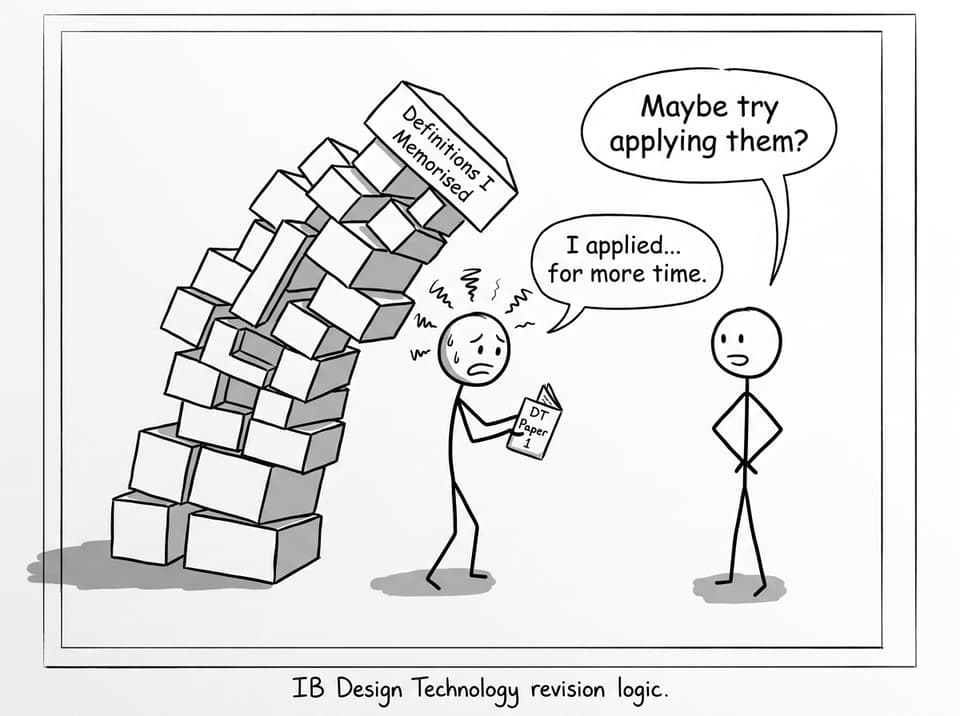
    A stressed student versus definitions pile
    A stressed student versus definitions pile

    What IB Design Technology Paper 1 actually rewards

    Paper 1 is multiple choice, but it is not “easy.” It rewards speed, precision, and the ability to apply concepts quickly.

    Here’s what IB Design Technology Paper 1 tends to test most:

    • Core theory (design process, modelling, materials, sustainability)

    • Understanding users and context (ergonomics, inclusive design, safety)

    • Distinguishing similar terms (where one word changes the whole meaning)

    • Recognising the best option under constraints (cost, environment, manufacturing, function)

    If you want a clear breakdown of the format and what to expect, read IB Design Technology Paper 1 Explained.

    A quick checklist before you start revising

    Use this as your “don’t-waste-time” checklist:

    • Can I define key terms in one clean sentence?

    • Can I give one product example for each key term?

    • Can I eliminate wrong options by using the scenario details?

    • Do I know the difference between common command terms?

    • Am I practising under time pressure at least twice a week?

    To organise everything in one place, start from the IB Design Technology hub and build outward.

    Stop memorising definitions in isolation

    You do need definitions. But Paper 1 usually marks recognition and application.

    A better way to revise IB Design Technology vocabulary is:

    1. Learn the definition.

    2. Attach it to one real product.

    3. Ask: “How would this show up in a multiple-choice scenario?”

    RevisionDojo makes this loop fast: use the IB Design Technology Key Definitions as your base, then test yourself using topic questions from the A. Design in theory Questionbank.

    Focus on a few high-leverage concepts first

    Some concepts show up everywhere because they apply to almost every product.

    Prioritise these IB Design Technology ideas early:

    • User-centred design and research methods

    • Ergonomics (physical and cognitive)

    • Sustainability and responsibility (life cycle thinking)

    • Materials and properties (why one is chosen over another)

    • Modelling and prototyping (purpose, types, limitations)

    If your notes feel messy, rebuild them with a visual-first approach using How to Create Effective IB Design Technology Revision Notes. You can also lean on curated summaries in IB Design Technology Notes.

    Practise “scenario thinking” (the Paper 1 superpower)

    Most Paper 1 mistakes come from ignoring what the question gives you.

    Train yourself to read scenarios like a designer:

    • Who is the user?

    • Where is the product used?

    • What is the main constraint (cost, safety, durability, environment)?

    • What is the hidden trade-off?

    Then do one small habit that changes everything: before you look at the options, predict what the answer should sound like.

    To build this skill with variety, mix study formats on RevisionDojo: Study Notes for clarity, Flashcards for recall, and AI Chat for quick “why is A wrong and C right?” explanations.
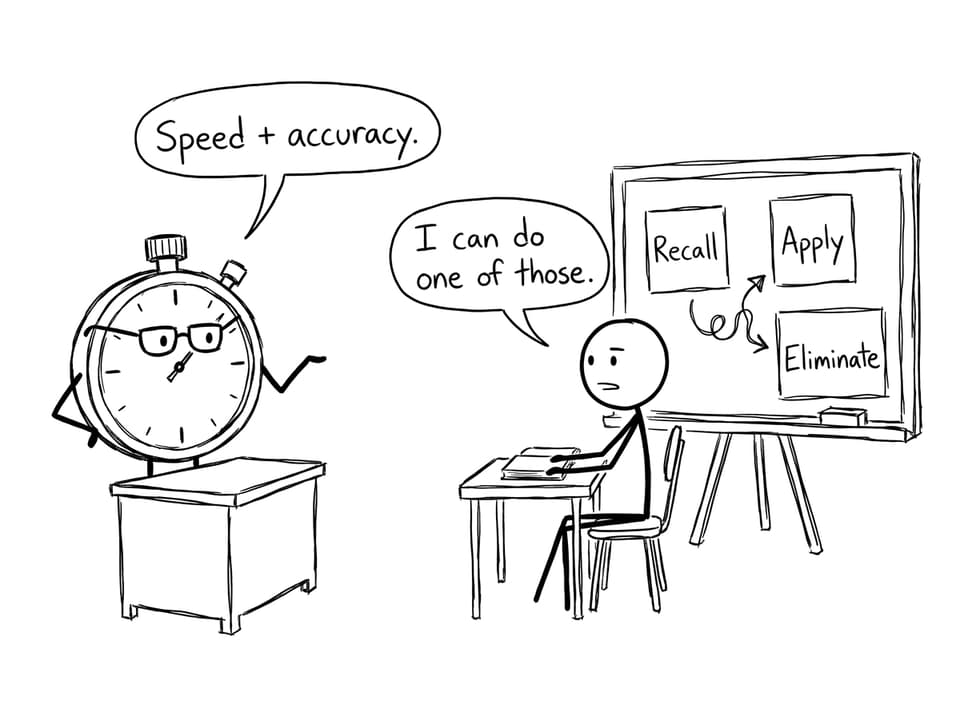
    Stopwatch coaching a student
    Stopwatch coaching a student

    Learn command terms so you don’t misread the task

    Even in multiple choice, command terms steer your thinking. “Identify” feels different from “analyse.” “Best justification” is different from “true statement.”

    Build command term fluency with:

    • What Command Terms Appear Most in IB Design Technology Exams

    • How to Use IB Command Terms Effectively in Exam Responses

    This is also one of the easiest ways to jump grades without learning extra content. (If you want proof, see How Do You Improve From a Grade 5 to a 7 in IB Design Technology?).

    Use timed practice the right way

    Practice only works if you treat it like feedback, not entertainment.

    Try this cycle for IB Design Technology Paper 1:

    • Build a timed set using RevisionDojo’s Questionbank and exam builder

    • Mark it (and write why each wrong option is wrong)

    • Turn recurring errors into Flashcards

    • Reattempt similar questions 48 hours later

    For full exam simulation, use Design Technology Predicted Papers (Free) or the dedicated IB Design Technology papers page. Pair this with RevisionDojo’s Grading tools to spot patterns quickly.
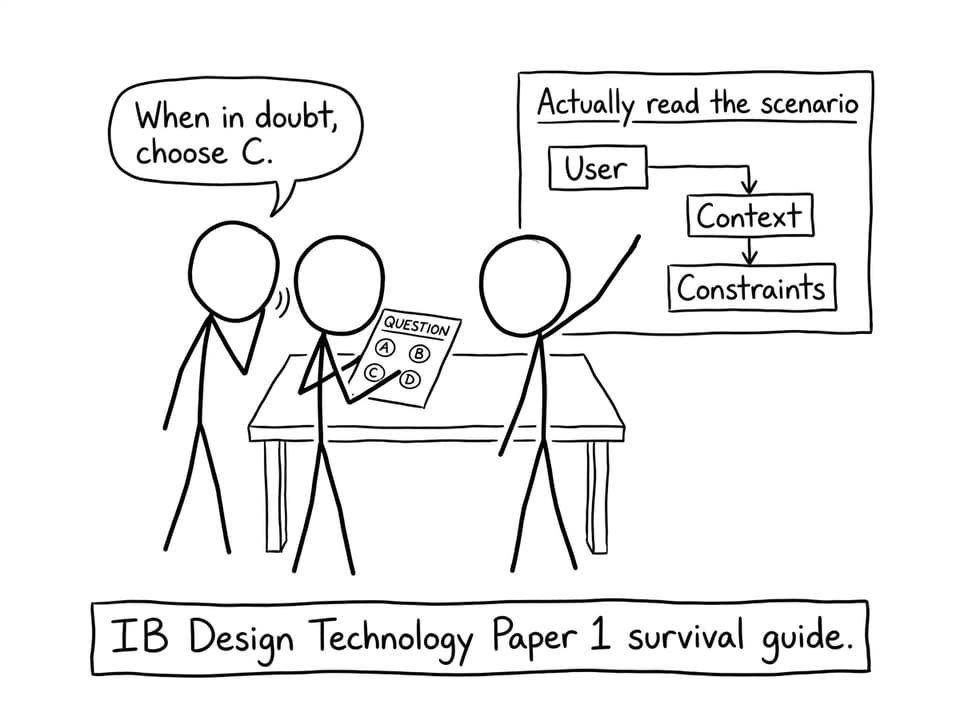
    Two students debating option C versus reading the scenario
    Two students debating option C versus reading the scenario

    A simple weekly plan (realistic, not heroic)

    If you do this for 3--4 weeks, Paper 1 starts to feel familiar.

    • 2 days/week: one core topic + definitions + quick Flashcards

    • 2 days/week: 25--35 minutes timed multiple choice (Questionbank)

    • 1 day/week: review mistakes + ask AI Chat to clarify confusion

    • 1 day/week: one mixed-topic mini mock (Predicted Papers or Mock Exams)

    If you want to avoid the traps students fall into, keep Top Mistakes to Avoid in IB Design Technology Exams open while you revise.

    Closing: make Paper 1 feel predictable

    The best revision for IB Design Technology Paper 1 is not louder effort. It’s quieter accuracy.

    Build definitions that you can recognise instantly, practise scenario thinking until it becomes automatic, and use timed questions as feedback loops. If you want all of that in one place -- Questionbank, Study Notes, Flashcards, AI Chat, Grading tools, Predicted Papers, Mock Exams, plus Coursework Library and Tutors when you need extra support -- start with RevisionDojo’s IB Design Technology hub and make your next practice set the beginning of a system, not a gamble.

    How helpful was this article?
    Add as a preferred source on Google

    Continue studying with RevisionDojo

    • IB Coursework GraderCheck an IA, EE, or TOK draft against IB assessment criteria.
    • IB Coursework ExamplesLearn from high-scoring coursework across IB subjects.
    • IB Grade CalculatorEstimate an IB grade using session-specific boundaries.
    • IB Grade BoundariesExplore historical grade boundaries by subject and session.

  • Spanish A
  • Spanish ab initio
  • Spanish B
  • Sports, exercise and health science (SEHS)
  • Theory of Knowledge (TOK)
  • Economics
  • English A Lang & Lit
  • English A Lit
  • English B
  • Environmental systems and societies (ESS)
  • French A
  • French ab initio
  • French B
    • Geography
    • German A
    • German ab initio
    • German B
    • Global Politics
    • History
    • Mathematics Analysis and Approaches (AA)
    • Mathematics Applications & Interpretation (AI)
    • Philosophy
    • Physics
    • Psychology
    • Psychology (First Exam 2027)
    • Spanish A
    • Spanish ab initio
    • Spanish B
    • Sports, exercise and health science (SEHS)
    • Theory of Knowledge (TOK)

    Frequently Asked Questions

    Related Articles

    IB Design Technology · 4 min read

    What Extra Topics Are Covered in IB Design Technology HL?

    Learn what extra topics IB Design Technology HL students study, how HL content is deeper than SL, and what this means for exams and coursework.

    IB Design Technology · 7 min read

    IB Design Technology IA: How to Show Real Iteration

    IB Design Technology iteration made simple: learn what counts, where to show it in your IA, and how to document changes for higher marks.

    IB Design Technology · 8

    IB Design Technology Problem Statement: Write It Strong

    IB Design Technology problem statement guide: learn the user-first formula, avoid solution language, add evidence, and set up high-scoring IA work.

    IB Design Technology · 8

    IB Design Technology IA Referencing: A Simple Guide

    IB Design Technology IA referencing made simple: what to cite, how to format in-text citations, and how to avoid plagiarism with consistent sources.

    IB Design Technology · 7

    IB Design Technology Without Creativity: Can You Still Excel?

    IB Design Technology success isn’t about being artistic. Learn what examiners reward, how to score higher, and how RevisionDojo helps.

    IB Design Technology · 7

    Common IB Design Technology Exam Mistakes (and Fixes)

    IB Design Technology exam mistakes are predictable. Learn the most common errors and quick fixes for command terms, evaluation, timing, and structure.

    min read
    min read
    min read
    min read