
When you’re deep in IB Biology revision, translation can feel like a neat flowchart: mRNA in, protein out. Then you meet the uncomfortable detail: cells are building enormous molecules at high speed, with thousands of chances to make a mistake. And yet most proteins come out functional.
That reliability is not luck. It’s engineering. Ribosomes behave less like passive machines and more like careful editors, catching errors before they become expensive.
The exam-ready checklist: what keeps translation accurate?
For IB Biology, you want a simple mental checklist you can deploy in any short-answer response:
-
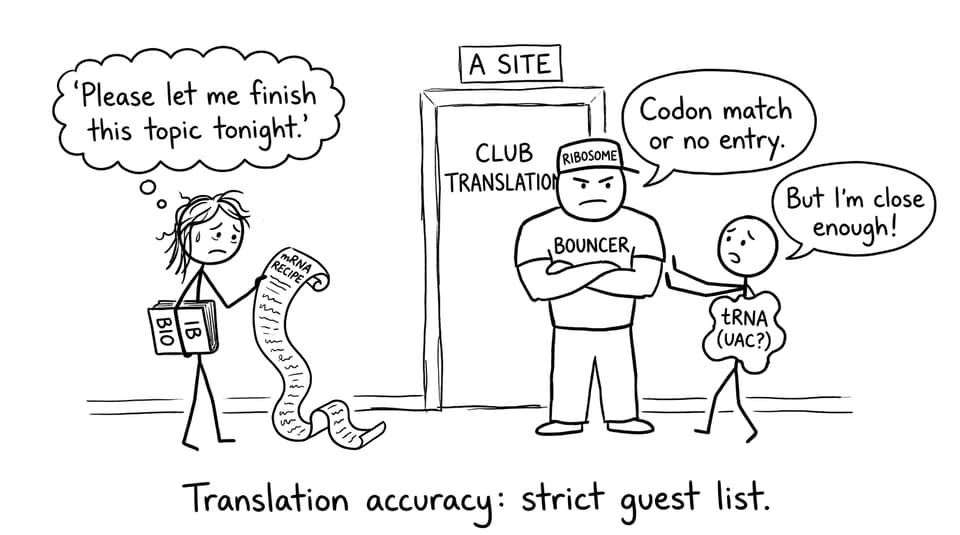
Codon-anticodon pairing checked in the ribosome’s A site
-
Wobble allowed mostly at the third base, but strict matching at the first two
-
Kinetic proofreading: time delay lets wrong tRNAs fall off
-
Correct tRNA charging by aminoacyl-tRNA synthetases (with their own proofreading)
-
Structural/conformational checkpoints in the small subunit’s decoding center
-
Elongation factors support fidelity by controlling entry and commitment
If you can explain those clearly, you’re doing the kind of explanation markers reward.
Codon-anticodon pairing: the ribosome’s first filter (IB Biology core)
Accuracy starts with base pairing. In the A site (aminoacyl site), the ribosome tests whether the incoming tRNA anticodon matches the mRNA codon. This is the first and most intuitive quality control step in IB Biology.
A key nuance is wobble base pairing. The third position of the codon can be more flexible, which helps cells translate efficiently with fewer tRNA types. But the ribosome stays much stricter at the first two positions, where a mismatch is far more likely to change the amino acid being added.
If you need a clean refresher on who does what in translation, RevisionDojo’s notes on Roles of mRNA, ribosomes and tRNA in translation help you keep the A, P, and E sites straight.
Kinetic proofreading: accuracy through waiting
Here’s the part students often skip in essays because it sounds abstract: the ribosome uses timing.
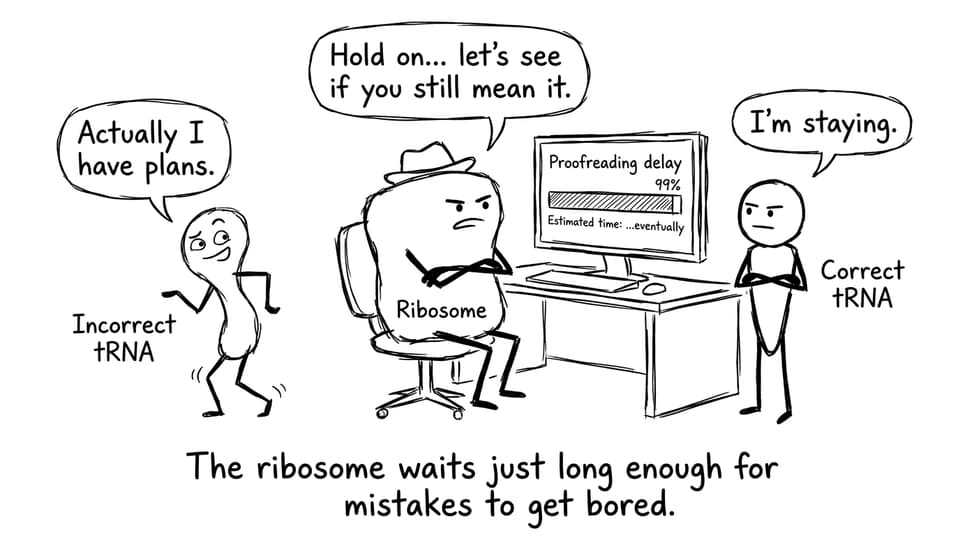
When a tRNA enters the A site, the ribosome doesn’t immediately lock in the peptide bond. It pauses just long enough that a weakly matched (incorrect) tRNA is more likely to detach. A correctly matched tRNA forms a more stable interaction, survives the delay, and then translation commits to the next step.
That small delay is kinetic proofreading. In exam terms, it’s a “second check” that happens after initial binding but before irreversible commitment.
To practice how this appears in exam-style prompts, try RevisionDojo’s D1.2 Protein synthesis Questionbank and look for questions describing “delay,” “dissociation,” or “fidelity.”
tRNA charging: the accuracy step that happens before the ribosome
A ribosome can only check the anticodon pairing. It does not verify whether the amino acid attached to that tRNA is correct. That’s why aminoacyl-tRNA synthetases matter so much.
Each synthetase matches:
-
the correct tRNA (identity features)
-
the correct amino acid
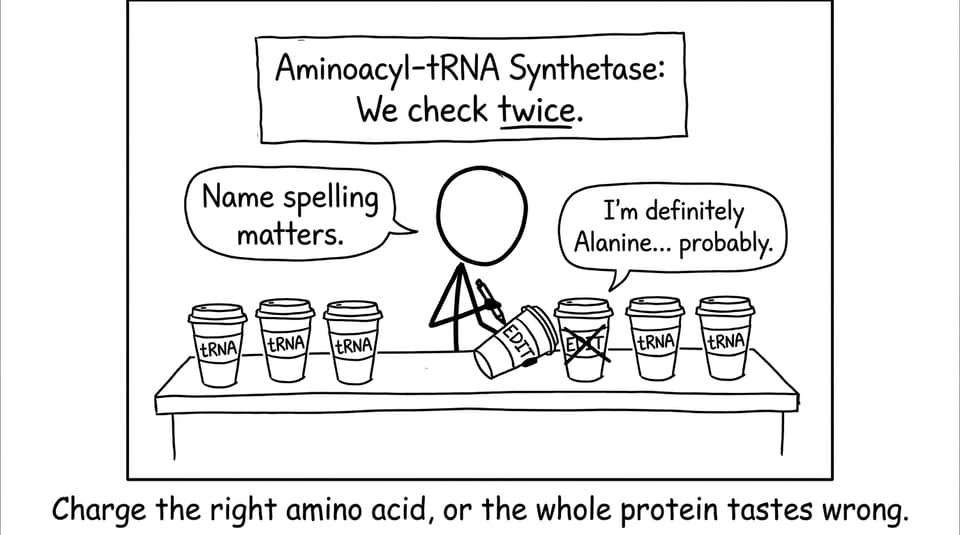
Many synthetases also have proofreading/editing ability: if the wrong amino acid is attached, the enzyme can remove it before the tRNA ever reaches the ribosome. In other words, translation accuracy in IB Biology is a team effort, and the ribosome depends on upstream checking.
Structural checkpoints and elongation factors: the ribosome commits only when it should
The ribosome’s decoding center (in the small subunit) undergoes conformational changes only when the codon-anticodon interaction is correct and stable. If pairing is unstable, the ribosome is less likely to proceed.
Elongation factors add another layer. In prokaryotes, EF-Tu helps deliver aminoacyl-tRNAs; in eukaryotes, the analogous factor is eEF1A. These factors effectively control when the ribosome “commits” to a tRNA, improving fidelity alongside kinetic proofreading.
If you’re comparing systems, RevisionDojo’s explanation of Prokaryotic vs Eukaryotic Translation is a quick way to pick up extra comparative language for longer responses.
Why this matters: the error rate you can quote
Put the mechanisms together and you get an impressively low error rate: roughly one incorrect amino acid per ~10,000 incorporated. In IB Biology, that number is useful because it shows these checkpoints aren’t just theoretical; they’re measurable and biologically crucial.
Errors can still happen. But high error rates would flood the cell with misfolded proteins, disrupt enzymes, and trigger stress responses. Translation accuracy protects the whole cell economy.
For a broader “where does translation sit in gene expression?” view, connect this topic to Gene expression notes and the wider unit 2.7 DNA replication, transcription and translation.
Bring it home with RevisionDojo (and revise smarter)
If you’re revising IB Biology and want this topic to stick, don’t just reread it. Use active recall: explain the three big fidelity layers (codon check, kinetic proofreading, tRNA charging) out loud, then test yourself.
RevisionDojo helps you do that efficiently with the Questionbank, Study Notes, and Flashcards for D1.2, plus AI Chat when a definition feels slippery. When you want exam realism, use Mock Exams, Predicted Papers, and the Grading tools to tighten your wording. And if you’re juggling gaps across the syllabus, the Tutors and Coursework Library give you structure when motivation runs thin.
Start with IB Biology Topic D1.2: Protein Synthesis, and make translation accuracy one of the easiest marks you pick up on exam day.