


A quick hook: the quiet shuffle that changes everything
If you have ever looked around your class and wondered how people can share the same basic blueprint yet turn out so differently, you are already thinking like an IB Biology student. The answer is not just “genes” in the abstract. It is the way genes get shuffled. During meiosis, genetic recombination acts like a careful editor, cutting and rejoining DNA so that no two gametes are quite the same. That small, hidden shuffle is one of the biggest reasons evolution has options.
IB Biology exam checklist: what to say about recombination
For IB Biology, exam answers score best when they are precise and tied to the phase of meiosis.
-
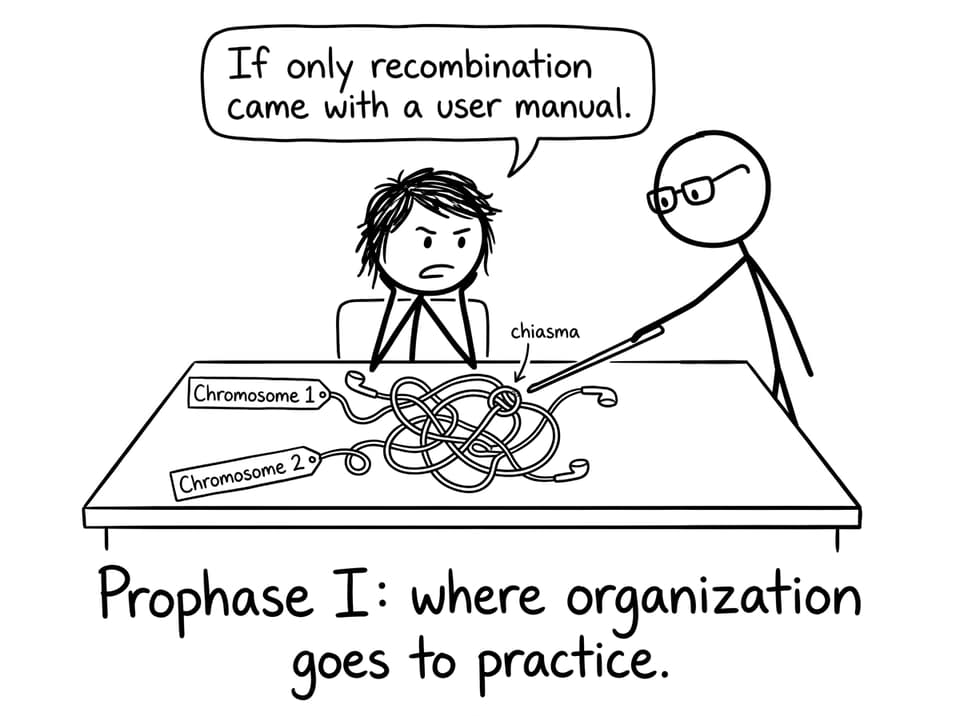
Recombination (crossing over) happens in prophase I after synapsis forms bivalents
-
Exchange occurs between non-sister chromatids of homologous chromosomes
-
The visible “crossing points” are chiasmata
-
Result: recombinant chromatids with new allele combinations
-
Linkage can be broken: genes far apart recombine more often than genes close together
If you want a syllabus-aligned refresher, start with Meiosis as a source of variation (D2.1.11) notes and then zoom out to Cell and nuclear division (D2.1) notes.
What actually happens in prophase I (and why it matters)
In IB Biology, “crossing over” can sound like a single event, but it is better pictured as a sequence.
First, homologous chromosomes pair up in synapsis, aligning gene-by-gene. That alignment matters because recombination is not random cutting. The exchange is coordinated so corresponding regions swap.
Next, at chiasmata, DNA strands break and rejoin between non-sister chromatids. When the cell later separates homologous chromosomes and then sister chromatids, those recombined pieces travel into gametes as new allele combinations.
A practical way to remember the consequence: without recombination, each chromosome would behave like an unedited paragraph passed down intact. With recombination, it becomes a paragraph with sentences swapped between two drafts.
To tighten your definitions (gene, allele, locus), link meiosis back to core genetics using Genes (3.1) notes.
Recombination vs other sources of variation
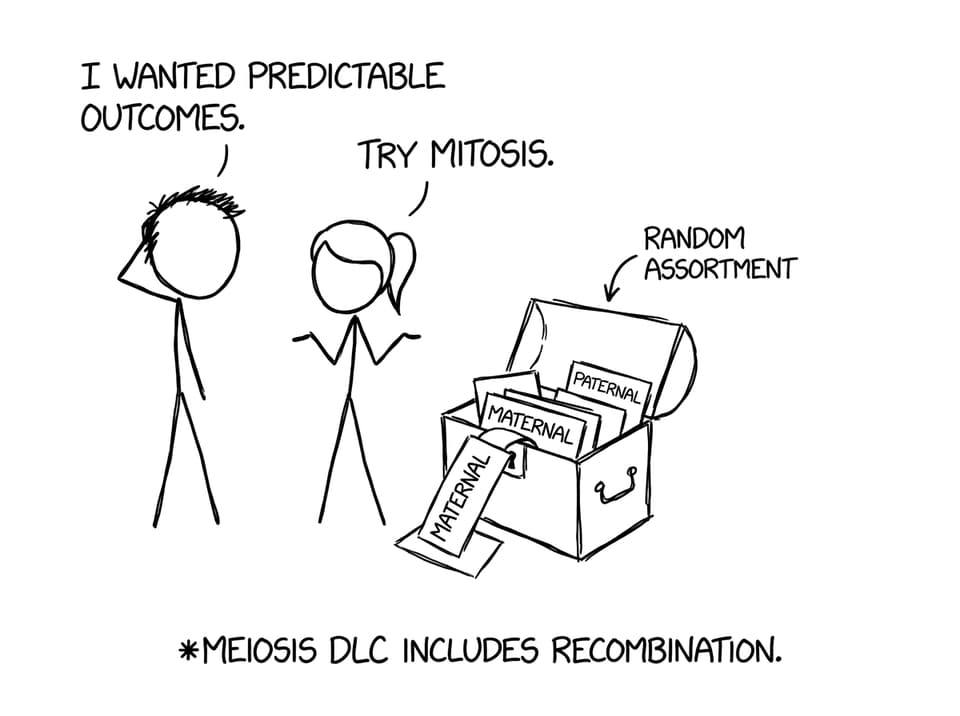
Recombination is powerful because it reshuffles alleles along a chromosome, not just whole chromosomes.
But in IB Biology, you usually earn extra credit by placing recombination in the full “variation toolkit”:
-
Independent assortment in metaphase I mixes whole maternal and paternal chromosomes
-
Random fertilization combines two already-unique gametes
-
Mutation creates brand-new alleles (raw material that recombination can later reshuffle)
RevisionDojo organizes these connections cleanly across topics, especially in Meiosis as a reduction division (D2.1.9) notes and the broader IB Biology resources hub.
Linkage groups: why gene distance changes recombination frequency
One of the most testable IB Biology ideas is that recombination frequency is not equal for all genes.
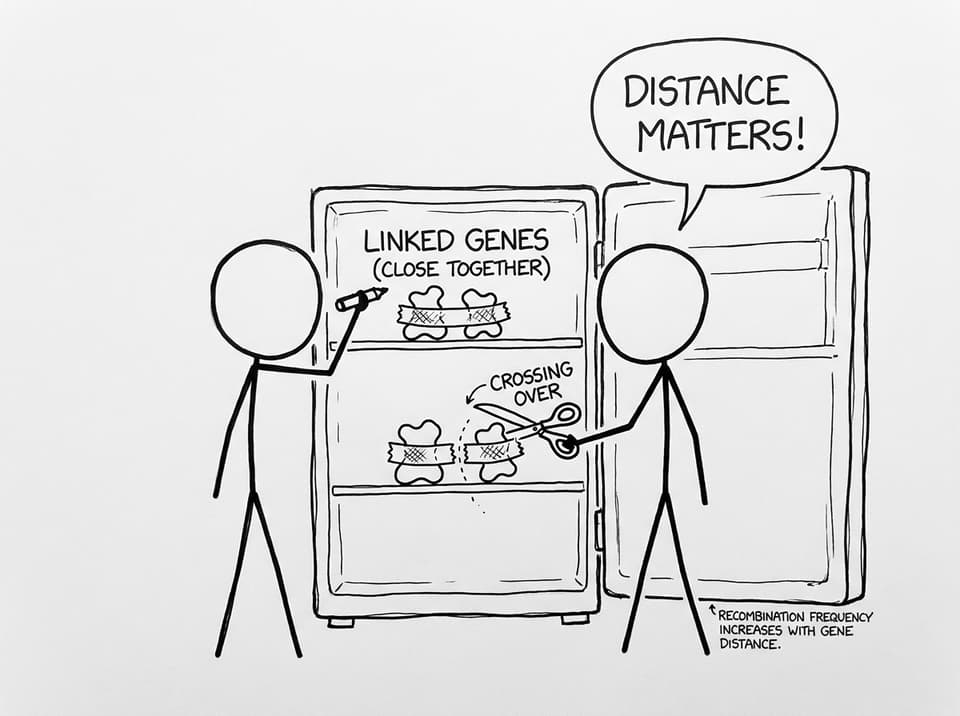
Genes close together on the same chromosome are part of a linkage group and tend to be inherited together. Crossing over can still separate them, but it is less likely because there is physically less space between the loci for a chiasma to occur.
Genes far apart have more “room” between them, so there is a higher probability that at least one crossing over event lands in the interval. That is why recombination frequency increases with gene distance, and why recombinants show up more often when loci are separated.
If you are studying linked vs unlinked genes, the clearest bridge into exam-style language is Recombinants in crosses involving linked or unlinked genes (D3.2.20) notes, plus the topic map in Inheritance (D3.2) notes.
Bring it home: revise recombination the way the exam tests it
Genetic recombination during meiosis is a quiet process with loud consequences: it reshuffles alleles, breaks linkage, and builds the variation that populations rely on. For IB Biology, the best revision move is to connect the story (prophase I, synapsis, chiasmata, recombinant chromatids) to the exam skills (definitions, linkage reasoning, and clear comparisons with independent assortment).
When you are ready to turn understanding into marks, RevisionDojo is built for that last step: use the Study Notes for clean explanations, the Flashcards for active recall, the Questionbank for exam-style practice, and AI Chat plus Grading tools to tighten your wording. Add Mock Exams and Predicted Papers for timed stamina, and if you want a coach, the Tutors can help you fix the same mistakes before they become a pattern. Recombination creates variety in cells; RevisionDojo helps you create consistency in results.