


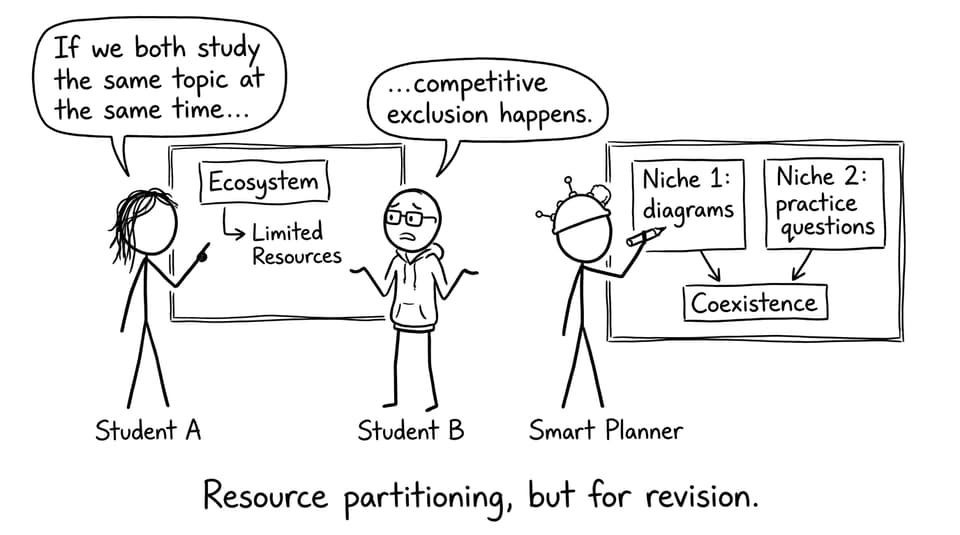
When you cram the night before an exam, it feels like every fact is fighting for the same tiny space in your head. Ecosystems face the same problem. In IB Biology, you learn that species often want similar things (food, space, light). Yet many still coexist. The quiet trick is niche differentiation: they don’t stop needing resources; they stop needing them in exactly the same way.
For IB Biology exams, niche differentiation is a high-value idea because it connects definitions (niche, competition) to bigger patterns (biodiversity, stability). Once you can explain how differentiation reduces overlap, your long answers become clearer and your data-based questions become easier.
Quick IB Biology checklist: what to mention
-
Define an ecological niche as role + resource use + conditions, not just habitat.
-
State the competitive exclusion principle: identical niches cannot coexist indefinitely when resources are limiting.
-
Explain that niche differentiation reduces niche overlap, lowering interspecific competition.
-
Give two concrete mechanisms (spatial, temporal, dietary, morphological).
-
Link to outcomes: coexistence, higher species richness, community stability.
If you need tight definitions, keep IB Biology Key Definitions open while revising IB Biology ecology.
What niche differentiation actually changes
A niche is like a job description written by the environment. It includes microhabitat, feeding strategy, activity time, tolerances, and interactions. When two species overlap too much, the loser doesn’t disappear out of politeness; it’s pushed out by reduced survival or reproduction.
RevisionDojo breaks this down cleanly in B4.2 Ecological niches, and you can reinforce it with exam-style practice in the B4.2 Ecological niches Questionbank. For IB Biology, that pairing (concept + questions) is often where understanding becomes exam-ready.
Spatial partitioning: “same place,” different slices
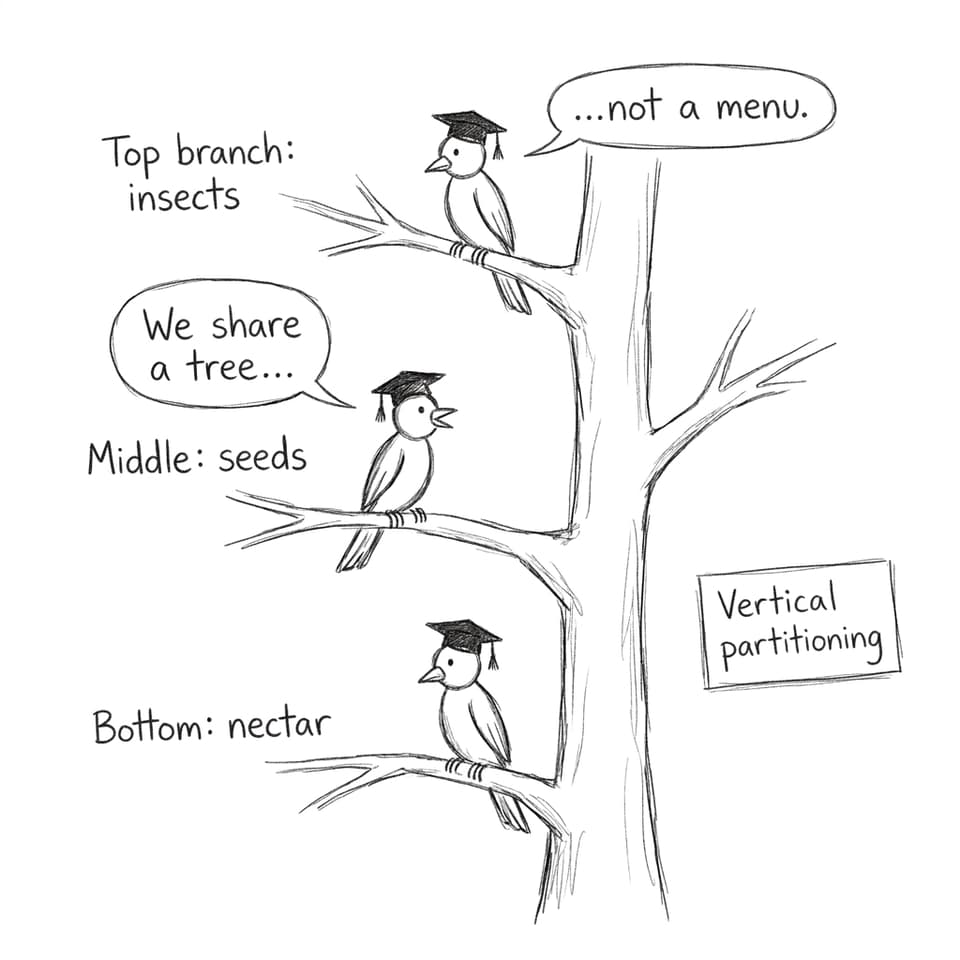
Species can share a habitat but divide it into usable layers or microzones. Classic examples include birds feeding at different heights in the same tree, or plants rooting at different soil depths. The point isn’t that they never compete; it’s that direct conflict is reduced because each species specializes in a different “slice” of the environment.
For broader IB Biology ecology revision, the hub Ecology - IB Biology is a good map, and IB Biology Ecology Notes helps you write more precise explanations.
Temporal differentiation: less overlap in time
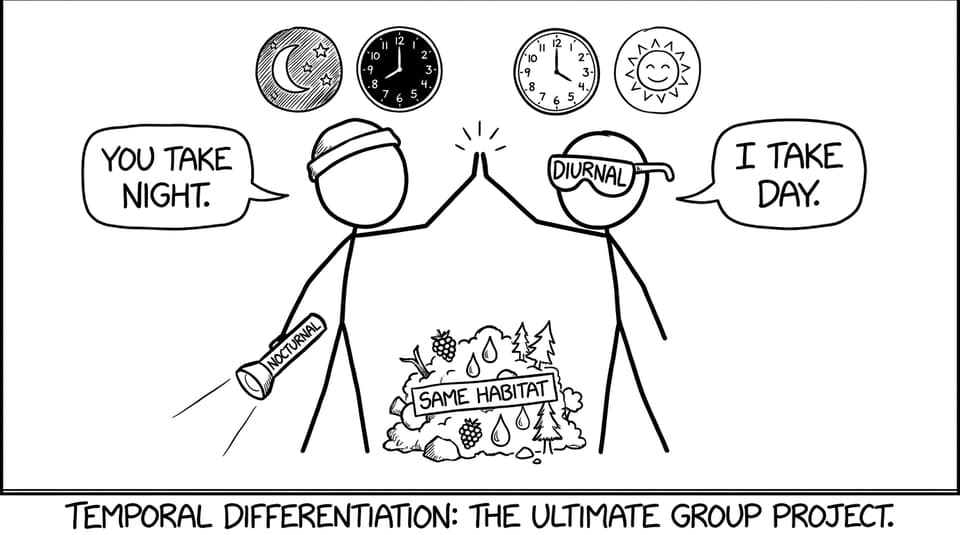
Sometimes the resource isn’t divided by place but by clock. Nocturnal vs diurnal activity patterns reduce direct encounters. Seasonal differences matter too: breeding, migration, or peak feeding can shift across months. In IB Biology terms, temporal differentiation reduces overlap in resource use even when habitat and diet look similar.
Morphology and feeding strategy: evolution’s “tool swap”
Specialized structures can lock species into different resources. Darwin’s finches are the story everyone remembers because it’s so visual: different beak shapes, different foods, less direct competition. Predator body size can do something similar by shifting prey choice. In IB Biology, these are strong examples because they connect ecology to adaptation and natural selection.
If you want a clean competition explanation to quote and apply, see Competitive exclusion and the uniqueness of ecological niches.
Bring it back to RevisionDojo (and your exam)
A good IB Biology answer on niche differentiation reads like a calm chain of logic: define niche, state competitive exclusion, explain differentiation mechanisms, then connect to coexistence and biodiversity. You can build that chain quickly using RevisionDojo’s Study Notes, drill it with the Questionbank, and tighten wording with Flashcards. If you get stuck turning ideas into exam language, AI Chat can help you practice explanations, and Grading tools can highlight what’s missing.
When you’re ready, deepen the topic through Populations and communities notes or practice with C4.1 Populations and Communities Questionbank. Niche differentiation reduces competition in ecosystems, and the right revision system reduces competition inside your schedule. That’s the kind of advantage that shows up on exam day in IB Biology.