
You can feel it in the exam hall: some questions reward logic, others reward calm. In IB Biology, the difference between natural selection and genetic drift is exactly that. One mechanism has a reason. The other has a roulette wheel.
If you can explain both clearly, you stop memorizing definitions and start scoring marks for real understanding -- the kind that survives tricky wording.

Quick checklist (IB Biology exam-ready)
Use this IB Biology mini-checklist when a question asks you to compare mechanisms:
-
Natural selection = non-random differences in survival and reproduction.
-
Genetic drift = random changes in allele frequency (chance events).
-
Selection tends to be directional (linked to environmental pressures).
-
Drift is strongest in small populations.
-
Selection leads to adaptation; drift does not necessarily.
For core definitions and gene pool language, pair this with Evolution as heritable change (A4.1.1) notes.
Natural selection: when the environment “votes”
In IB Biology, natural selection is the mechanism you can defend with a chain of causation: variation exists (from mutation and meiosis), selection pressures act (predation, disease, competition), and heritable advantageous traits become more common because their carriers leave more offspring.
The key exam phrase is: natural selection is non-random because the environment consistently favors certain phenotypes. The alleles linked to those phenotypes rise in frequency, shifting the gene pool over generations.
If you want the syllabus-aligned wording and examples, use D4.1.1 Natural selection notes and the deeper allele-frequency framing in D4.1.11 Changes in allele frequency notes (HL).
Genetic drift: when chance “wins”
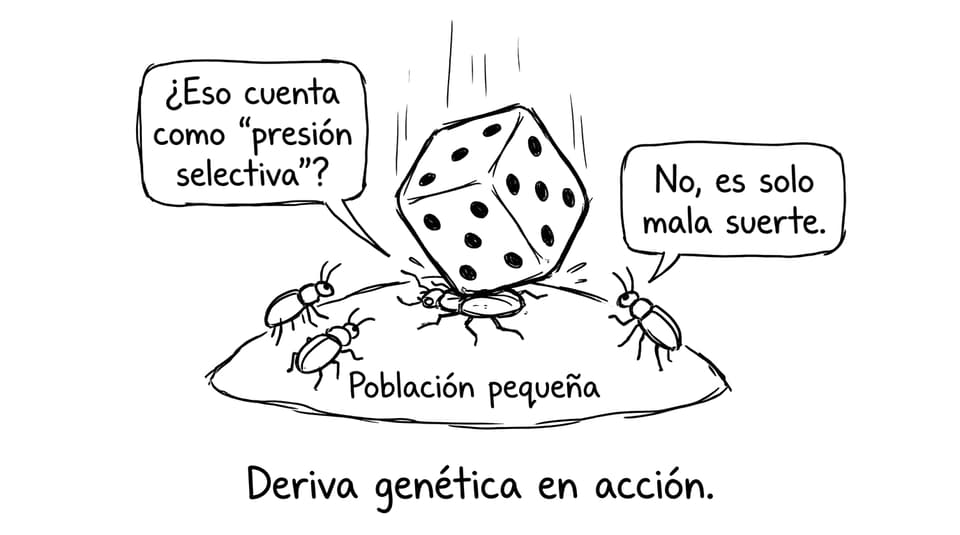
Genetic drift is the IB Biology reminder that evolution can happen without improvement. Drift is random change in allele frequencies due to chance -- not because an allele is better.
In a small population, random events can dominate: who happens to reproduce, who is accidentally lost, or which individuals survive a sudden event. Drift can increase harmful alleles or remove beneficial ones simply because randomness is loud when the sample size is tiny.
Bottleneck effect (a sharp narrowing)
A bottleneck happens when a large population is suddenly reduced by a random event (fire, storm, disease). The survivors are not a “representative” genetic sample. In IB Biology, the takeaway is: genetic variation decreases, and allele frequencies can shift dramatically.
Founder effect (a small beginning)
A founder effect happens when a small group splits off to form a new population. They carry only a fraction of the original gene pool, so allele frequencies in the new population can look very different right away. Again, variation tends to drop, making adaptation harder later.
The cleanest way to compare them in IB Biology
When you write your comparison paragraph, aim for two contrasts:
-
Cause: selection = environmental pressure; drift = chance.
-
Outcome: selection = adaptation more likely; drift = unpredictable, not necessarily adaptive.
Then add one shared point (often earns marks): both change allele frequencies over time.
To practice exam-style phrasing, use the D4.1 Natural selection Questionbank and the broader Evolution and biodiversity Questionbank. RevisionDojo’s Grading tools and AI Chat can help you tighten definitions, while Flashcards lock in the bottleneck/founder distinctions.
Conclusion: turn two definitions into one clear story
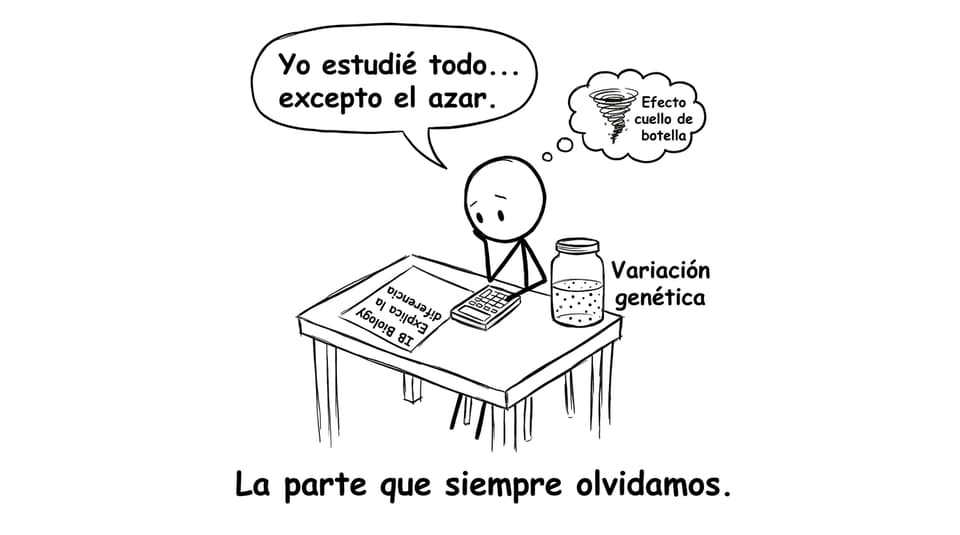
In IB Biology, natural selection is the mechanism with a reason -- environments consistently favor heritable traits that improve reproductive success. Genetic drift is the mechanism with no reason -- allele frequencies shift because luck matters, especially when populations are small.
If you want this topic to feel effortless in exams, build a short revision loop: read the key notes, drill the question styles, and use RevisionDojo’s Study Notes, Flashcards, AI Chat, and Tutors to polish your wording until it sounds like the markscheme.
Start here: IB Biology resources hub.
