Join 650k+ students breezing through the IBReady to breeze through the IB?
If you have ever looked at a cell diagram and thought, “How does a message on the outside become a decision on the inside?”, you are already asking the exact question that sits at the heart of IB Biology.
Ligand-receptor interactions can feel like tiny, polite events: one molecule docks, something shifts, and the cell “knows” what to do. But the truth is more interesting. That small docking moment is often the first domino in a loud biochemical argument inside the cell: signals get amplified, rerouted, shut down, and sometimes written into gene expression.
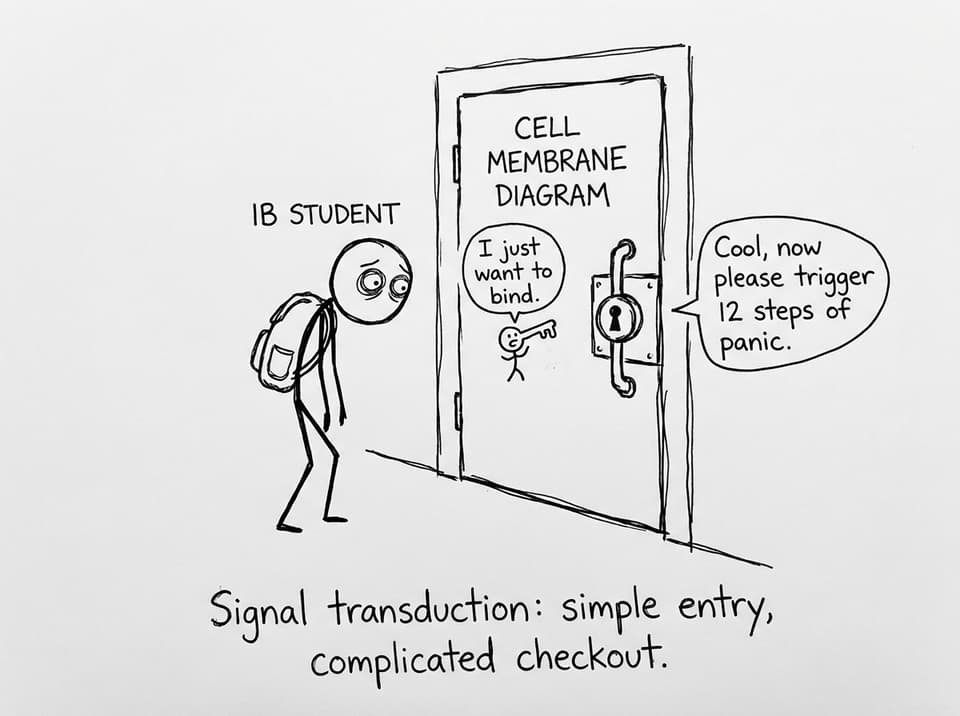
Signal transduction comic relief
The IB Biology checklist: what examiners want you to say
When you describe intracellular signalling in IB Biology, hit these points cleanly:
Reception: a ligand binds a specific receptor (high specificity).
Conformational change: receptor shape changes, activating it.
Transduction: a stepwise pathway (often phosphorylation) relays the signal.
Second messengers: small molecules like cAMP or Ca2+ spread the message.
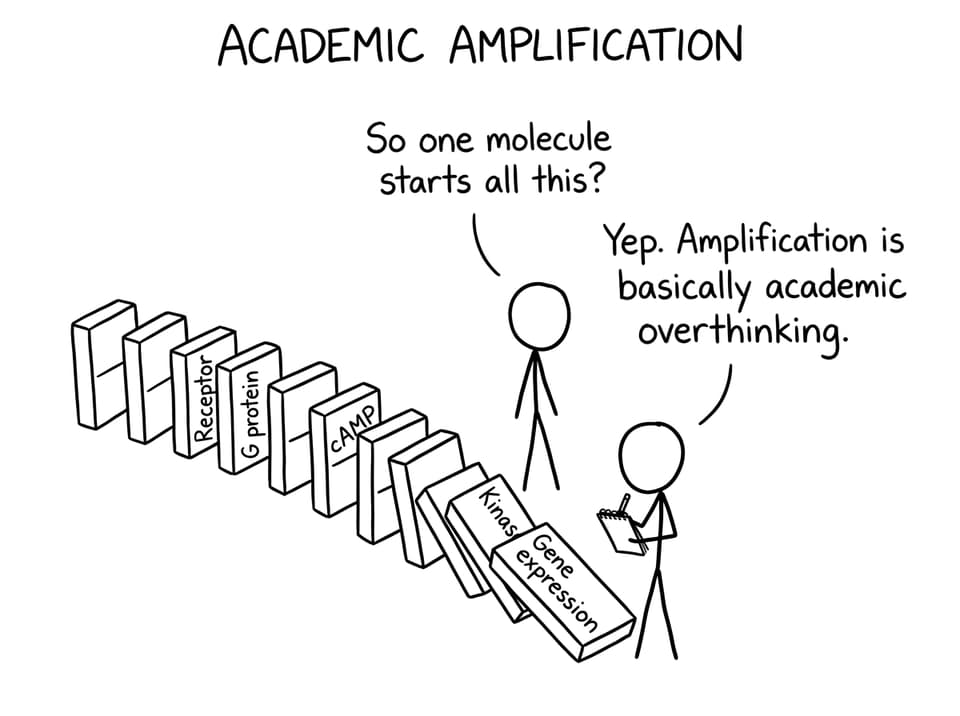
Amplification: one binding event triggers many downstream activations.
min read
min read
min read
min read
Response: short-term (enzyme activity, ion flow) or long-term (gene expression).
Regulation: negative and positive feedback tune the response.
Ligand-receptor binding: the “shape change” that starts everything
A ligand is any signalling molecule (hormone, neurotransmitter, cytokine). A receptor is typically a protein built to bind that ligand and not others. In IB Biology, specificity is not just trivia: it is the reason insulin does not accidentally do adrenaline’s job.
Once binding happens, the receptor undergoes a conformational change. That change is the real beginning of the cascade. It exposes new active sites, triggers dimerization, opens a channel, or recruits intracellular proteins. A good quick comparison comes from Transmembrane vs intracellular receptors.
Domino amplification joke
The big receptor types you must know for IB Biology
GPCRs: the classic “second messenger” pathway
G protein-coupled receptors (GPCRs) activate G proteins, which then activate enzymes such as adenylyl cyclase. That produces cAMP, a second messenger that activates protein kinases. The key exam phrase: signal amplification happens because one activated enzyme can make many second messenger molecules.
Receptor tyrosine kinases (RTKs): docking and phosphorylation logic
RTKs often dimerize when a ligand binds. Then they autophosphorylate, creating docking sites for relay proteins. From there, pathways such as MAP kinase cascades can push the signal toward growth, differentiation, or longer-term nuclear changes.
The easiest way to describe RTKs in IB Biology is to emphasize phosphorylation as an on/off switch: kinases add phosphate groups, phosphatases remove them.
Ligand-gated ion channels: fast, electrical, and exam-friendly
These receptors open an ion channel upon binding. Ion movement changes membrane potential and can trigger rapid cellular responses. If you like connecting concepts, pair this with how signals can be localized or distant in Localized and distant effects of signalling molecules.
Intracellular receptors: when the ligand enters the cell
Hydrophobic ligands (like steroid hormones) can diffuse through the membrane and bind receptors in the cytoplasm or nucleus. The receptor-ligand complex can act as a transcription factor, changing gene expression directly. This is a common IB Biology contrast point versus membrane receptors.
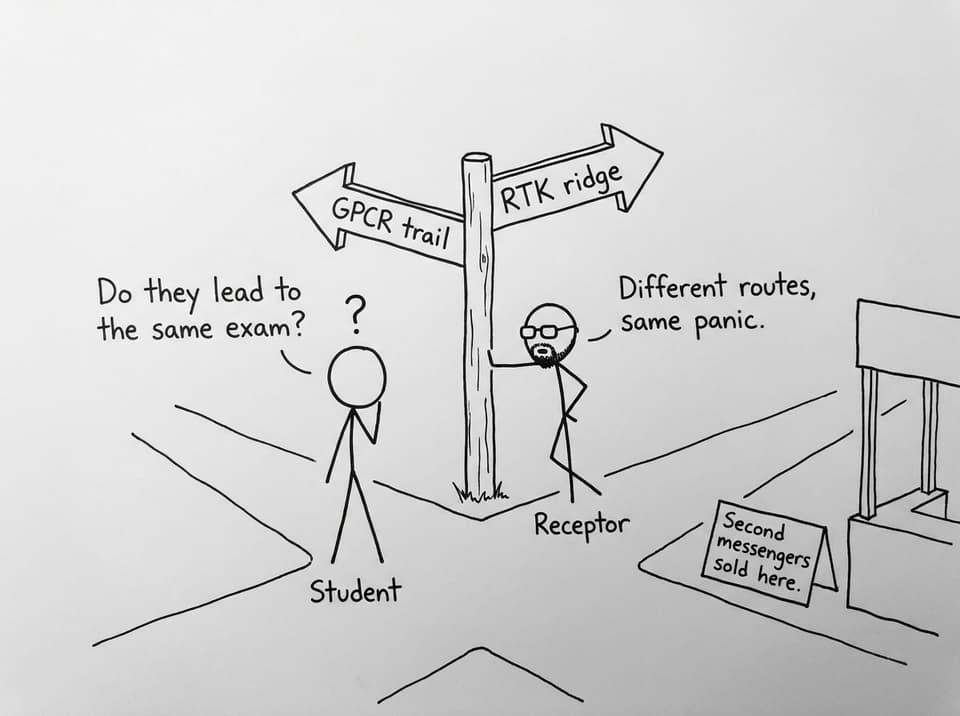
Two pathways, same exam stress
Regulation and feedback: why cascades don’t run forever
Real cells cannot afford infinite signalling. Cascades are controlled by feedback loops and timed shutoffs: receptor desensitization, phosphatases reversing phosphorylation, and second messengers being broken down.
This is where many IB Biology answers level up: when you mention feedback, you show you understand control, not just steps. Revise with Regulation of cell signalling pathways notes.
Build exam confidence with RevisionDojo
If intracellular signalling cascades still feel like a blur of arrows, make them concrete with RevisionDojo. Use the Study Notes to lock in definitions and contrasts, then switch to the Questionbank for exam-style practice and fast feedback.
For active recall, turn pathways into Flashcards, then use AI Chat to test yourself with “Explain GPCR signalling in 6 lines” prompts. When you want pressure practice, add Mock Exams, Predicted Papers, and Grading tools to catch weak wording before the real exam. And if you want guidance that adapts to you, RevisionDojo’s Tutors and Coursework Library help you connect signalling to the broader story of IB Biology.
In the end, ligand-receptor interactions are not just content to memorize. They are a reminder that small inputs can create huge outcomes, which is exactly what happens when a few good revision choices compound over time.