



Ergonomics usually shows up in your revision as a single bullet point.
Then the exam happens.
A product scenario appears, you write “it is ergonomic,” and suddenly that bullet point feels like a trapdoor. In IB Design Technology, ergonomics isn’t decoration. It’s one of the cleanest ways to turn vague design talk into marks because it forces you to do what the syllabus rewards most: link a design choice to a specific user need.
If you want one topic in IB Design Technology that pays you back every time you apply it properly, ergonomics is it.
What ergonomics really means in IB Design Technology
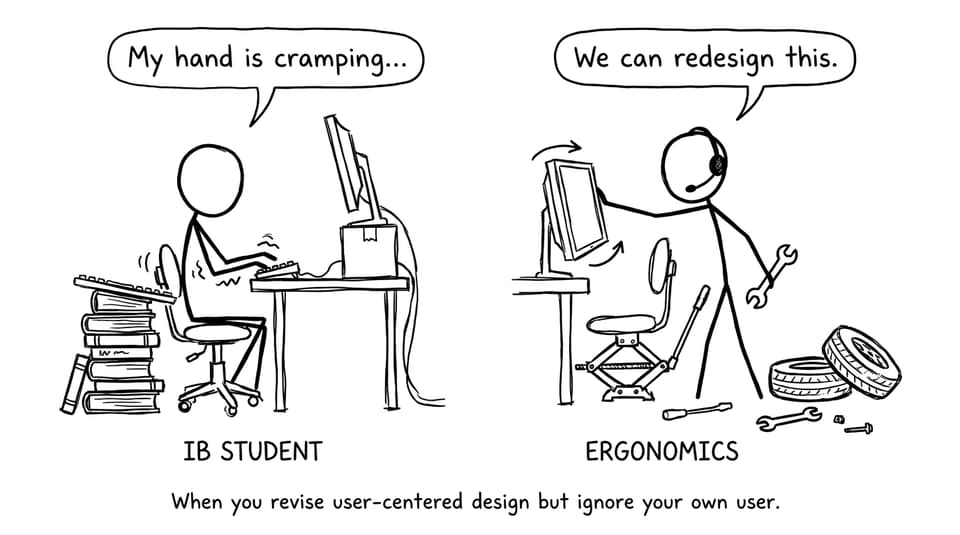
In IB Design Technology, ergonomics means designing so the product fits the user, not the other way around. Examiners aren’t just looking for a definition. They want to see you connect:
-
User (who exactly?)
-
Task (what are they doing?)
-
Context (where and for how long?)
-
Design feature (what changes?)
-
Outcome (comfort, safety, efficiency, reduced fatigue)
Ergonomics sits inside human factors, alongside anthropometrics (body measurements), physiology (human limits), and psychology (perception and usability). If you need a structured refresher, use Human Factors and Ergonomics in IB Design Technology and then drill the core definitions with Flashcards for A1.1 Ergonomics.
Why IB Design Technology examiners love ergonomics
Ergonomics appears often in IB Design Technology exams for a simple reason: it is incredibly easy to test and incredibly hard to fake.
Most products can be improved ergonomically. And most students can say “comfort” without proving anything. The markscheme rewards the students who can move from generic claims to contextual reasoning.
That’s also why ergonomics shows up in short answers, scenario questions, and longer evaluation prompts. It’s a theory concept that behaves like a real design decision.
To see the exam-style phrasing you’ll actually meet, practise from A1.1 Ergonomics Questionbank or the broader Human Factors and Ergonomics Questionbank.
How ergonomics is assessed (and how students lose marks)
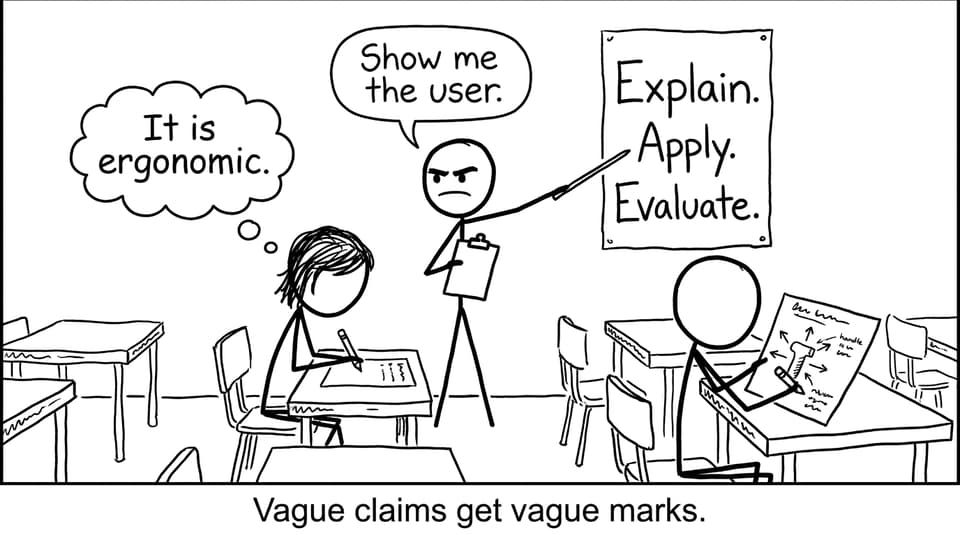
In IB Design Technology, the fastest way to lose marks is to treat ergonomics like a compliment.
“Ergonomic handle.”
That’s not an answer. It’s a label.
Examiners award marks for explaining mechanisms (what feature changes posture, grip, force, reach?) and justifying impact (how does that reduce strain, improve safety, or increase efficiency for that user?).
A simple structure that scores consistently
Use this five-line pattern in IB Design Technology answers:
-
Identify the user (age, ability, experience, strength, handedness).
-
Identify the task and the ergonomic problem (repetition, awkward posture, high force).
-
Name the design feature (angle, diameter, texture, adjustability, spacing).
-
Explain the effect using ergonomic logic (reduced wrist deviation, lower grip force).
-
Add a trade-off for evaluation questions (cost, weight, aesthetics, durability).
If you want a revision routine that makes this automatic, pair question practice with spaced recall using Top Revision Techniques for IB Design Technology Students and then build a weekly plan from Best Study Strategies for IB Design Technology Students.
Quick checklist: what to mention under time pressure
When you see an ergonomics prompt in IB Design Technology, scan your answer for these:
-
A specific user (not “people”)
-
A specific body interaction (grip, reach, posture, visibility)
-
One measurable or observable improvement (less strain, safer angle, fewer errors)
-
A context detail (duration, environment, PPE, wet hands, limited space)
-
An evaluation point (trade-offs)
This is also where RevisionDojo’s AI Chat helps: paste your draft paragraph and ask it to “rewrite in markscheme style with clearer user linkage.” Then test that improvement immediately using the Questionbank.
Ergonomics beyond exams (and why it still matters)
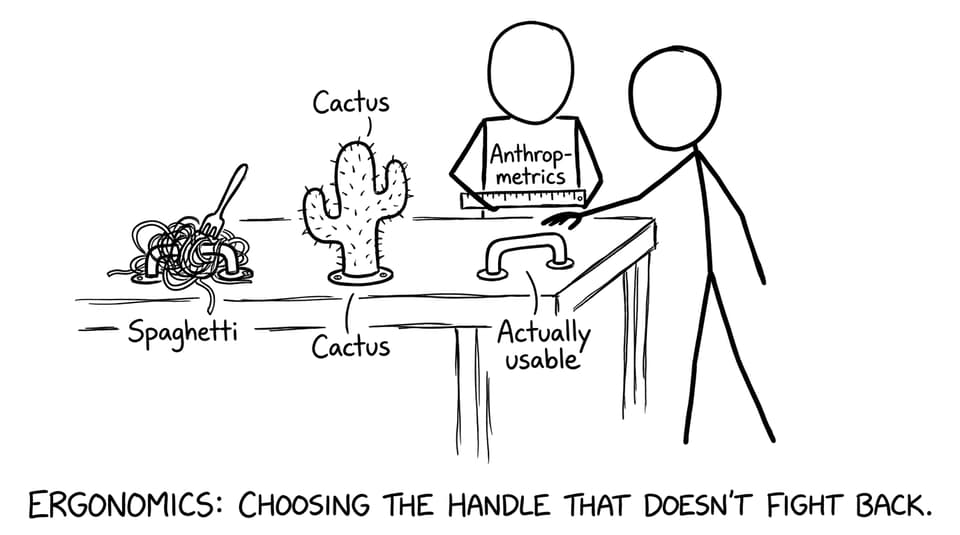
Even if today’s goal is exam performance, ergonomics strengthens your design thinking everywhere in IB Design Technology.
When you treat the user as real, you naturally create better research questions, better prototypes, and better evaluation language. That’s why ergonomics connects cleanly to user-centred design and modelling.
On RevisionDojo, students often combine ergonomics with:
-
Study Notes for precise terminology: Notes for A1.1 Ergonomics
-
Mock Exams built from mixed topics using the Exam builder inside IB Design Technology Resources
-
Grading tools for draft feedback (especially evaluation paragraphs)
-
Coursework Library and IB Design Technology Exemplars to see how top students justify ergonomic choices with evidence
Conclusion: treat ergonomics like a marking strategy
Ergonomics is one of the most dependable scoring concepts in IB Design Technology because it turns theory into decisions: user, feature, impact, trade-off. The students who score well aren’t the ones who mention ergonomics more often; they’re the ones who explain it more precisely.
If you want that precision to become automatic, build a simple loop on RevisionDojo: learn the wording in Study Notes, lock it in with Flashcards, test it with the Questionbank, refine paragraphs using AI Chat, and then pressure-test your timing with Mock Exams and Predicted Papers. In IB Design Technology, ergonomics isn’t extra. It’s leverage.