

If you have ever looked at your IB subject choices and thought, “How does this actually match the world I live in?”, you are not alone. Many subjects feel like they were designed for a different century. IB Digital Society feels like the opposite: it begins with the assumption that your life already runs through networks, platforms, data, and algorithms.
The good news is that IB Digital Society is not an “extra” or experimental add-on. It fits cleanly inside the IB Diploma Programme (DP) as a fully fledged course, with the same academic weight, the same expectations of evidence and clarity, and a very familiar Individuals and Societies style of assessment.
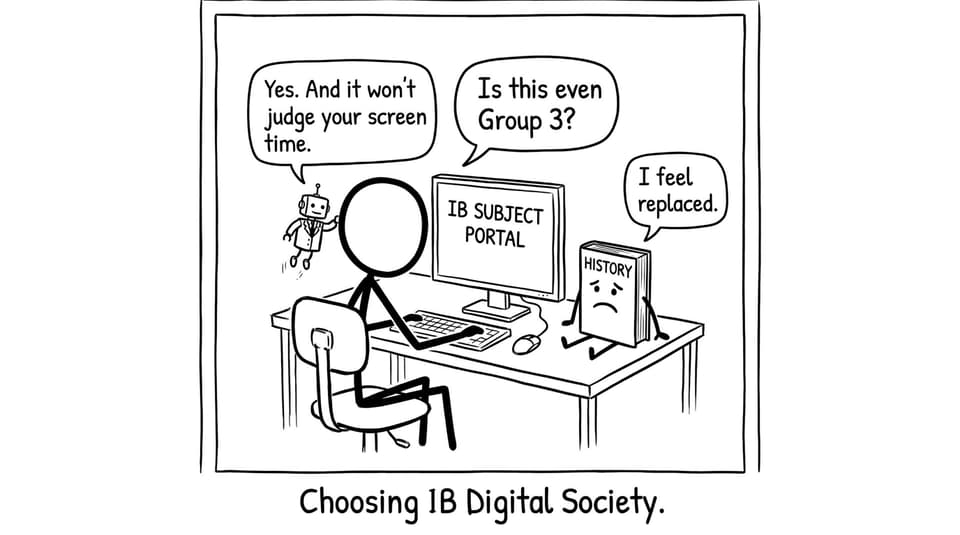
Quick checklist: where IB Digital Society fits
-
Group placement: Group 3 (Individuals and Societies)
-
Levels: available at SL and HL
-
Assessment feel: concept-driven analysis, case studies, structured writing, and an IA
-
Natural overlaps: TOK, Global Politics, Economics, Computer Science, ESS
-
Exam advantage: rewards clear arguments more than memorized facts
If you want a single hub to see how the course is organized (notes, practice, and tools), start with IB Digital Society Resources.
IB Digital Society as a Group 3 subject (Individuals and Societies)
In the DP structure, IB Digital Society sits in Group 3, alongside subjects like History and Psychology. That placement matters because it tells you what the IB expects: you are not being tested on whether you can name every tech term. You are being tested on whether you can think like a social scientist about digital systems.
That means you will repeatedly do three things:
-
Define a digital issue in a precise way
-
Use concepts to analyze impacts on people and communities
-
Evaluate trade-offs (who benefits, who loses, what changes over time)
Revision tip: build your revision around the course’s themes and concepts, then attach case studies to them. A strong starting point is Key Themes in IB Digital Society Explained.
SL vs HL: what changes in IB Digital Society
Students often worry that HL means “more content.” In IB Digital Society, HL usually feels like more depth and more demanding evaluation.
At both SL and HL, you will work with core ideas and real-world examples. At HL, you are expected to:
-
sustain more complex lines of argument
-
handle counterarguments more explicitly
-
evaluate evidence and perspectives with more nuance
A practical way to study is to organize your notes by syllabus topics, then pressure-test them with timed writing. RevisionDojo’s topic hubs make this easier, for example IB Digital Society Topic 3: Content and IB Digital Society Topic 4: Contexts.
How assessment works (and why it matters for exams)
The assessment style is one reason IB Digital Society fits the DP so well. It behaves like a classic Group 3 course, but with modern case studies: AI systems, social media dynamics, online surveillance, misinformation, digital identity.
Expect:
-
Internal Assessment (IA): an individual research investigation where you frame a focused question, analyze evidence, and reach a reasoned judgement
-
Written exams: structured responses where you apply concepts to situations and case studies
If you are choosing your IA topic now, don’t guess what “good” looks like. Use How to Write a Strong IB Digital Society IA Research Question and the Digital Society Coursework Guide to get the scope and wording right.
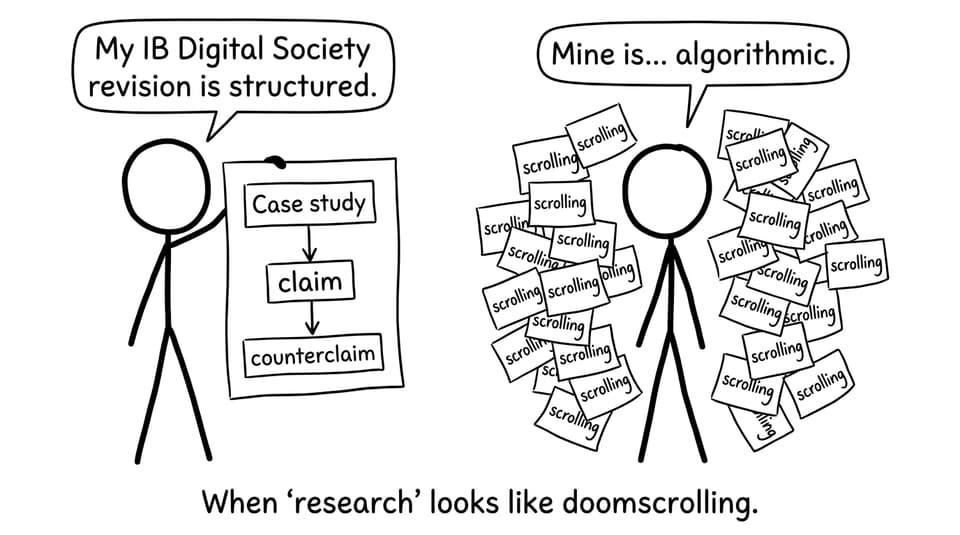
How IB Digital Society connects to the rest of the DP
One quiet advantage of IB Digital Society is that it strengthens skills the DP already rewards.
The TOK connection
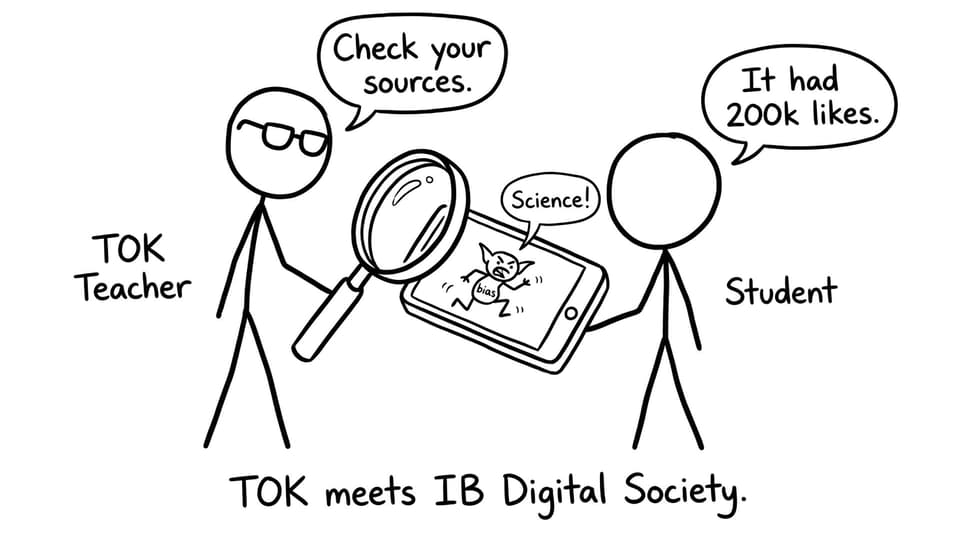
TOK asks: what counts as knowledge, who decides, and how bias and power shape “truth.” IB Digital Society gives you a daily laboratory for those questions.
Use TOK resources to sharpen your evaluation language and perspective handling, like IB Theory of Knowledge Resources and TOK posts on RevisionDojo.
Connections to other subjects
-
Economics: digital markets, inequality, incentives, regulation
-
Global Politics: governance, activism, surveillance, power
-
Computer Science: social impact meets technical possibility
If you have ever wondered whether the subject is “hard,” the answer is: it is hard in a writing-and-thinking way, not a coding way. This is explained clearly in Is IB Digital Society Hard? Honest Expectations Explained.
Exam prep: a simple IB Digital Society revision system
A calm, effective IB Digital Society system is usually:
-
Study Notes to clarify concepts quickly (see Digital IB Study Notes: Access Anywhere, Anytime)
-
Flashcards for definitions and key terms (active recall, not rereading)
-
Questionbank and Mock Exams to learn how answers are marked
-
AI Chat when you are stuck turning ideas into evaluation
-
Grading tools to get feedback on structure and clarity
-
Predicted Papers when you want realistic exam practice
-
Coursework Library and Tutors when your IA needs a higher standard of evidence and argument
For a full strategy playbook, use Ultimate Survival Guide for IB Digital Society Students.
Closing: make IB Digital Society work for your diploma
IB Digital Society fits the IB Diploma Programme because it follows a familiar DP logic: concepts first, real-world evidence second, and clear judgement at the end. If you revise it like a system (themes, concepts, case studies, timed writing), the course becomes surprisingly manageable.
When you are ready to make your revision feel structured, use RevisionDojo as your home base: IB Digital Society Resources for Study Notes, Flashcards, AI Chat, Grading tools, Questionbank practice, Predicted Papers, Mock Exams, the Coursework Library, and Tutors that keep IB Digital Society exam prep moving every week.

