
Meiosis is the quiet moment where biology either keeps its promises, or breaks them.
One cell has to divide twice, cut its chromosome number in half, and still walk away with gametes that carry a complete, balanced set of genetic instructions. For IB Biology students, it’s tempting to memorize phases and move on. But accurate segregation in meiosis isn’t a checklist of terms. It’s a choreography. And homologous chromosomes are the partners that make the whole routine work.
The exam-ready checklist (what must go right)
To explain accurate segregation in IB Biology, you want these mechanisms on your fingertips:
-
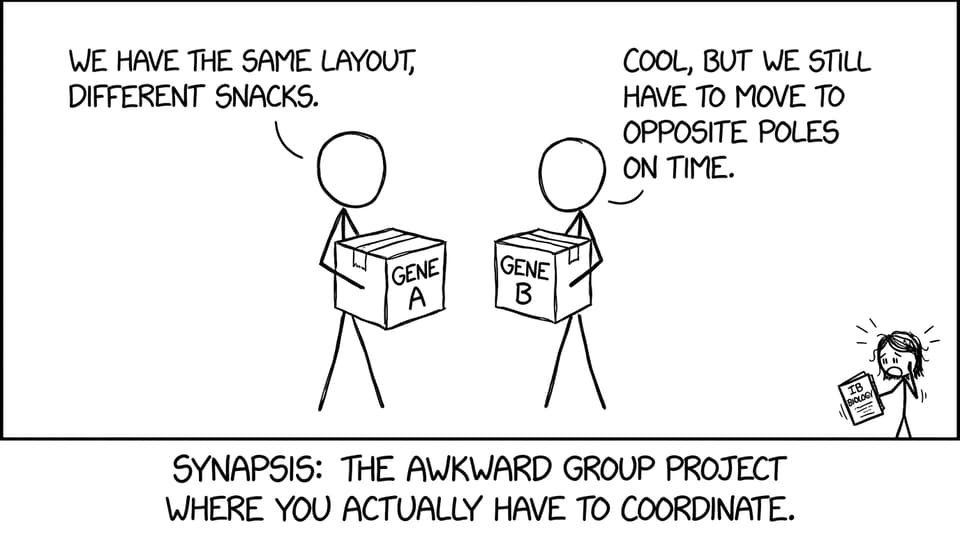
Homologous chromosomes pair precisely (synapsis)
-
Crossing over forms chiasmata that physically link homologs
-
Spindle fibers attach correctly to kinetochores (bi-orientation)
-
Cohesin is cleaved in the right places at the right time
-
Checkpoints delay division if attachment/pairing is wrong
For a clean phase-by-phase overview, anchor your revision with 1.6 Cell division notes and D2.1.9 Meiosis as a reduction division.
Synapsis: how homologous chromosomes find the right partner
Early in prophase I, homologous chromosomes pair up gene-by-gene through synapsis. This isn’t just “they sit next to each other.” Proteins build a synaptonemal complex that forces alignment with near-molecular precision.
In IB Biology, you can think of synapsis as the anti-error step: if chromosomes don’t align properly, the rest of meiosis becomes guesswork. Once paired, the homologs behave as a bivalent (tetrad), acting like a single unit for the spindle to manage later.
If you want more structured reinforcement across the whole unit, the D2.1 Cell and nuclear division notes tie meiosis concepts together in one place.
Crossing over and chiasmata: variation that also prevents mistakes
Crossing over is often taught as “it increases genetic variation.” True. But for accurate segregation, its underrated role is mechanical.
When non-sister chromatids exchange segments, they create chiasmata: visible physical links that remain after the synaptonemal complex dissolves. Those links keep homologous chromosomes connected long enough for them to line up properly at metaphase I and separate cleanly at anaphase I.
To deepen this for IB Biology exam explanations, see Genetic recombination during meiosis and Meiosis as a source of variation.
Spindle attachment: the “bi-orientation” that makes segregation accurate
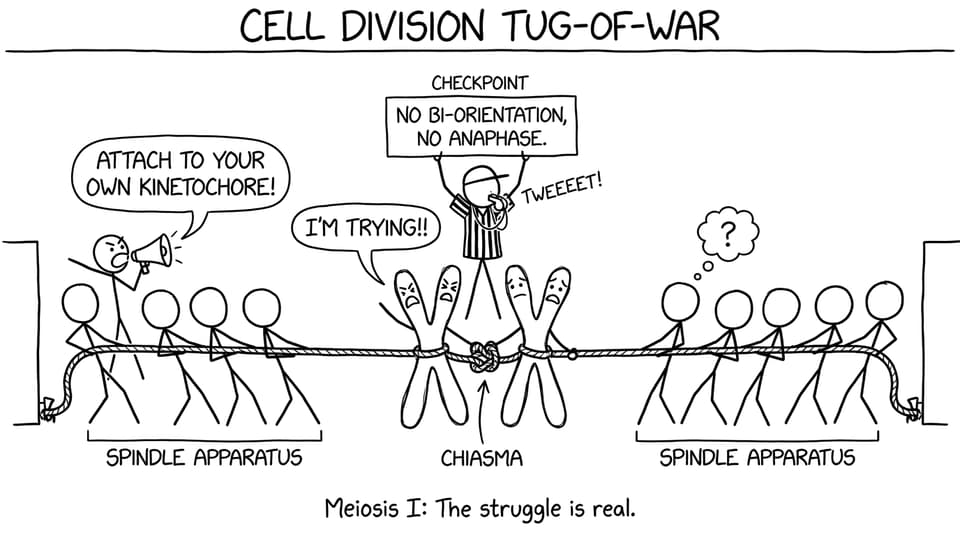
At metaphase I, each homolog must attach via its kinetochore to spindle fibers from opposite poles. This is what ensures homologous chromosomes move to different poles in anaphase I.
A common IB Biology pitfall is mixing this up with mitosis: in meiosis I, it’s homologs that separate, not sister chromatids. Correct attachment is monitored, and incorrect attachment raises the risk of nondisjunction.
You can link this to allele behavior using Segregation and independent assortment (HL), and for the “random orientation” angle, use Random orientation during metaphase I.
Cohesin timing: why sisters stay together in meiosis I
The order of separation matters.
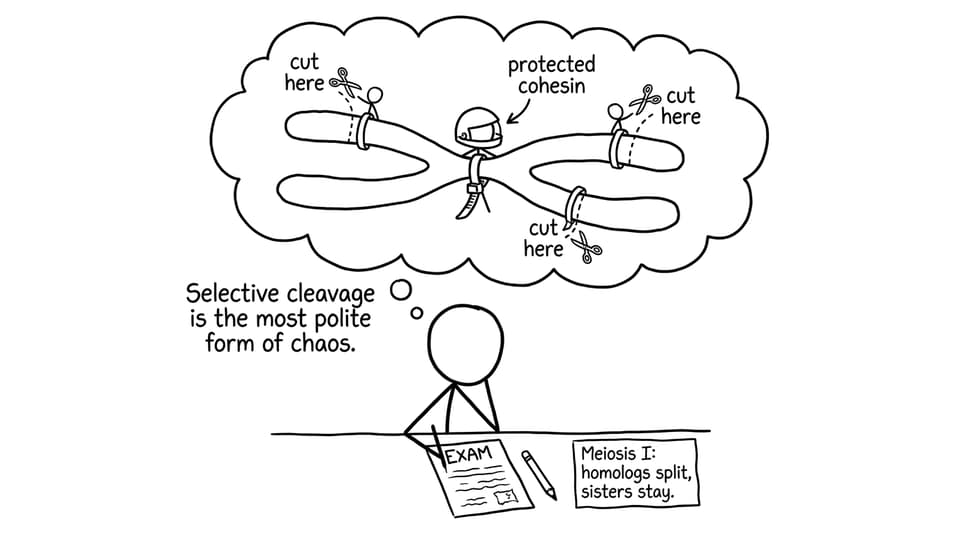
During anaphase I, cohesin on chromosome arms is cleaved so homologous chromosomes can separate, but cohesin at the centromere is protected so sister chromatids remain joined until meiosis II. That single timing rule is one of the cleanest “explain why” answers in IB Biology.
When it fails: nondisjunction and aneuploidy
If homologous chromosomes fail to separate in anaphase I, nondisjunction can produce gametes with an extra chromosome or missing one. This can lead to aneuploidy after fertilization.
For syllabus-aligned examples, revise Down syndrome and non-disjunction and connect it to bigger mutation categories with Chromosomal vs gene-level mutations.
The last step: turn understanding into marks with RevisionDojo
Accurate segregation isn’t luck. It’s synapsis, chiasmata, spindle attachment, cohesin timing, and checkpoints all doing their job so homologous chromosomes separate cleanly, the core story you’re expected to explain in IB Biology.
When you’re ready to practice it the way exams demand, RevisionDojo makes the process feel manageable: build speed with the Questionbank, tighten explanations with Study Notes and Flashcards, and use AI Chat to test your reasoning when you get stuck. Add Mock Exams, Predicted Papers, and Grading tools when you want realistic feedback, then round it off with the Coursework Library and Tutors when you need targeted help.
If meiosis has ever felt like a blur of phases, make it a narrative you can explain, and a topic you can score on.