
In the final minutes of an exam, your brain does something strange: it remembers the story of a concept, not the definition.
So here’s the story of chromatin. DNA is not sitting politely in the nucleus like a neat set of notes. It’s wrapped, folded, and tucked away. And in IB Biology, that packaging isn’t background detail; it’s the whole reason transcription can be switched on or off.
Histone modifications act like tiny chemical decisions that change whether genes are readable. Get the logic once, and you can answer a surprising number of gene expression questions.
Quick IB Biology checklist: what to say in exam answers
Use this as a fast structure when a question asks how histone modifications control transcription:
-
DNA wraps around histones to form nucleosomes (chromatin).
-
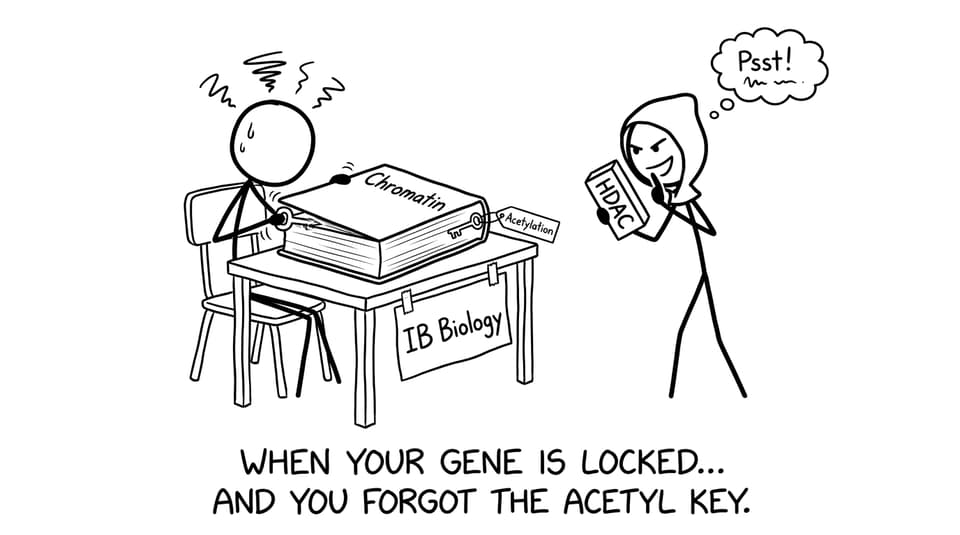
Acetylation usually opens chromatin (more transcription).
-
Deacetylation usually condenses chromatin (less transcription).
-
Methylation can activate or repress (depends on the site).
-
These are epigenetic tags: gene expression changes without changing DNA sequence.
If you want a clean syllabus-aligned refresher on nucleosomes, use Structure of a nucleosome (HL only).
Chromatin is a gate: why histones matter for transcription
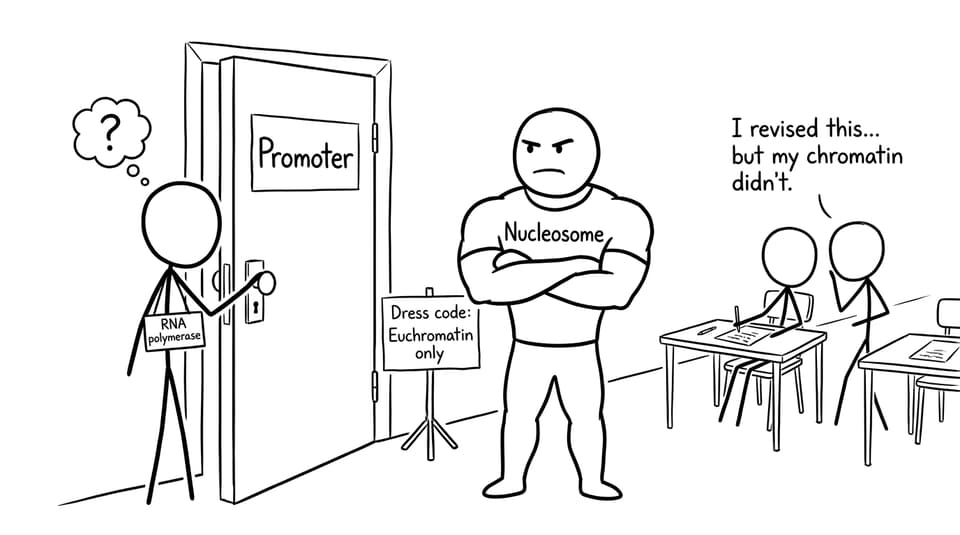
Transcription needs access. RNA polymerase and transcription factors must physically bind to DNA at or near promoters. But if DNA is tightly wrapped around histones, those binding sites are effectively hidden.
This is why IB Biology often frames chromatin as either:
-
Euchromatin: loosely packed, accessible, transcription more likely.
-
Heterochromatin: tightly packed, inaccessible, transcription less likely.
To connect this to the bigger gene expression chapter, revise the steps around initiation in D2.2 Gene expression (HL) notes and the broader unit 2.7 DNA replication, transcription and translation.
Histone acetylation: the “open chromatin” switch
Histones are positively charged, and DNA is negatively charged. That attraction helps keep DNA tightly wrapped.
When histone acetyltransferases (HATs) add acetyl groups to histone tails, the positive charge is reduced. The DNA-histone interaction weakens. Chromatin loosens into euchromatin.
In exam language: acetylation increases transcription because transcription machinery (RNA polymerase and transcription factors) can access promoters more easily.
If you want practice that matches IB exam style, use RevisionDojo’s D2.2 Gene expression (HL) Questionbank to see how this is tested.
Histone deacetylation and methylation: closing genes, or tagging them
Histone deacetylases (HDACs) remove acetyl groups, restoring stronger DNA-histone attraction. Chromatin becomes more condensed, often heterochromatin. Transcription decreases.
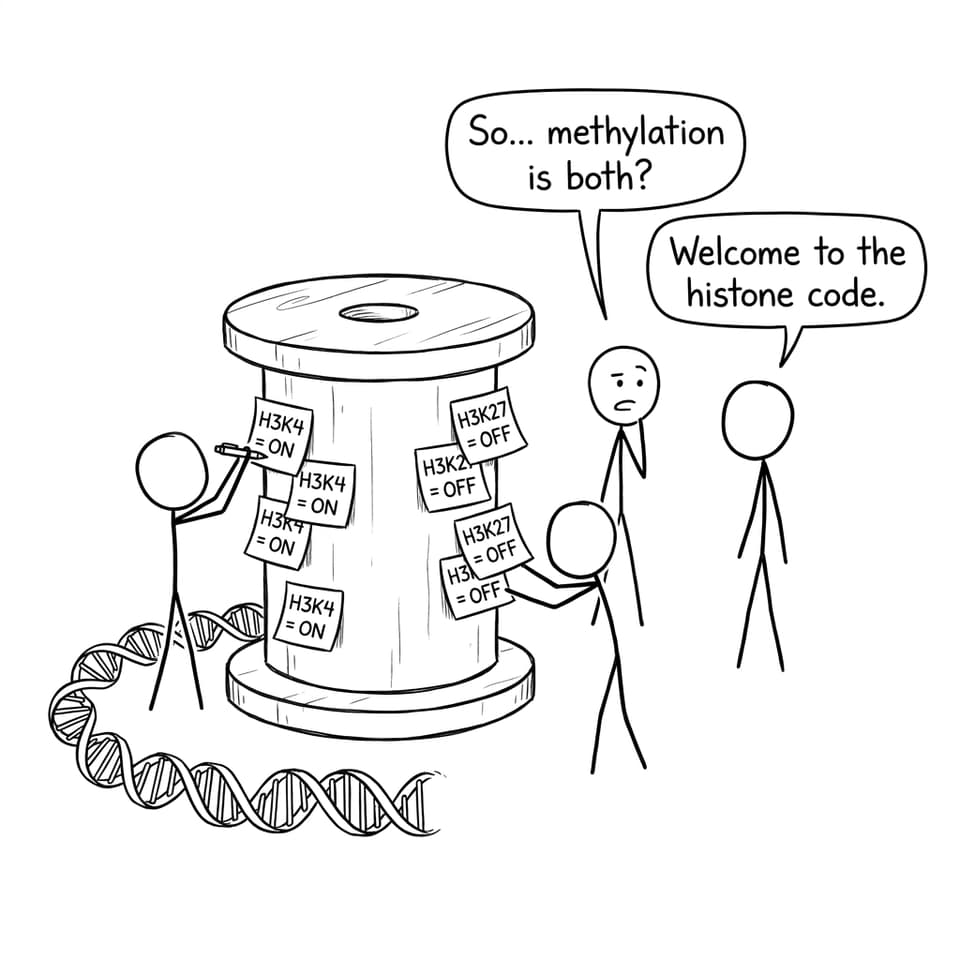
Histone methylation is more nuanced. Methyl groups added to specific residues can either recruit activators or repressors.
A common IB Biology example:
-
H3K4 methylation is linked to activation.
-
H3K9 or H3K27 methylation is linked to repression.
The clean way to revise this syllabus point is D2.2.6: Methylation of the promoter and histones (epigenetic tags).
Why IB Biology calls this “epigenetics” (and why it’s examinable)
Histone modifications are part of epigenetic regulation: they alter gene expression without altering base sequence. Cells use these tags to maintain cell identity (a neuron stays a neuron) and to respond to signals from inside and outside the organism.
Environmental factors can shift these patterns by changing enzyme activity and signalling pathways. For a focused example set, see D2.2.8: Environmental effects on gene expression and the bigger picture post How Epigenetics Regulates Gene Expression.
Bring it home: revise IB Biology gene control the smart way
Histone modifications control transcription because they control access, who gets to read the DNA, when, and how often. That one idea turns chromatin from a memorisation topic into a decision-making tool you can use across gene expression questions.
When you’re ready to turn understanding into marks, RevisionDojo is built for IB Biology revision: use the Questionbank for exam-style practice, Study Notes for tight explanations, Flashcards for definitions, AI Chat to fix misconceptions fast, and Grading tools, Predicted Papers, Mock Exams, Coursework Library, and Tutors when you need higher-stakes feedback.
If this topic felt slippery before, go back through D2.2 Gene expression (HL) Flashcards and lock in the language that IB examiners reward in IB Biology.