RevisionDojo was developed independently of the IBO and as such is not endorsed by it in any way.
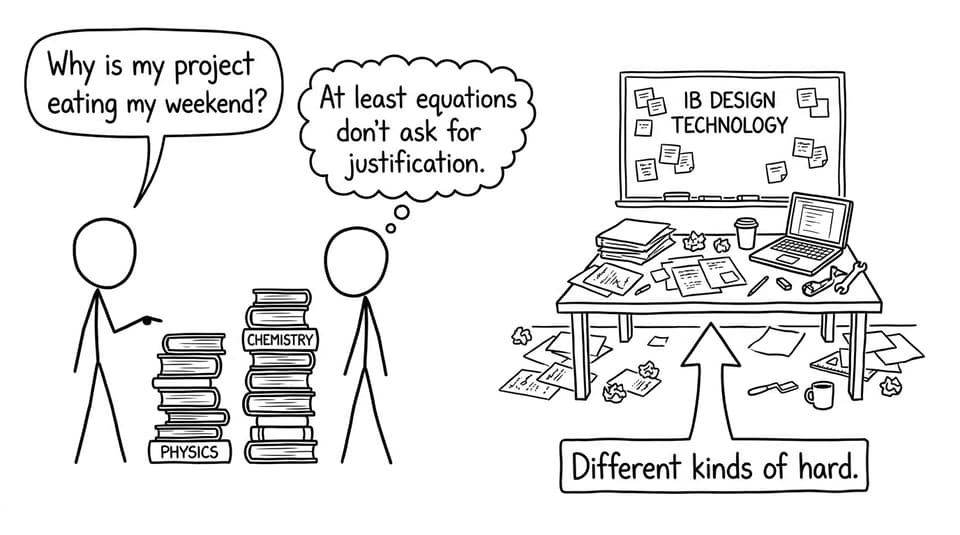
Some IB subjects feel hard in a predictable way. You can point to the equations in Physics, the mechanisms in Chemistry, the pages of Biology notes. IB Design Technology is different. It can look “creative” from the outside, and that makes it easy to underestimate. Then the deadlines arrive, the design project keeps evolving, and suddenly your weekend has been absorbed by a prototype that refuses to behave.
That’s the real question: not whether IB Design Technology is easy or hard, but what kind of hard it is compared to other IB sciences.
Two kinds of hard: books vs project chaos
How to judge difficulty across IB sciences
If you’re choosing between Group 4 options, it helps to compare difficulty using the same lenses. Here’s a quick checklist you can use to judge IB Design Technology against Biology, Chemistry, and Physics:
Content load: how much you must remember and recognise under time pressure.
Answer style: calculations vs structured explanations vs evaluation.
Time management: how much independent planning the subject demands.
Coursework weight and complexity: how long a task stays “alive” in your schedule.
Markscheme feel: single correct answers vs justified, defensible decisions.
If you want a syllabus-aligned starting point for content and practice, the IB Design Technology hub keeps everything in one place: Study Notes, Flashcards, a Questionbank, and exam practice tools.
IB Design Technology vs Physics: fewer equations, more justification
Physics has a reputation for a reason. The difficulty often comes from abstract models, multi-step problem solving, and mathematical precision. When you miss a detail, the final number drifts, and the markscheme doesn’t negotiate.
IB Design Technology usually feels lighter on advanced maths, but heavier on explaining why. Many DT exam questions reward the student who can connect a concept to a real design context, then evaluate trade-offs. Instead of “calculate X,” you’ll see prompts that quietly ask: justify, compare, recommend, refine.
A practical way to prepare is to practise command terms as a writing skill, not an afterthought. RevisionDojo’s Questionbank helps here because you can drill exam-style prompts and get feedback that pushes you toward marks you can actually defend.
IB Design Technology vs Chemistry: less certainty, more reasoning
Chemistry often rewards students who like structure: definitions, patterns, calculations, and specific right answers. Even when concepts are tricky, the destination is usually clear.
IB Design Technology can feel harder if you depend on certainty. DT questions tend to be more open: you’re expected to choose a direction, then back it up with evidence and logic. Good answers don’t just describe a material or a process. They explain suitability, constraints, users, sustainability, manufacturing realities, and the consequences of your choices.
IB Design Technology vs Biology: less memorisation, deeper thinking per question
Biology is famously content-heavy. It tests whether you can hold a lot of information and retrieve it quickly, often with short, specific mark points.
IB Design Technology usually involves less pure memorisation, but it can demand deeper thinking per response. A single question may expect you to apply multiple ideas at once: user needs, ergonomics, materials, manufacturing, lifecycle impacts, and iterative improvement.
If you want a concrete example of how DT content is organised for revision, try a focused topic page like Classic Design (Topic 6). Treat it like a mini-syllabus: notes to learn, flashcards to retain, questions to prove you can apply it.
The design project: the place DT often feels hardest
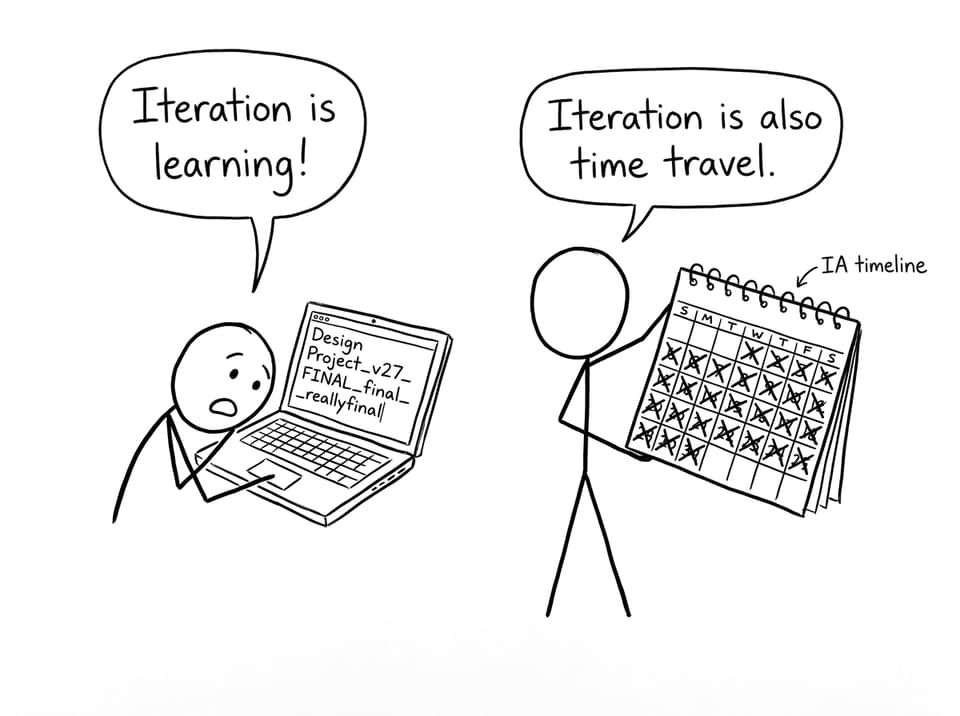
For many students, the hardest part of IB Design Technology isn’t the exam at all. It’s the long, open-ended design project. Not because the rubric is impossible, but because it asks for something school rarely trains you for: sustained self-management.
The project stretches over months. It rewards iteration and reflection. It punishes last-minute “pretty documentation” that lacks testing, evidence, and justification.
Who tends to find IB Design Technology harder (and why)
IB Design Technology tends to feel hardest for students who:
prefer one correct answer and feel uncomfortable defending choices
write descriptively instead of analytically (what it is, not why it matters)
delay coursework and then try to compress iteration into a single week
avoid testing because results might be messy
If that’s you, the fix isn’t “be more creative.” It’s building a repeatable system: weekly project progress, short evidence-based reflections, and frequent exam-style practice.
Who often finds IB Design Technology more manageable
IB Design Technology can feel surprisingly manageable if you:
enjoy applied problem-solving and real products
can explain your thinking clearly in writing
like improving an idea through feedback and testing
are willing to plan long tasks early
In other words, DT rewards students who can think like a designer and write like an examiner is watching.
The real verdict: IB Design Technology is “different hard”
IB Design Technology isn’t the easy science, and it isn’t the hardest science. It’s the science where your grade depends on how well you can think in public: justify choices, evaluate outcomes, and manage a long project without panic.
If you want to make IB Design Technology feel predictable, build your routine around RevisionDojo: start from the DT hub, drill weak areas with the Questionbank, lock in language with Flashcards, and use AI Chat and Grading tools to tighten your explanations. Then use Predicted Papers and Mock Exams to pressure-test your readiness.
When you treat IB Design Technology as a skill you train, not a subject you “get,” difficulty stops being a surprise and starts being a plan.