
In the last week before exams, gene expression can start to feel like magic: the same DNA sits inside every cell, yet one cell becomes muscle and another becomes neuron. In IB Biology, the “magic” is mostly architecture. A gene isn’t just a protein-coding recipe--it’s a carefully built control panel that decides when transcription starts, how fast it runs, and what final message gets sent.
This post breaks down how gene structure controls expression in a way you can turn into marks.
Quick exam checklist (the parts that earn marks)
When you see a prompt on transcription regulation in IB Biology, scan for these structures:
-
Promoter: where RNA polymerase binds; affects transcription frequency
-
Regulatory DNA: enhancers and silencers that change transcription rate
-
Exons + introns: splicing choices change the final mRNA
-
Terminator: stops transcription at the right place
-
Operon (prokaryotes): several genes controlled together
For syllabus-aligned notes you can revise quickly, start with D2.2 Gene expression (HL) and the focused D2.2.1 Gene expression notes.
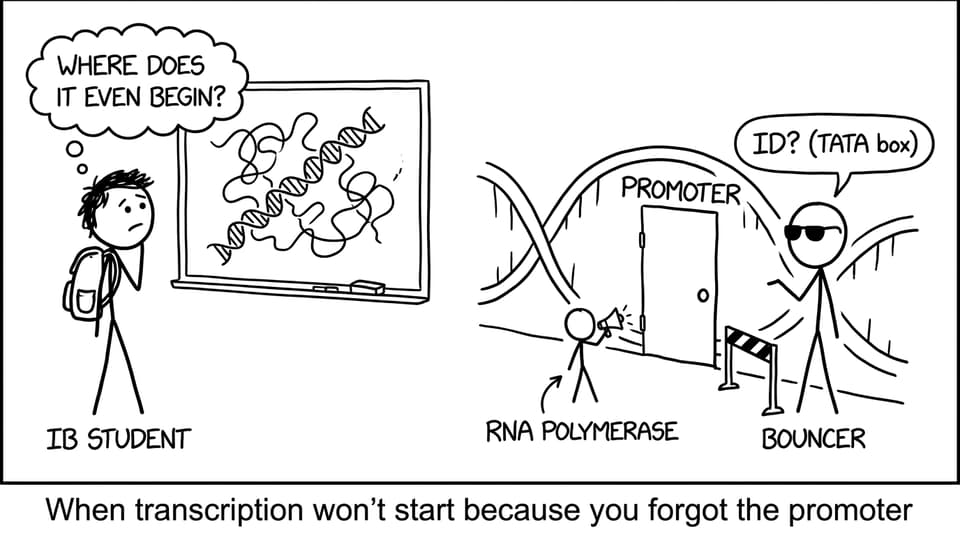
Promoters: the “start line” that sets the pace
A promoter is the DNA sequence where transcription begins because it’s where RNA polymerase (and transcription factors in eukaryotes) assembles. In many eukaryotic genes, you’ll hear about motifs like the TATA box. The key exam idea is simple: promoter strength influences expression level. If binding is efficient, transcription initiates more often; if binding is difficult, transcription happens less.
If you want a clean, quotable explanation for initiation, review Initiation of transcription at the promoter (HL) notes.
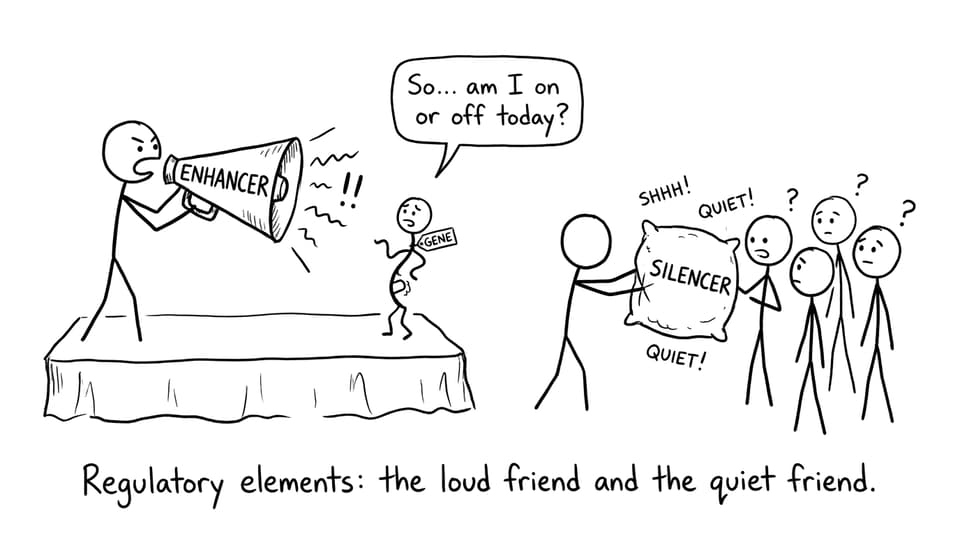
Enhancers and silencers: volume knobs for transcription
Promoters start the process, but regulatory DNA decides the “mood” of the gene.
-
Enhancers increase transcription when activator proteins bind.
-
Silencers reduce transcription when repressors bind.
In eukaryotes, enhancers can be far from the gene they control because DNA can loop, bringing bound proteins into contact with the promoter machinery. In IB Biology, this is a classic place to earn marks: mention transcription factors, DNA looping, and “increased/decreased recruitment of RNA polymerase.”
To deepen this quickly, use How Activators & Repressors Control Genes and the broader context in internal and external control of gene expression.
Exons, introns, and alternative splicing: one gene, many outcomes
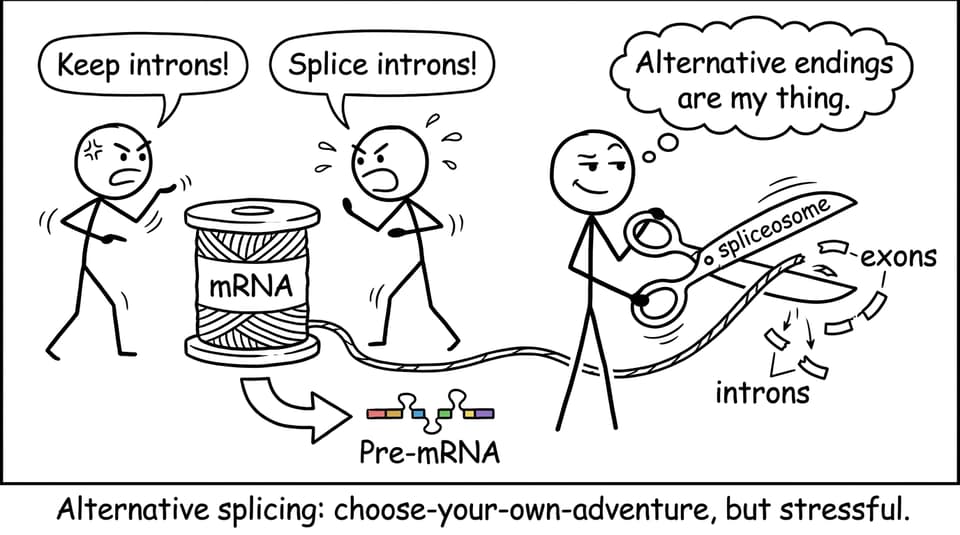
In eukaryotes, genes often contain exons (kept) and introns (removed). Splicing is not just housekeeping. It creates control:
-
Introns enable alternative splicing, where different exon combinations produce different mRNA variants.
-
Different mRNAs can be translated into different polypeptides, increasing protein diversity without adding more genes.
In an exam answer, be explicit: “introns are removed by splicing; alternative splicing changes which exons are joined; this changes the final protein product.” That’s the core IB Biology logic chain.
Terminators: stopping matters as much as starting
A terminator is the sequence that tells transcription to end. Proper termination helps produce an mRNA of the correct length and prevents RNA polymerase from running into neighbouring DNA regions. In markscheme language: accurate termination supports stable, controlled gene expression.
Prokaryotes and operons: coordinated structure, coordinated expression
Prokaryotes often package regulation differently. An operon groups several genes under one promoter so they’re transcribed together as a unit. This is efficient when the genes share a pathway (like breaking down a nutrient). For IB Biology, the big takeaway is coordination: one regulatory decision can switch on (or off) multiple enzymes at once.
How to revise this fast with RevisionDojo
If you’re trying to turn understanding into exam performance, use RevisionDojo as your workflow:
-
Read the core Gene expression study notes, then condense them into your own 6-line model answer.
-
Drill definitions with Gene expression flashcards (HL) so “promoter/enhancer/intron” becomes automatic.
-
Practice application with the D2.2 Gene expression (HL) Questionbank, then use AI Chat-style self-explanations: “What structure is being changed, and what happens to transcription?”
RevisionDojo’s Questionbank, Study Notes, Flashcards, AI Chat, Grading tools, Predicted Papers, Mock Exams, Coursework Library, and Tutors fit together best when you use them in that order: learn, recall, apply, then get feedback.
Bringing it together
When you zoom out, gene structure is a set of tiny physical decisions that create big biological outcomes: start here (promoter), turn up the volume (enhancer), edit the message (splicing), stop precisely (terminator), or coordinate a whole pathway (operon). That’s why IB Biology keeps returning to gene structure--it’s the bridge between DNA as information and DNA as behaviour.
If you want to lock this in before exams, build one perfect paragraph, then test it against exam-style prompts using RevisionDojo’s notes, flashcards, and Questionbank. Gene expression stops feeling like magic when you can name the parts that control it.
