
A single letter can change the meaning of an entire sentence. Genetics has the same problem, except the “sentence” is a protein your cells rely on.
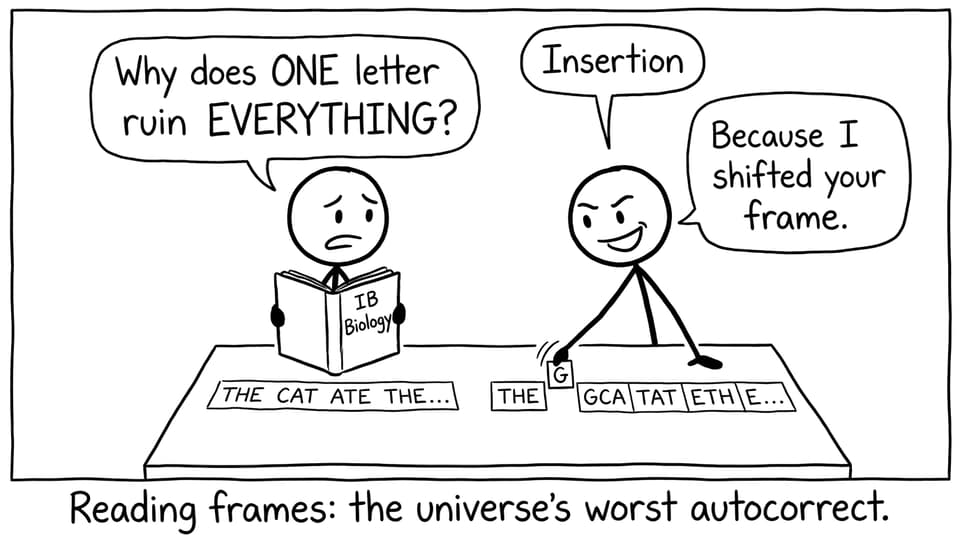
In IB Biology, frameshift mutations are the classic example of how tiny changes in DNA can cause huge downstream consequences. One extra nucleotide (or one missing nucleotide) can turn a neat, readable message into gibberish for the ribosome. If you can explain why that happens in clear steps, you can pick up marks in any IB Biology genetics question.
The quick IB Biology checklist for frameshifts
Use this as your fast explanation under exam pressure (and to spot the trick in multiple choice):
-
Codons are read in triplets (groups of three bases).
-
A frameshift mutation is an insertion or deletion that is not a multiple of three.
-
The reading frame shifts from the mutation onward.
-
Amino acids change downstream, often causing misfolding.
-
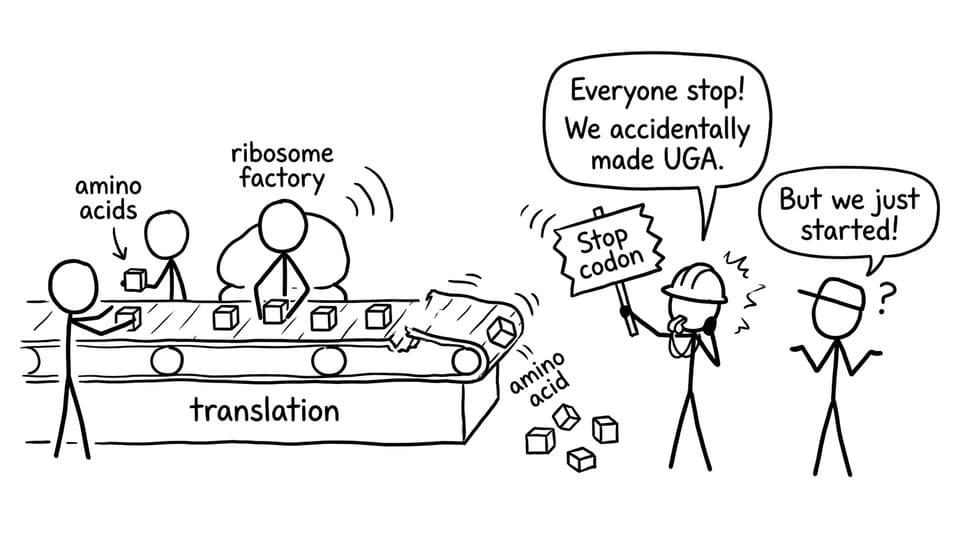
A premature stop codon is common (UAA, UAG, UGA), producing a truncated polypeptide.
If you want extra practice applying this logic to exam-style stems, the D1.3 Mutations and gene editing hub is a clean place to revise the whole section.
How frameshift mutations change the reading frame
In IB Biology, the ribosome reads mRNA like a ticker tape: three bases at a time, one codon after another. That “group of three” rule is the whole story.
Imagine an mRNA sequence like:
- AUG | UUU | GGC | ...
Now remove one base near the start (a deletion). Suddenly the ribosome is still reading in threes, but it’s reading the wrong threes:
- AUG | UUG | GC…
From that point onward, every codon boundary is shifted. That’s why frameshift mutations feel so dramatic: they don’t just swap one amino acid (like many substitutions do). They rewrite the entire downstream message.
To connect this to the bigger flow of information (DNA, then RNA, then protein), review 2.7 DNA replication, transcription and translation and the IB Biology framing becomes almost automatic.
Why frameshift mutations often destroy protein function
Protein function depends on shape, and shape depends on sequence. When a frameshift mutation changes most amino acids after a certain point, you usually lose:
-
the active site of an enzyme,
-
a binding region of a receptor or transport protein,
-
or the stability of the overall fold.
Even if a few early amino acids remain correct, the “rest of the chain” can drag the structure into the wrong shape. That’s why frameshift mutations are commonly classified as severe in IB Biology explanations.
For targeted syllabus language on mutation types, see 3.1 Genes Notes.
Premature stop codons: the sudden full stop
A shifted reading frame creates new codons that were never “meant” to exist. By chance, one of those new codons may become UAA, UAG, or UGA. When that happens, translation ends early.
In exam answers, a strong IB Biology phrase is: “The frameshift increases the probability of a premature stop codon, producing a truncated polypeptide that is usually nonfunctional.”
If you want to practise these ideas in the exact tone of exam questions, the D1.3 Questionbank is built for that.
Where frameshift mutations come from (and why cells try to prevent them)
Frameshift mutations can arise from:
-
DNA replication errors (especially in repetitive sequences),
-
exposure to mutagens,
-
incorrect DNA repair.
That’s also why proofreading and repair systems matter so much. If you need a wider comparison point, IB Biology: Chromosomal vs Gene-Level Mutations helps you explain scale and impact clearly.

Study smarter for IB Biology with RevisionDojo
Frameshift mutations are small, but the logic is big: triplets, shifted frame, altered codons, altered protein. To turn that logic into marks, use RevisionDojo’s IB Biology resources alongside the Questionbank, Study Notes, and Flashcards to lock in definitions. When you want feedback on how you phrase explanations, AI Chat and Grading tools can help you tighten exam wording. And when it’s time to simulate the real thing, build timed practice with Mock Exams and Predicted Papers.
If your next IB Biology response includes a crisp reading-frame explanation, frameshift mutations will stop feeling like chaos and start feeling like a predictable pattern you can control.