

Financial mathematics in IB Math rarely fails because students can’t calculate. It fails because the question feels like a story, and you’re asked to translate that story into a model before you touch a number.
You’ve seen it: a bank account, an interest rate, a timeline, a few messy assumptions hidden in a paragraph. Your brain wants a clean equation. The exam gives you prose.
This guide breaks down how financial mathematics works in IB Math, how to spot the “type” of problem quickly, and how to keep your marks safe when the wording tries to distract you.

Financial mathematics in IB Math: the quick checklist
Before you do any algebra in IB Math, pause and run this checklist:
-
What is changing over time: a single balance, or repeated payments?
-
Is the change growth (interest) or decay (depreciation)?
-
What is the compounding frequency (annual, monthly, etc.)?
-
What does the question actually want: final value, time, rate, or payment size?
-
What units are you using for time and rate, and do they match?
When you treat the setup as the main task, the arithmetic becomes the easy part.
Why financial maths feels harder than it “should” in IB Math
Financial questions in IB Math are deliberately written in real-world language because that’s the skill being assessed: modelling judgement.
Most students lose marks in two places:
Misidentifying the situation
A loans question can look like compound interest. An annuity can look like a geometric series. A depreciation question can look like “negative interest.” The first win is simply naming the structure correctly.
If you want extra practice with the exact syllabus angle, use the AA finance strand on RevisionDojo: IB Math AA resources.
Substitution errors that snowball
Financial maths is exponential. A small mismatch (like using 7% instead of 0.07, or forgetting monthly compounding) doesn’t just nudge the answer. It rewrites the whole outcome.
For a focused place to revise the core subtopic, these are gold: SL 1.4 Financial apps: compound interest and depreciation and the matching SL 1.4 Questionbank practice.
Simple vs compound interest in IB Math
In IB Math, simple interest is usually the warm-up. Compound interest is the main event.
-
Simple interest grows linearly (interest on the original principal only).
-
Compound interest grows exponentially (interest on interest).
The exam trick is that compound interest has “hidden knobs”: rate format, number of compounding periods, and time.

A reliable habit for IB Math: write the growth factor explicitly. For example, 3.2% becomes (1.032). It’s a tiny step that prevents big mistakes.
If you’re also in AI and want a clean reference for finance formulas and calculator-ready notation, keep this bookmarked: IB Math AI Data Booklet.
Loans and annuities: what IB Math is really testing
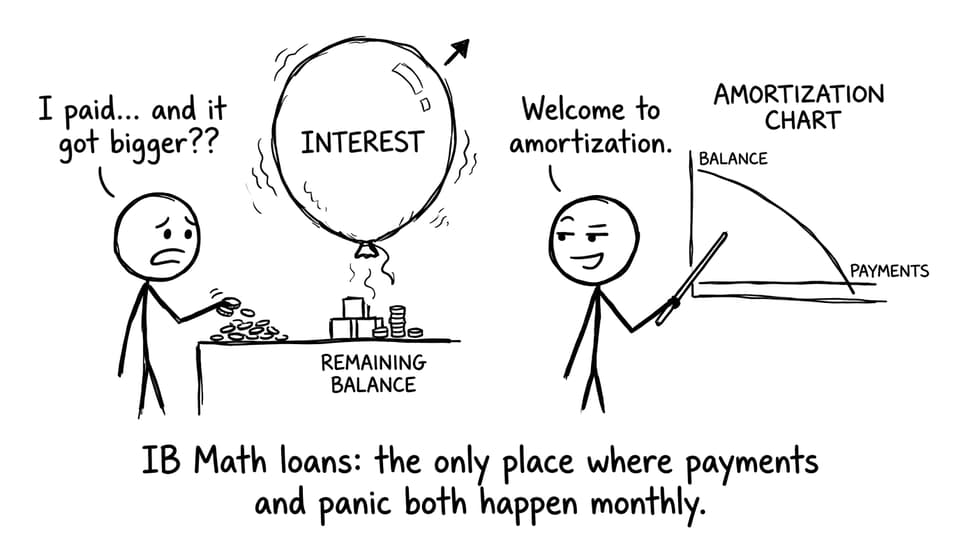
Loans and annuities in IB Math are about regular payments over time. That’s it. The difficulty is that you’re tracking two opposing forces:
-
The loan balance wants to grow (interest).
-
Your payments want to shrink it.
Students often compute the payment correctly, then lose communication marks by not interpreting what it means (for example, “total repaid” vs “interest paid” vs “remaining balance”).
To build speed here, drill with examiner-style prompts and immediate feedback: IB Math AA Questionbank and the targeted AA videos for SL 1.4.
Common mistakes (and the quick fixes) in IB Math financial maths
Mistakes in IB Math financial mathematics are predictable. That’s good news.
-
Percent not converted: write (r=0.05), not (r=5).
-
Wrong time unit: if compounding is monthly, time must be in months or converted cleanly.
-
Wrong model: single deposit vs repeated payments changes everything.
-
Ignoring the question’s meaning: always state what your answer represents in context.
For deeper context on why IB questions don’t just hand you the formula, read: Why do IB Maths questions avoid giving financial formulas directly?.
Mini exam strategy for IB Math financial mathematics
When the clock is loud, use a “translate then compute” routine:
-
Underline what changes (balance, payment, value, time).
-
Write a one-line model description: “compound growth monthly” or “loan with fixed repayments.”
-
Define variables before substituting.
-
Check compounding frequency against your time unit.
-
Interpret the final number with units and context.
Bring it home with RevisionDojo
Financial mathematics is one of the most practical parts of IB Math because it’s real life hiding inside algebra. The fastest way to get confident is to combine clear notes with lots of exam-style repetition.
RevisionDojo is built for that loop: Study Notes and Flashcards to lock in the models, Questionbank practice with instant feedback, AI Chat when wording trips you up, and Grading tools plus Mock Exams to test timing under pressure. When you’re ready to push for the top bands, add Predicted Papers for realistic exam rehearsal, the Coursework Library for broader support, and Tutors for targeted help.
If you want one place to start today, open the SL 1.4 Financial apps hub and do a short timed set in the IB Math Questionbank. Your future self will thank you.