



The moment your IA either gets easier, or quietly collapses
In IB Design Technology, most students think the hard part is the prototype. But the real turning point happens earlier, in a place that looks boring on the page: design requirements (often called success criteria).
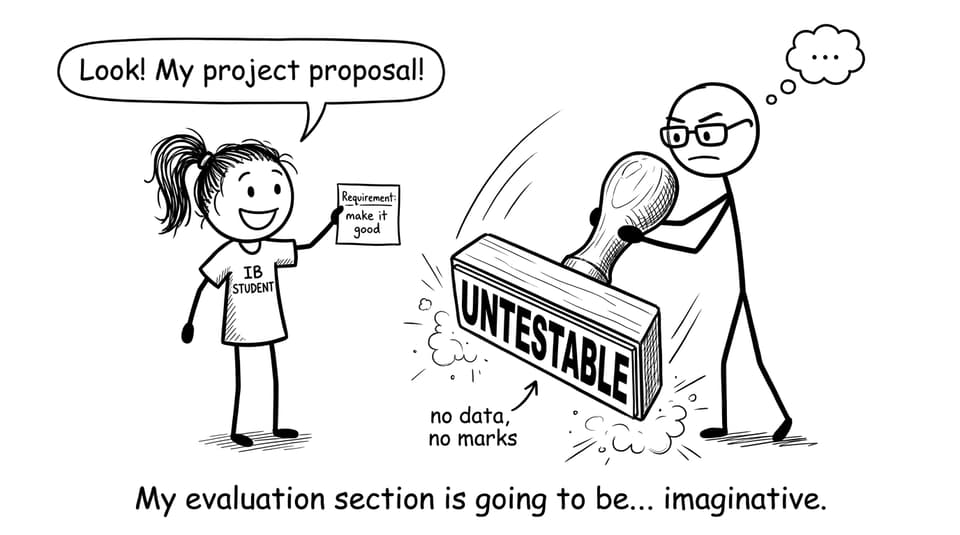
I have watched smart students build beautiful solutions and still lose marks because their requirements read like compliments: “easy to use,” “durable,” “comfortable.” Those words feel true, but they don’t produce evidence. And in IB Design Technology, evidence is what lets an examiner reward your thinking.
When your design requirements are strong, something calming happens: your testing becomes obvious, your evaluation writes itself, and your marks have a clear pathway.
Quick checklist: strong design requirements in IB Design Technology
Use this as a fast filter before you lock anything into your IA:
-
Each requirement is specific (no vague adjectives without context).
-
Each requirement is testable (you can collect data, not just opinions).
-
Each requirement is justified by the problem, user needs, or research.
-
Each requirement is user-focused (written for a real person, not a generic market).
-
Each requirement will be used again in testing and evaluation.
If you want a bigger picture of how examiners judge your thinking, read What Do IB Design Technology Examiners Look For?.
What are design requirements in IB Design Technology?
In IB Design Technology, design requirements are clear statements describing what a successful solution must achieve. They are not decoration. They function like the rules of the game.
They guide your design decisions (what you choose to include, remove, or prioritise). They structure your testing (what data you collect). And they become the backbone of your evaluation (how you prove success).
This is why requirements sit at the centre of high-scoring work. If your requirements are vague, your testing becomes improvised. If your testing is improvised, your evaluation becomes storytelling instead of analysis.
For a DT syllabus-aligned reference point, start at the IB Design Technology hub and work outward from the sections you are currently writing.
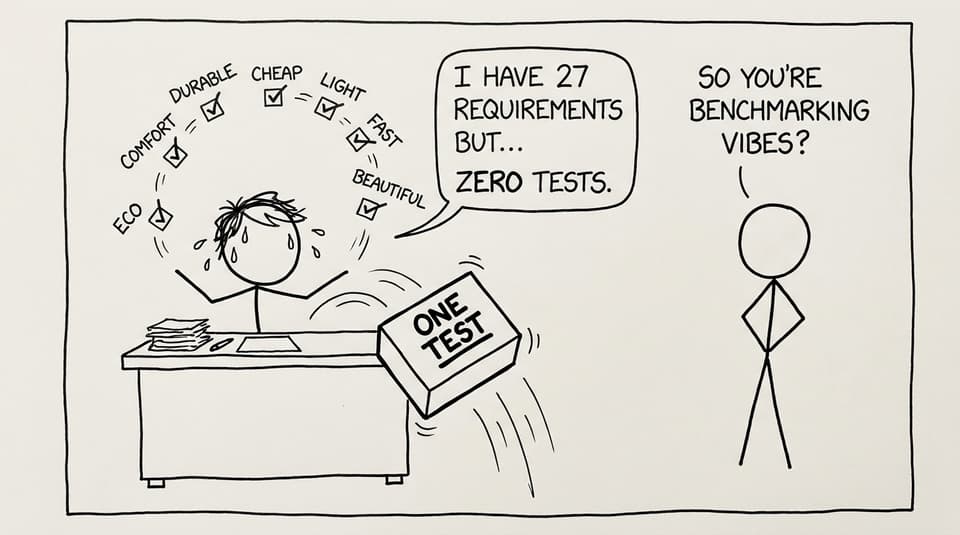
The most common IB Design Technology mistake: “benchmarking vibes”
The biggest mistake in IB Design Technology is writing requirements that sound sensible but cannot be tested.
Examples that hurt marks:
-
“The product should be easy to use.”
-
“The solution should be durable.”
-
“It should be sustainable.”
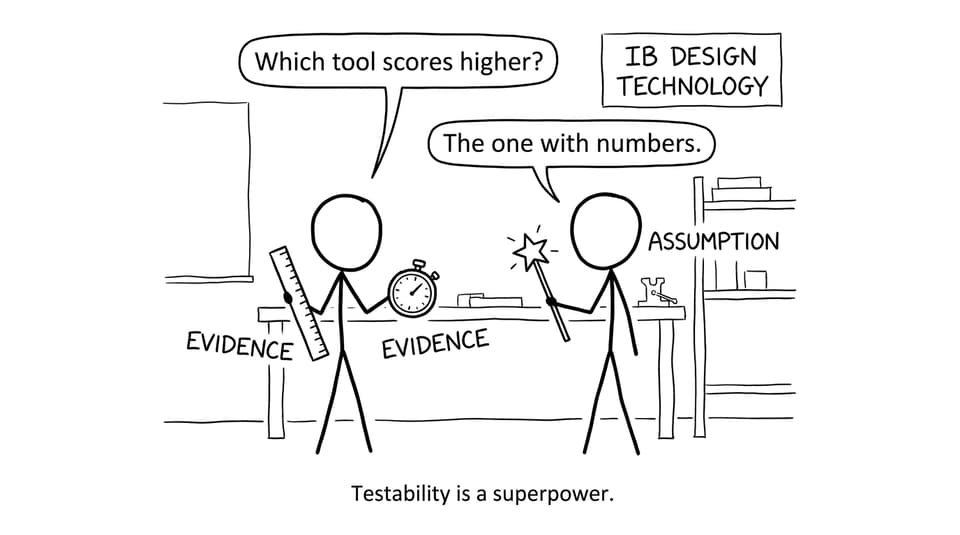
The issue is not that these ideas are wrong. The issue is that they don’t specify how you will know. In IB marking, you don’t get credit for assumptions. You get credit for justified decisions backed by evidence.
If you recognise this pattern across your whole IA, it is worth scanning What Are the Most Common IB Design Technology IA Mistakes? before you continue.
Where strong design requirements come from (hint: not your imagination)
Strong IB Design Technology requirements come from three places:
-
Your problem statement (what must be solved)
-
Your user needs (what matters to the person)
-
Your research (what evidence and constraints exist)
A simple self-check: if you cannot write one sentence explaining why a requirement exists, it probably should not exist.
If you need help turning research into criterion-ready statements, RevisionDojo’s notes on design specification can help you phrase requirements properly: Design specification notes.
How to write testable design requirements in IB Design Technology
A requirement becomes powerful when it contains a built-in method of measurement. In IB Design Technology, you want requirements that naturally create a test table.
Start with the vague version
Example: “The product should be comfortable.”
Add time, conditions, and evidence
Stronger: “The product must allow the user to use it for at least 30 minutes without reporting discomfort during user testing.”
Now you can gather evidence: a timed trial, a short questionnaire, observation notes.
Another common upgrade: size
Weak: “The solution should be compact.”
Stronger: “The solution must fit within a 300 mm × 200 mm desk space to match the user’s available area.”
In other words, the best IB Design Technology requirements are written so an examiner can already see the test method.
If you want to connect requirements directly to top-band scoring, How Can You Score a 7 in IB Design Technology? explains how high achievers use requirements strategically.
How many design requirements should you include?
In IB Design Technology, quality beats quantity. A smaller set of well-justified, clearly testable requirements usually scores higher than a long list you cannot evaluate properly.
As a practical guideline, aim for a set you can realistically test with depth. Too many requirements leads to rushed testing and shallow evaluation. Too few can make your project feel under-justified. The sweet spot is where each requirement earns its space by being essential, evidence-based, and measurable.
Common categories (use only what your problem needs)
Your IB Design Technology requirements often fall into categories like:
-
Function and performance
-
Ergonomics and comfort
-
Dimensions and spatial constraints
-
Safety
-
Materials and durability
-
Sustainability and lifecycle impact
Not every project needs every category. The goal is relevance: include what your user and research demand.
For context on the wider design process, RevisionDojo’s topic notes are helpful: B2.1 The design process.
How design requirements improve testing and evaluation
Here is the quiet advantage: strong requirements make your evaluation almost automatic.
In IB Design Technology, your evaluation should reference each requirement and do three things:
-
State whether it was met
-
Provide evidence (test data, user feedback, observations)
-
Explain limitations honestly
If you want a dedicated guide for that stage, use How Do You Evaluate Success in the IB Design Technology IA?.
Bring it home: make your requirements do the heavy lifting
The best IB Design Technology students are not the ones with the fanciest prototypes. They are the ones who make assessment easy to award: requirements that are specific, justified, and testable, followed by testing that produces evidence, followed by evaluation that calmly judges results.
If you want a single place to practise that loop, RevisionDojo helps at every step: build terminology with Study Notes and Flashcards, pressure-test your understanding with the Questionbank and Mock Exams, and use AI Chat to tighten vague requirements into measurable statements. When you are ready to sanity-check your draft, the IB Design Technology HL IA Grader can help you align your writing with the rubric.
Return to your requirements list, and ask one final question: in IB Design Technology, could you prove each line under exam-level scrutiny? If the answer is yes, you have already made the rest of your IA simpler, and stronger.