


If you have ever stared at an empty set of axes in IB Math and felt your mind go blank, you are not alone. Graph sketching questions look innocent, then quietly steal marks: one missed asymptote, one ignored domain restriction, one shape that does not match the algebra. The strange part is that the drawing is rarely the problem. The real problem is starting with your pen instead of your plan.
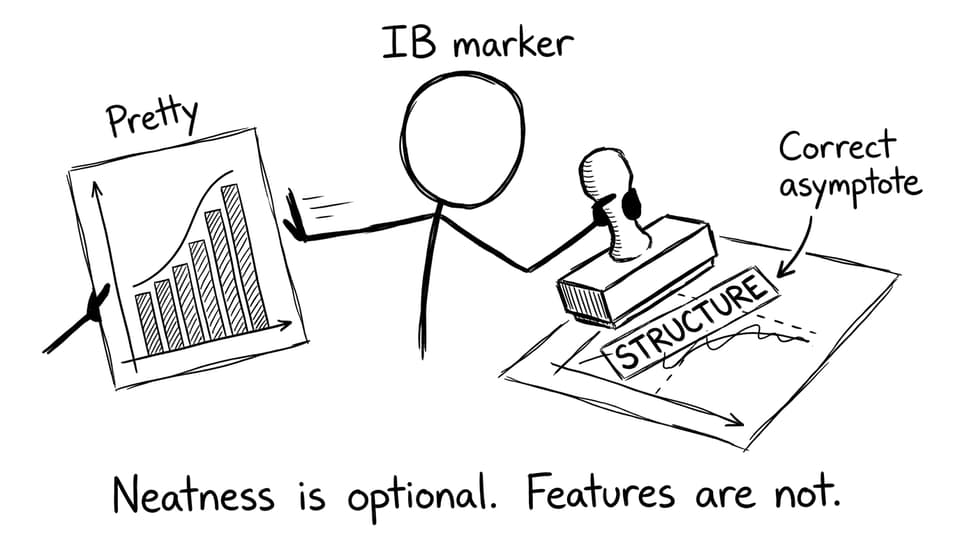
In IB Math, “sketch” is examiner code for: show the structure, not the artistry. Once you know what structure means, graph sketching becomes one of the most predictable ways to pick up marks.
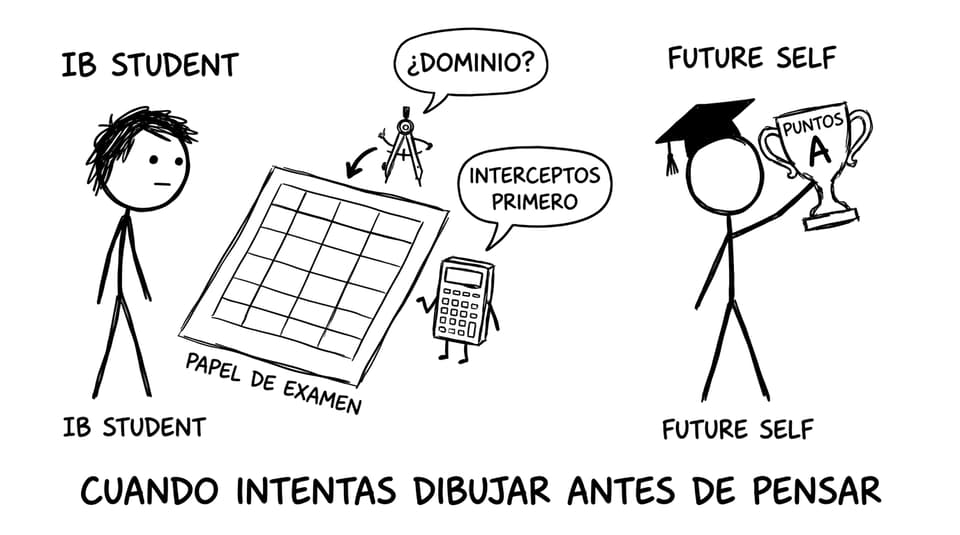
The IB Math graph-sketch checklist (use this every time)
Before you draw anything, run this fast checklist. In IB Math, this is what most mark schemes are silently rewarding.
-
Function type (quadratic, rational, trig, exponential, log)
-
Domain and restrictions (denominator zero, square root negative, log of non-positive)
-
Intercepts (x- and y-intercepts if they exist)
-
Asymptotes (vertical, horizontal, oblique when relevant)
-
Key points (turning points, local max/min, intersections if asked)
-
End behavior (what happens as (x\to\pm\infty) or near an asymptote)
If you want a tight foundation for these ideas, RevisionDojo’s SL 2.3 Graphing notes lay out the features IB expects without fluff.
Why “sketch” feels vague in IB Math
“Sketch” sounds like guesswork, but in IB Math it is more like summarizing a story. The examiner does not need every sentence. They need the plot points.
Graph questions also blend topics on purpose: functions plus transformations, or graphing plus calculus, or sketching plus solving equations visually. If you draw first, you usually commit too early to a shape, and then you try to force the features to fit.
A steadier approach is to treat each feature as evidence. You collect evidence, then you draw the only curve that could reasonably match.
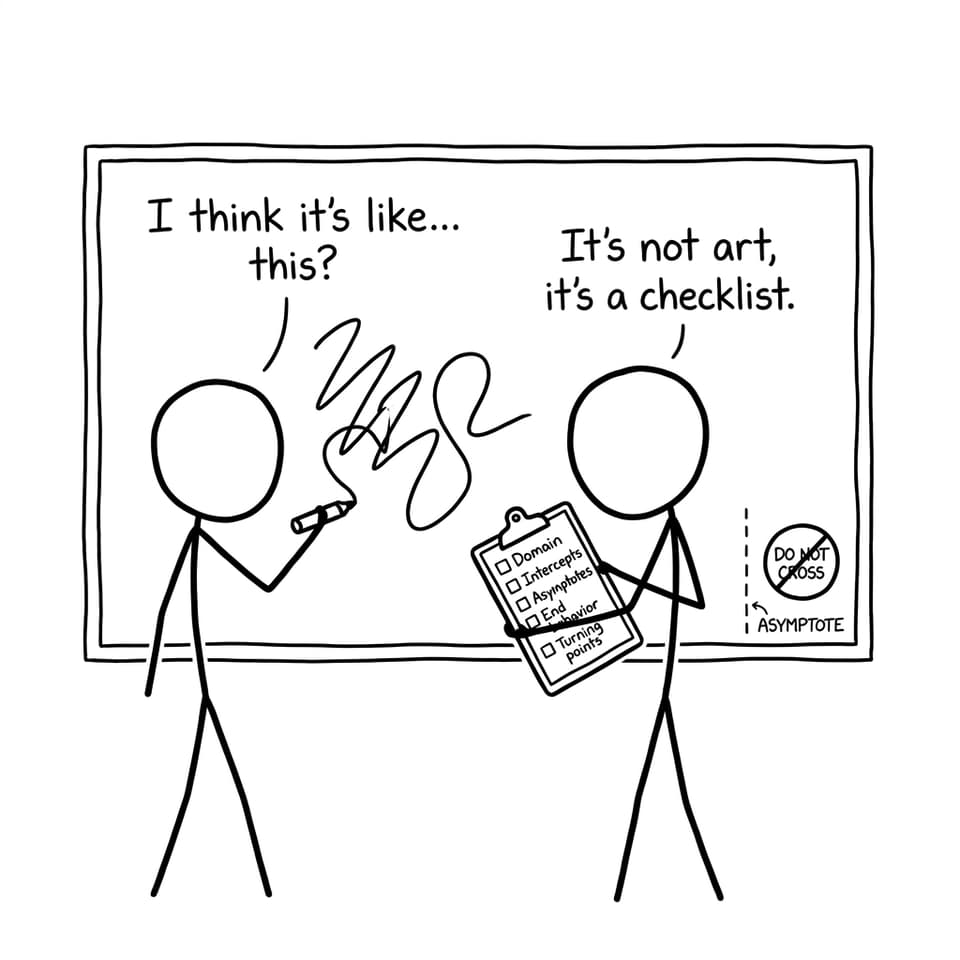
A calm step-by-step method to sketch graphs in IB Math
Start with constraints: domain and “danger zones”
In IB Math, domain mistakes are expensive because they change the entire picture. Before anything else, mark where the function cannot exist. Typical danger zones:
-
Rational functions: denominator (=0) gives vertical asymptotes or holes.
-
Square roots: inside must be (\ge 0).
-
Logs: inside must be (>0).
For rational functions, RevisionDojo’s SL 2.8 rational functions notes are especially useful because they emphasize asymptotes and side-behavior (which branch goes where).
Anchor the sketch with intercepts and one or two clean points
Next, find intercepts if they exist.
-
(y)-intercept: set (x=0).
-
(x)-intercepts: solve (f(x)=0) (if it factors nicely or if the question hints).
If algebra is ugly, you are still allowed to sketch intelligently: grab one additional easy input (like (x=1) or (x=-1)) to confirm which side of an asymptote is positive or negative.
Add asymptotes and end behavior like guardrails
Asymptotes are not decoration in IB Math. They are guardrails that tell the reader how the curve behaves when it is off-screen.
-
Vertical asymptotes: show the curve tending to (\pm\infty) on each side.
-
Horizontal/oblique asymptotes: show the curve approaching a line as (|x|) grows.
Only then think about transformations
Transformations are where students feel “lost” because the algebra looks like code. The simplest move: identify the parent function, then apply transformations one at a time.
If you want a clear toolkit for this, see How to Master Functions and Transformations (Graphing Toolkit) and the SL 2.11 transformations notes. They make it easier to translate symbols into movements.
Common IB Math graph sketching mistakes (and quick fixes)
-
Drawing a curve that crosses a vertical asymptote: treat vertical asymptotes like walls.
-
Ignoring domain restrictions: lightly shade or mark excluded x-values first.
-
Over-plotting random points: IB Math rewards key features, not pointillism.
-
Forgetting labels: label intercepts and asymptotes clearly; it signals understanding fast.
Targeted practice helps here: RevisionDojo’s SL 2.3 Graphing Questionbank lets you drill exactly these mark-winning features with exam-style prompts.
Bring it home: turn sketching into easy IB Math marks
Graph sketching stops being scary in IB Math when you stop treating it like drawing and start treating it like evidence. Run the checklist. Place the guardrails. Anchor with intercepts. Then let the curve reveal itself.
If you want this to become automatic, RevisionDojo is built for the full loop: Study Notes for the method, Flashcards for the features, Questionbank for repetition, Grading tools and AI Chat for feedback, and Mock Exams plus Predicted Papers for realistic pressure. Start with the IB Math AA hub, then drill one graphing set today. In IB Math, consistency compounds quickly.