
Extended response questions in IB Design Technology feel a bit like walking into a workshop where every tool is familiar, but the clock is loud and the instructions are vague. You know the content. You can explain ergonomics, sustainability, and user-centred design. Yet marks slip away when your answer becomes a dump of ideas instead of a guided argument.
That is the hidden truth of IB Design Technology exams: extended responses reward decision-making. Not just knowledge.
What extended response questions are testing in IB Design Technology
In IB Design Technology, extended response questions (most commonly in Paper 2) usually:
-
Carry higher marks, so structure matters more
-
Use command terms like analyse, evaluate, and justify
-
Require connected paragraphs (bullet points rarely show depth)
-
Demand application to a scenario (a product, user group, context, or design choice)
The examiner is essentially asking: “Can you think like a designer under constraints?”
If you want a clear Paper 2 game plan, pair this with How to Tackle IB Design Technology Paper 2 Successfully.
A quick checklist before you write (30 seconds that saves marks)
Use this micro-plan every time you see an extended response in IB Design Technology:
-
Underline the command term (analyse/evaluate/justify)
-
Circle the scenario specifics (user, environment, constraints)
-
Pick 2--3 key concepts only (not 8)
-
Decide your judgement early (what you will recommend and why)
That is the difference between “I know DT” and “I can score in DT.”
A repeatable paragraph structure that fits most markbands
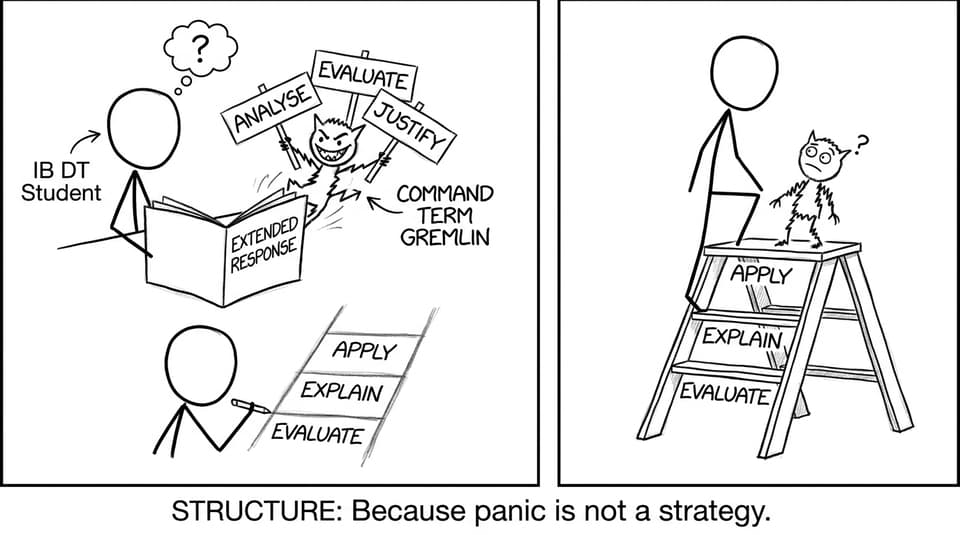
Strong IB Design Technology extended responses usually follow a simple rhythm: apply, explain, evaluate.
Start with applied context (not a generic definition)
Begin by naming the concept, then immediately anchor it to the scenario.
Instead of: “Ergonomics is designing for human comfort…”
Try: “In this scenario, ergonomics matters because the product is used one-handed by commuters, so grip diameter and button placement affect usability and safety.”
This signals to the examiner that you are answering this question, not a textbook.
Want content support for topic knowledge? Build your examples from the IB Design Technology Resources hub and topic notes like 4.1 Properties of Materials Notes.
Explain cause and effect like a designer
This is where many IB Design Technology students accidentally stay descriptive. Push one step further:
-
What changes in performance or user experience?
-
Why does the concept matter in this context?
-
What is the mechanism (comfort, strength, safety, lifecycle impact, manufacturability)?
The examiner is looking for reasoning that connects design choices to outcomes.
Evaluate with trade-offs (this is where top marks live)
High-mark IB Design Technology answers do not pretend there is a perfect solution. They weigh options.
Evaluation sounds like:
-
“This improves X, but reduces Y…”
-
“This is ideal for this user group, although…”
-
“A more sustainable material may increase cost, so the best compromise is…”
Balanced judgement is not weakness. It is design thinking.
How much should you write for IB Design Technology extended responses?
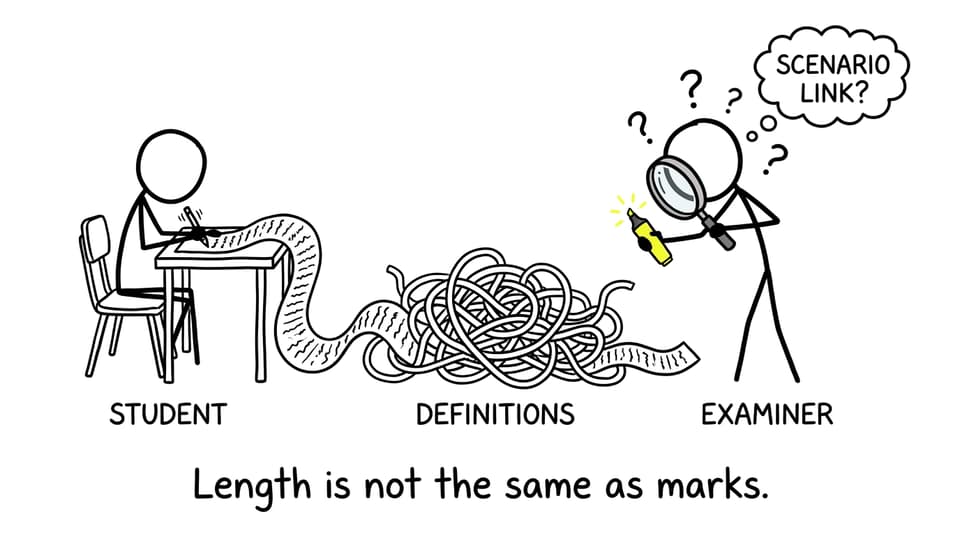
In IB Design Technology, write as much as you need to complete the argument and satisfy the command term.
A tight, well-evaluated answer can beat a long answer that:
-
Repeats definitions
-
Lists examples without linking them
-
Drifts away from the scenario
If you want to practise timing with realistic prompts, use RevisionDojo’s Questionbank and exam builder flow starting from IB Design Technology Topic B2.2 Modelling and Prototyping Questionbank.
Examples: use them like evidence, not decoration
Examples lift an IB Design Technology extended response when you:
-
Choose one example that matches the scenario
-
Explain why it supports your point
-
Loop it back to the judgement
For sustainability questions, a product lifecycle angle can be powerful. Practise with 5.5 Product Life Cycle Questionbank so “example” becomes “evidence.”
Common mistakes that quietly cap your mark
These show up again and again in IB Design Technology scripts:
-
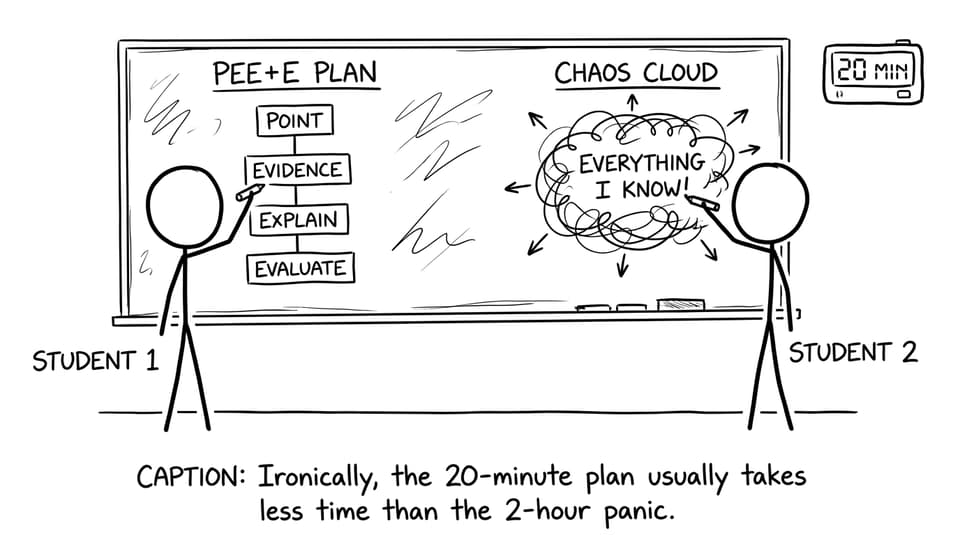
Writing everything you know instead of answering the command term
-
Leaving out evaluation (no trade-offs, no judgement)
-
Using definitions as a substitute for application
-
Forgetting to reference the scenario after the first line
A good test: if your answer could fit five different questions, it is too generic.
How to practise extended responses without wasting time
To improve quickly in IB Design Technology, practise in a loop:
-
Plan in 30 seconds
-
Write in timed conditions
-
Compare your answer to markband expectations
-
Rewrite just the evaluation paragraph (the highest-return fix)
RevisionDojo makes this loop faster: use Study Notes to build topic clarity, Flashcards for key terminology, and AI Chat to check whether your paragraphs truly analyse and evaluate. Then pressure-test your progress with Mock Exams and Predicted Papers (examiner-written, markscheme-aligned) like the Design Technology Predicted Papers. If you are working on written clarity across coursework too, the Grading tools and Coursework Library help you see what “evaluation” looks like in real student work.
Closing: build arguments, not paragraphs
Extended response questions in IB Design Technology are predictable once you treat them like design itself: understand the context, make a reasoned choice, and evaluate the compromises. If you can do that consistently, your marks stop depending on inspiration and start depending on method.
If you want that method built into your revision, use RevisionDojo as your home base: drill scenario-based prompts in the Questionbank, tighten terminology with Flashcards, clarify concepts with Study Notes, and get unstuck quickly with AI Chat and Tutors. Then walk into Paper 2 knowing your structure will hold under pressure in IB Design Technology.
