



If you have ever watched a government change its tone after a viral campaign, a boycott, or a security scare, you have already seen the quiet truth of IB Global Politics: the world is not run by states alone. Some of the loudest forces shaping global outcomes do not have flags, seats at the UN, or formal sovereignty. Yet they still move agendas, rewrite norms, and sometimes destabilize entire regions.
In IB Global Politics, these forces are called non-state actors (NSAs): organizations or individuals that influence political outcomes without being part of a national government. Your exam answers get sharper when you stop asking “Do they matter?” and start asking “How do they matter here, and how much?”
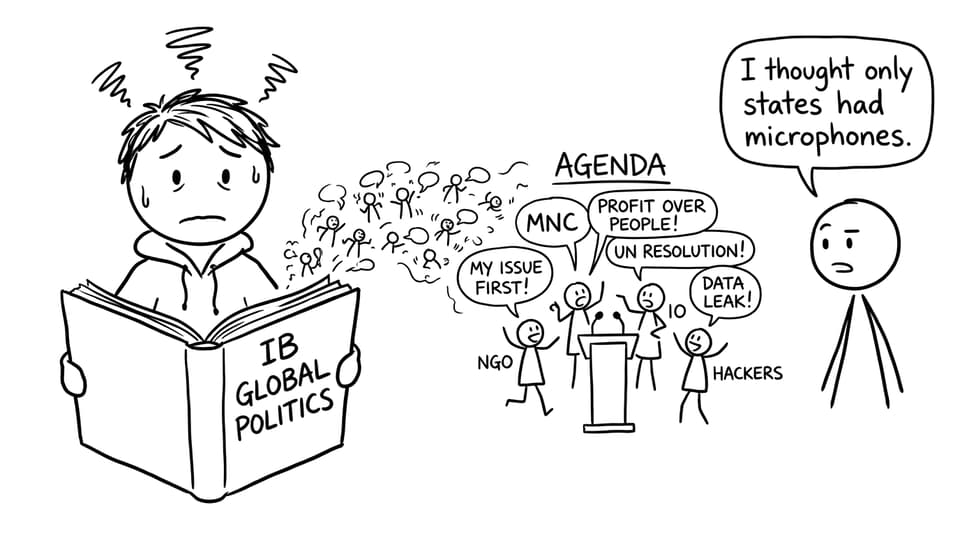
Quick checklist: how non-state actors influence global politics
For IB Global Politics essays and source questions, you can usually sort NSA influence into five mechanisms:
-
Agenda-setting and advocacy (spotlight, campaigns, reports)
-
Economic leverage (investment, supply chains, employment)
-
Norm creation and diffusion (what becomes “acceptable”)
-
Global governance participation (expertise, monitoring, implementation)
-
Disruption and coercion (violence, crime, cyber, intimidation)
If you want a clean definition to anchor paragraphs, pair this article with State vs Non-State Actors in Global Politics.
Agenda-setting: winning attention before winning policy
Most political battles are not decided by law first, but by attention first. NGOs, civil society groups, and media networks can elevate an issue from “background noise” to “international priority.” They do it with reports, documentation, social media pressure, and storytelling that reframes what counts as urgent.
This matters in IB Global Politics because agenda-setting is power without formal authority. A state may still hold the legal tools, but it often reacts to reputational pressure. For exam evaluation, ask: How dependent is the state on international legitimacy, aid, trade relationships, or tourism? The more it cares about image, the more vulnerable it is to advocacy.
To tighten terminology, revise definitions in the IB Global Politics Glossary.
Economic power: when markets negotiate like diplomats
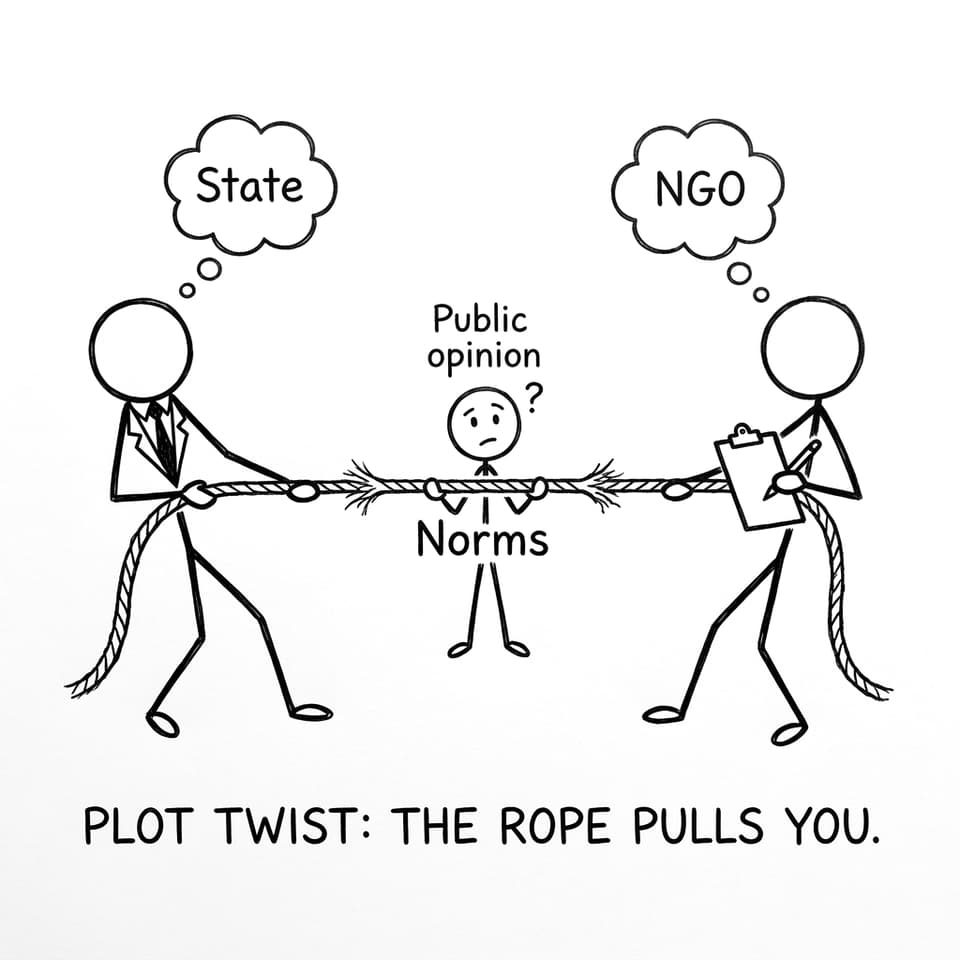
Multinational corporations do not pass laws, but they can change what laws are politically “affordable.” When jobs, tax revenue, and supply chains depend on corporate decisions, states adapt. Regulations shift. Labor rules soften or tighten. Environmental standards are debated with one eye on investment.
In IB Global Politics, this is a great place to show nuance: economic influence is not absolute. Governments can regulate, nationalize, or coordinate with other states. But coordination is hard, and corporations can relocate faster than most parliaments can legislate.
To link this back to core concepts, review Power in Global Politics and then connect it to sovereignty using What Is Sovereignty in Global Politics?.
Norms and legitimacy: changing the rules people expect
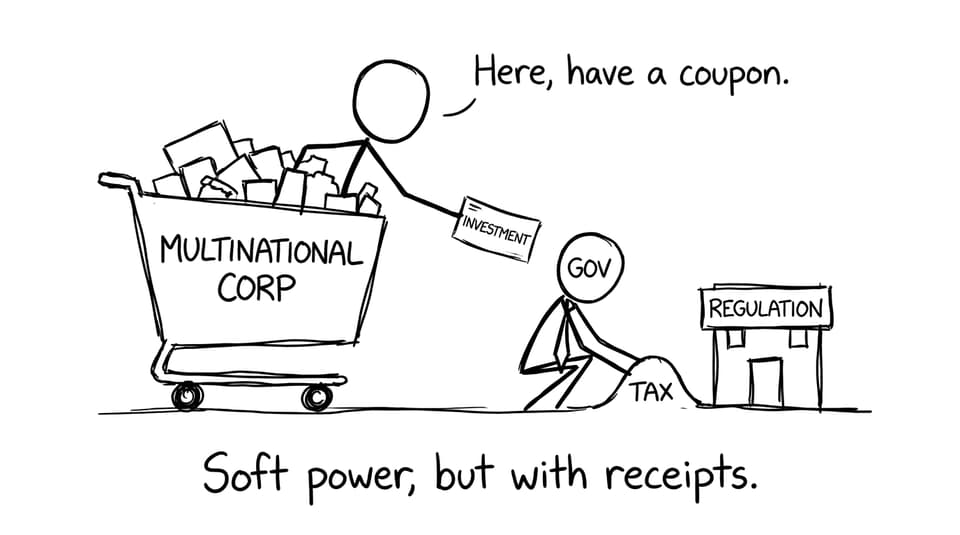
Some of the biggest political shifts happen when expectations change. Non-state actors help create and spread norms about human rights, environmental responsibility, and ethical business. Over time, norms seep into treaties, institutional practices, school curricula, and corporate policies.
In IB Global Politics, this is where you score by using “legitimacy” accurately. NSAs often gain legitimacy through expertise, moral authority, or effectiveness, even without elections or sovereignty. See Legitimacy of Non-State Actors and, for contrast, What is state legitimacy?.
Global governance: influencing outcomes by doing the work
International organizations, expert networks, and NGOs frequently supply the data, monitoring, and on-the-ground capacity that global governance needs. States may sign agreements, but implementation often depends on partners that can operate across borders.
This is especially visible in peacebuilding, humanitarian response, and development coordination. For course alignment, connect this to stakeholder interaction notes like Civil Society Organizations including NGOs and Intergovernmental Organizations.
Disruption and coercion: influence through insecurity
Not all non-state influence is constructive. Terrorist groups, armed movements, criminal networks, and some cyber actors can force states into costly security responses, trigger foreign intervention, or undermine public trust.
In IB Global Politics, the key is balance: these actors may shape decisions, but they rarely replace states as the primary legal authorities. They influence through fear and instability, not recognized sovereignty.
For quick revision on actor types, use Stakeholders and Actors Notes.
Bringing it home for IB Global Politics revision
Non-state actors influence global politics because politics is not just law and borders; it is attention, legitimacy, money, expertise, and fear. In IB Global Politics, you earn top marks by showing how influence works, when it works, and what stops it.
If you want to turn this into exam-ready writing, build one paragraph per mechanism, then test it with RevisionDojo’s Study Notes, Flashcards, AI Chat, and Grading tools. Add Questionbank practice, Mock Exams, Predicted Papers, and case study planning from the Coursework Library, and you will feel the difference the next time you face a timed essay or source set. For students who want tailored feedback faster, RevisionDojo Tutors can help you turn solid ideas into consistently high-mark responses in IB Global Politics.