



Geometric sequences tend to show up when you least want them to: halfway through a timed question, when your brain is still thinking in “add a constant” mode. One small slip (using a difference instead of a ratio) and the whole solution quietly drifts off course.
That’s why IB Math treats geometric sequences as more than a formula to memorise. They’re a way of thinking: change that compounds, grows, shrinks, flips sign, and sometimes stabilises. If you can spot the pattern early, the algebra becomes calm again.
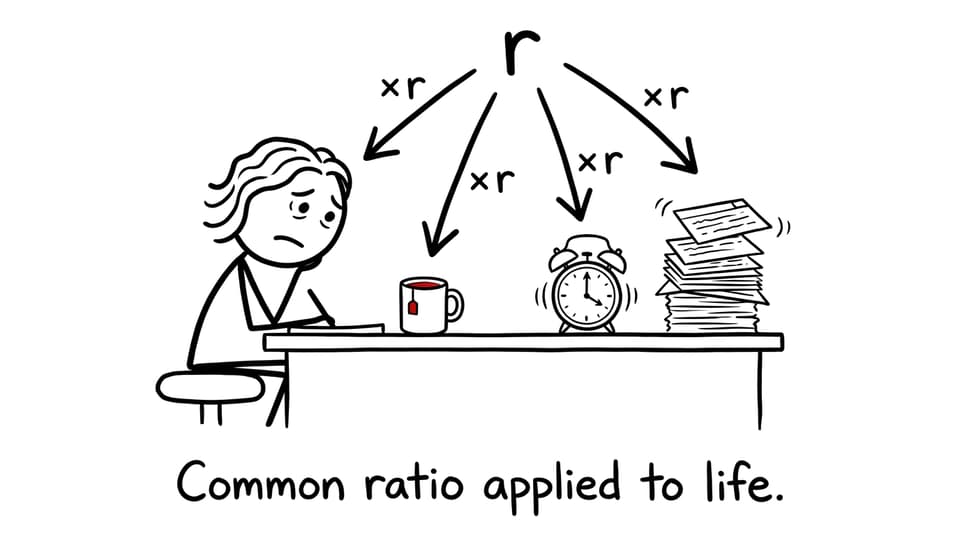
Geometric sequences in IB Math (quick checklist)
Use this as a 30-second reset before you start a question:
-
Confirm it’s geometric: check the ratio between consecutive terms.
-
Write down the first term (a) and common ratio (r).
-
Use (u_n = a,r^{n-1}) for an nth term.
-
If asked for a sum, switch to geometric series formulas.
-
Always sanity-check signs and whether (|r|<1) affects long-term behaviour.
If you want the syllabus-aligned home base for this topic, start here: SL 1.3 Geometric sequences and series.
What is a geometric sequence?
A geometric sequence is a list of numbers where each term is formed by multiplying the previous term by a constant value, the common ratio (r). In IB Math, this matters because the “shape” of the pattern is exponential, not linear.
Example pattern:
- (2, 6, 18, 54, \dots) is geometric because (6/2 = 3), (18/6 = 3), (54/18 = 3).
To compare (and avoid the classic confusion), it helps to revisit arithmetic sequences: SL 1.2 Arithmetic sequences and series.
The nth term formula (and how IB Math tests it)
The core result:
where:
-
(u_n) is the nth term,
-
(a) is the first term (when (n=1)),
-
(r) is the common ratio.
In IB Math AA SL and HL, the tricky part is often that you’re not given consecutive terms. You may get, say, (u_3) and (u_8), and you must solve for (r) using:
That one step is where method marks live. If you want targeted practice with markscheme-style reasoning, use SL 1.3 Geometric sequences and series Questionbank.
Why geometric sequences matter beyond this chapter
Geometric sequences are the “quiet doorway” into topics that dominate IB Math later:
-
Exponential growth/decay models (the ratio is the growth factor)
-
Logarithms (solving for (n) often becomes a log step)
-
Limits and convergence ideas (especially when (|r|<1))
-
Series work, including sums to infinity
To see the bigger story of why IB leans on geometric models, read: Why geometric sequences model reality better than arithmetic ones.
If sequences still feel abstract, this helps frame the mindset shift: Why sequences and series feel so abstract in IB Maths.
Common mistakes that cost marks
Most errors aren’t “hard math” errors. They’re pattern errors.
-
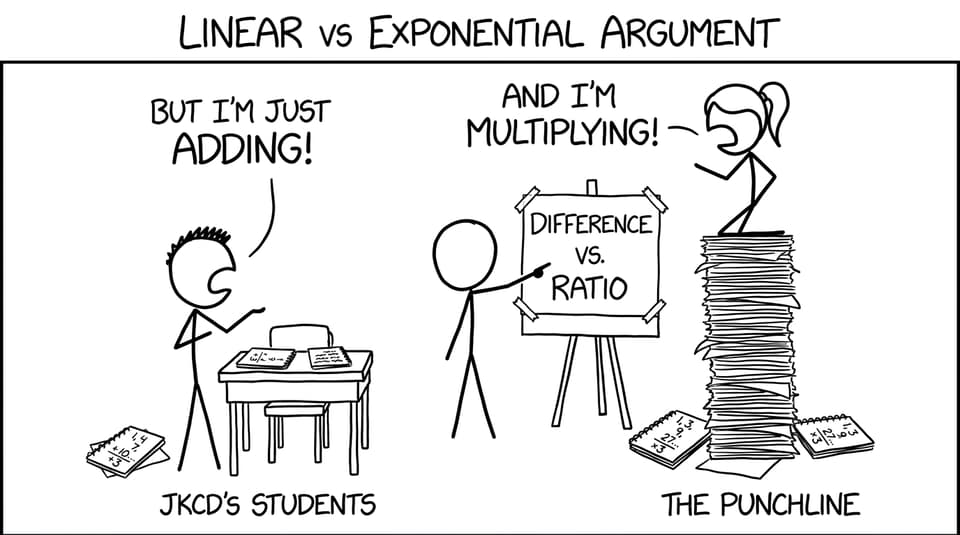
Using difference instead of ratio: If you find yourself subtracting terms, pause and divide.
-
Assuming (r) is positive: A negative ratio alternates signs, which changes interpretation.
-
Forgetting the exponent is (n-1): A surprisingly common slip under time pressure.
-
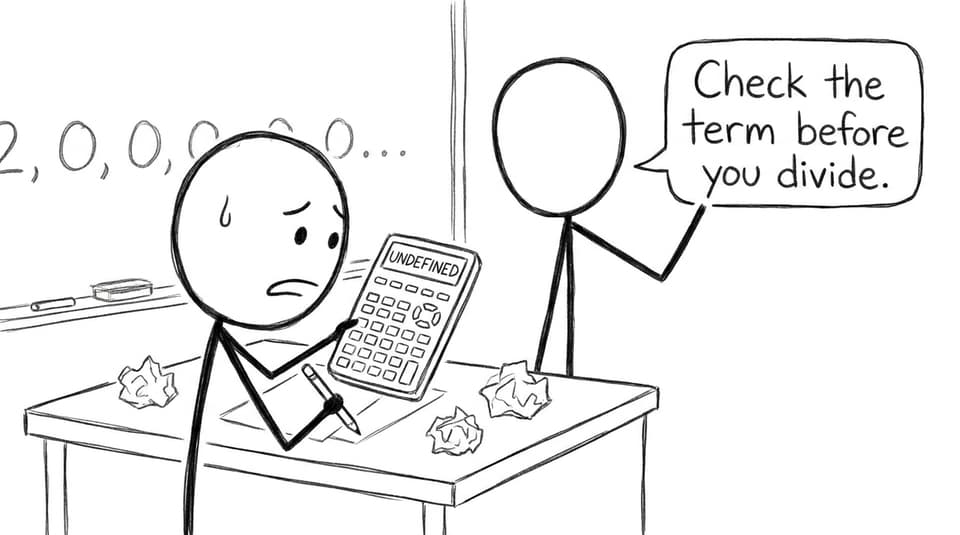
Dividing by a term that could be zero: Always check before you compute a ratio.
Exam tips (AA SL & HL)
-
Write “(a=) …, (r=) …” explicitly before you substitute into formulas.
-
When solving for (r), use exponent rules cleanly before you touch a calculator.
-
If a question hints at long-term behaviour, consider whether (|r|<1) leads to convergence.
-
Practise under realistic timing using RevisionDojo’s Predicted Papers for IB Math AA and then patch weak spots with the Questionbank.
For a broader strategy, keep this open before a revision session: Top tips for understanding IB Math sequences and series.
Closing: make geometric sequences predictable
Geometric sequences aren’t difficult because the algebra is long. They’re difficult because they punish rushed pattern recognition. In IB Math, your advantage comes from slowing down for the first ten seconds: confirm the ratio, define (a) and (r), then let the formula do its job.
When you’re ready to practise this the way the exam expects, RevisionDojo is built for it: Study Notes for clarity, Flashcards for retention, AI Chat for stuck moments, Grading tools for feedback, and the Questionbank, Mock Exams, and Predicted Papers to pressure-test your accuracy. Start with SL 1.3 Geometric sequences and series and train until the ratio instinct becomes automatic.