In the last week before an exam, your brain starts bargaining.
“Surely if I just name a fitness test, I’ll get the mark.”
But IB SEHS doesn’t reward the name. It rewards the reason. In IB SEHS, fitness testing is basically a small story you tell the examiner: what you’re measuring, why this test fits the sport, and how the protocol makes the data trustworthy.
This guide breaks down the core fitness tests you’re expected to know in IB SEHS, plus the moments when each one actually makes sense (exam scenarios, IA-style designs, limited equipment, safety constraints). You’ll also see the three words that quietly run the whole chapter: specificity, validity, reliability.
Student vs beep test chaos
IB SEHS fitness testing: a quick decision checklist
Use this whenever you’re choosing a test in IB SEHS short-answer or extended responses:
What component are you measuring (aerobic capacity, anaerobic power, strength, flexibility, speed, agility)?
What does the sport demand (continuous endurance vs repeated sprints vs change of direction)?
Specificity: does the movement and energy system match performance?
Validity: does the test actually measure what it claims?
Reliability: can you repeat it and get consistent results?
Aerobic questions are common in IB SEHS because they’re easy to set up and easy to evaluate.
Multistage Fitness Test (beep test)
Best used when you need a field-based estimate of aerobic capacity/VO₂ max and your sport is intermittent (team games).
When to use it in IB SEHS:
A school-based investigation where lab equipment isn’t realistic.
Team-sport profiles (football, hockey, basketball) where stop-start running is part of the performance.
How to justify it:
Practical and inexpensive.
Standardised protocol improves reliability.
Still an estimate of VO₂ max, so validity depends on good pacing, motivation, and environment.
If VO₂ max appears in your prompt, RevisionDojo’s VO₂ max notes help you connect testing to physiology (stroke volume, cardiac output, oxygen delivery).
Laboratory VO₂ max test (treadmill/cycle ergometer)
Most valid for VO₂ max, but least practical.
When to use it in IB SEHS:
Evaluation questions where you compare field vs lab methods.
Any scenario where you can explicitly discuss high validity but limited accessibility.
Anaerobic power tests in IB SEHS
Anaerobic testing is where many students lose marks by being vague. In IB SEHS, you need to link the test to explosive performance and short-duration output.
Wingate test
A classic 30-second maximal cycling sprint used to estimate peak anaerobic power and fatigue index.
When to use it in IB SEHS:
Sprint cycling, power-based athlete profiling.
Higher-level evaluation responses where you discuss equipment requirements and safety.
Key evaluation points:
High validity for cycling-based anaerobic power.
Less specific for running sports unless you justify the trade-off.
Requires calibrated ergometer and controlled conditions.
To practise exam-style evaluation phrasing, use RevisionDojo’s fitness testing Questionbank (great for “outline and evaluate” command terms).
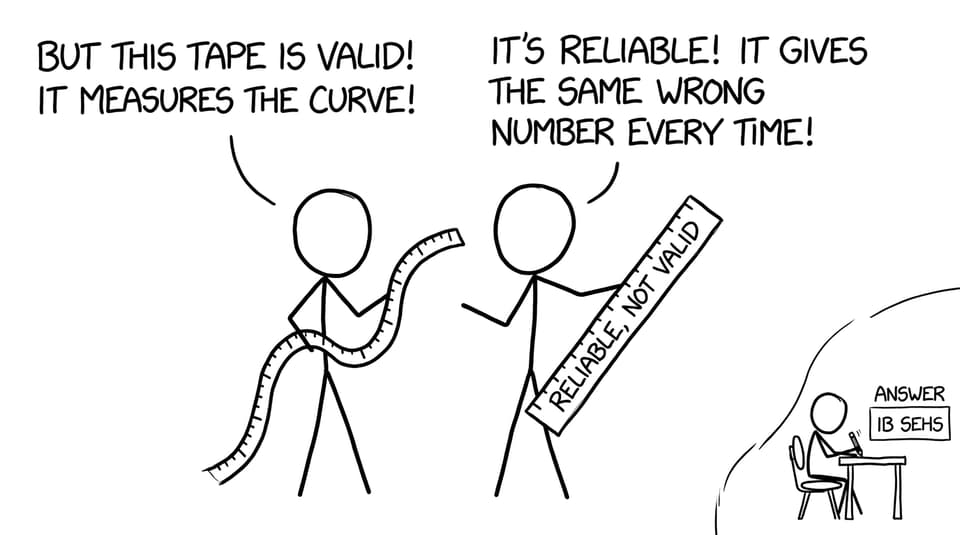
Validity vs reliability argument
Strength and muscular endurance tests in IB SEHS
These are popular in IB SEHS because they’re straightforward to run, repeat, and compare pre/post intervention.
Handgrip dynamometer
Measures grip strength reliably with minimal time.
When to use it in IB SEHS:
General strength screening.
Studies where standardisation matters and you need a clean, repeatable metric.
Limitation to mention:
Great reliability, but limited specificity for sports where grip isn’t central.
Push-up or sit-up tests (muscular endurance)
Counts repetitions under standardised conditions.
When to use it in IB SEHS:
Training programme evaluations (pre-test vs post-test).
Settings with limited equipment.
Reliability warning:
You must standardise technique, cadence, and rest rules.
If your answer needs a physiology link (muscle contraction, fatigue), RevisionDojo’s muscle contraction notes help you add depth without rambling.
Speed and agility tests in IB SEHS
Speed and agility are easy to confuse in IB SEHS. Speed is straight-line acceleration/max velocity. Agility includes change of direction (and, in real sport, decision-making).
40 m sprint
When to use it:
Sports where acceleration and top speed matter.
Clear, simple pre/post comparisons.
Illinois Agility Test or 5-10-5 shuttle
When to use it:
Court sports and invasion games requiring rapid changes of direction.
Evaluation points:
High face validity for change-of-direction ability.
Must control surface, footwear, timing method, and recovery time for reliability.
Agility test in a classroom
Flexibility tests in IB SEHS
Sit-and-reach
Measures hamstring and lower-back flexibility.
When to use it in IB SEHS:
General flexibility screening.
Sports where hamstring flexibility is relevant (dance, gymnastics, hurdling).
Limitation to mention:
It doesn’t represent whole-body flexibility, so validity is narrow.
How to write stronger IB SEHS justifications (the examiner wants this)
A high-mark IB SEHS justification often looks like this:
Name the test.
State what it measures.
Explain why it fits the sport (specificity).
Comment on validity and reliability.
Mention practicality/safety and standardisation.
If you want a full course roadmap (SL/HL structure, what topics link together), RevisionDojo’s Ultimate Guide to IB SEHS is a useful starting point.
Closing: turn IB SEHS fitness testing into easy marks
Fitness testing in IB SEHS is less about hunting for the “best” test and more about choosing the most defensible test for that scenario. When you match the component and sport demands, then evaluate specificity, validity, and reliability with practical constraints, you write like an examiner thinks.
When you’re ready to revise this properly, RevisionDojo gives you the full toolkit: Study Notes for clean definitions, a targeted Questionbank for application practice, Flashcards for retention, AI Chat for instant feedback, plus Grading tools, Mock Exams, Predicted Papers, a Coursework Library, and expert Tutors to help you sharpen your justifications before exam day.