



The first term IB Business Management experience usually begins gently, then becomes analytical faster than students expect. You will probably start with what businesses do, how they are organized, why their objectives differ, and how decisions affect stakeholders. Before long, you must apply those ideas to unfamiliar organizations rather than simply repeat definitions.
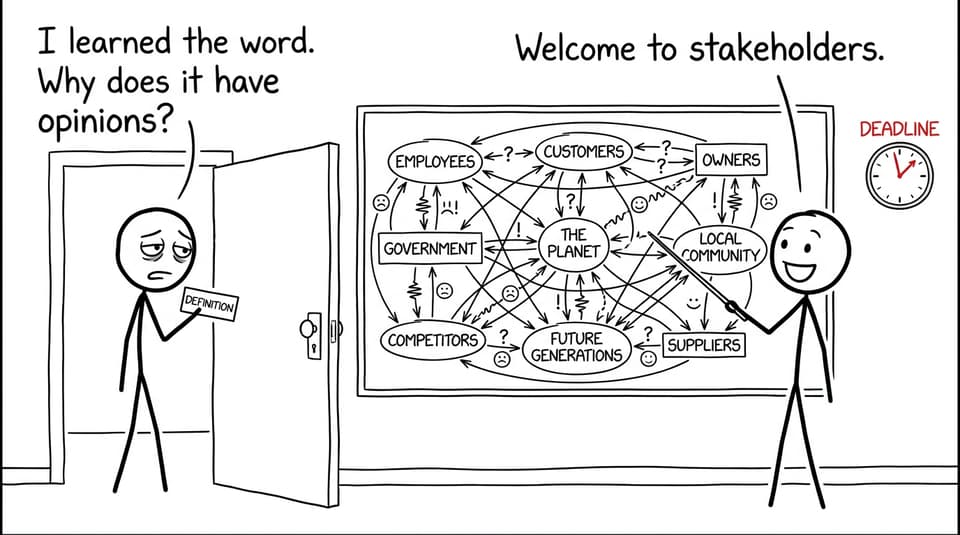
The workload is normally manageable. The real adjustment is learning how to think. A term such as stakeholder conflict looks simple on a flashcard, but a case may ask you to explain whether a decision benefits employees while creating risks for owners, customers, or the local community.
Your school's sequence may differ, but the outline below reflects the current course structure and a common first-term pattern.
Your first-term overview
Expect some version of this progression:
- Build the vocabulary of businesses, sectors, entities, objectives, and stakeholders.
- Apply definitions to short case studies.
- Learn tools such as SWOT analysis.
- Complete structured responses, presentations, quizzes, or case assignments.
- Discover that longer answers require analysis and judgement, not longer definitions.
- Possibly begin Unit 2 on human resource management.
- Hear an early introduction to the Business Research Project.
The current syllabus allocates 20 recommended teaching hours to Unit 1 at both SL and HL. That does not create a universal calendar. Holidays, lesson frequency, teacher sequencing, and induction activities can change how far your class travels during its first term.
What the first term usually looks like
| Stage | Likely classroom focus | What changes for you |
|---|---|---|
| Opening weeks | Business functions, sectors, entrepreneurship, and business entities | You build precise vocabulary and distinguish similar terms. |
| Middle of term | Objectives, stakeholders, growth, and business tools | Definitions become evidence for case-based arguments. |
| Later weeks | Longer responses, tests, and possibly human resources | You analyse consequences and make supported judgements. |
The opening weeks feel familiar
Early lessons often revolve around straightforward questions: What is a business? Why do entrepreneurs accept risk? How does a private-sector organization differ from a public-sector organization? What separates a sole trader from a company?
This stage can create false confidence. The language makes intuitive sense, especially if you follow business news or have studied introductory economics. But IB questions require precision. Saying that a company is large does not explain its legal structure. Saying that an entrepreneur wants profit does not fully address independence, social objectives, or risk.
Use the Unit 1 introduction hub to follow the syllabus in order. The focused What Is a Business notes are useful when classroom explanations move quickly.
The middle of term introduces trade-offs
Business Management becomes more interesting when reasonable people can disagree. Owners may want higher profit. Employees may want higher wages. Customers may want lower prices. Governments may care about employment, tax revenue, or environmental effects.
Your task is to explain the conflict, use details from the organization, and judge which consideration matters most under the circumstances. The stakeholder notes and examples help turn this broad idea into something you can apply.
This is also when tools may appear. SWOT analysis separates internal strengths and weaknesses from external opportunities and threats. Completing four boxes is easy. Explaining which factors deserve management attention is harder. RevisionDojo's Business Management toolkit notes explain the purpose and limitations of core frameworks.
The end of term feels more like the IB
By the final part of term, teachers often expect developed responses. You may receive an unfamiliar stimulus and need to define a concept, select evidence, analyse consequences, and reach a justified conclusion.
A strong paragraph begins with the case. Suppose a fictional café wants to open a second location. A weak answer says growth can increase revenue. A stronger answer explains how the location could increase sales capacity, then considers added rent, recruitment needs, quality-control risk, and cash flow.
Your class might also move into organizational structure, leadership, or motivation. If it does, the Unit 2 human resource management notes provide a useful bridge. Other classes may remain in Unit 1 and explore growth and evolution in greater depth. Neither pace is automatically better.
The workload is steady rather than dramatic
Business Management rarely creates enormous nightly assignments. Instead, it produces smaller demands: terminology, reading, case annotations, short responses, quizzes, and occasional presentations.
A sensible starting routine is two or three sessions outside class each week, perhaps 20-30 minutes each. This is a planning suggestion, not an official requirement. Your workload will depend on your teacher, level, timetable, and confidence.
Divide those sessions by purpose:
- Recall: Review terminology with Business Management Flashcards.
- Understanding: Read one section of the Business Management Study Notes, then summarize it without looking.
- Application: Complete several prompts from the Business Management Questionbank.
- Correction: Record one missing definition, one weak application, and one unexplained consequence.
This is more effective than rereading an entire unit on Sunday evening. Small misunderstandings are easier to correct early because later topics assume you understand the foundation.
What surprises new students most
Common sense is not enough
Business experience can help, but ordinary opinions do not earn marks by themselves. A recommendation needs theory, case evidence, analysis, and reasoned judgement. You are not being asked what feels sensible. You are being asked what the evidence supports.
Definitions are only the entrance
Students often spend too much time perfecting definitions because definitions feel controllable. Yet the harder skill is application. After learning a term, ask what it would look like in a specific organization, who benefits, what could go wrong, and whether the effect might change over time.
There is rarely one perfect answer
Many business decisions involve uncertainty. Expansion might create economies of scale while weakening quality control. Higher wages might increase costs while improving motivation and retention. A good conclusion can be conditional: choose one option if demand remains strong, but reconsider if cash flow deteriorates.
HL may not feel different immediately
Both SL and HL study Unit 1, for which the guide recommends the same teaching time. The difference becomes clearer as HL extensions, additional toolkit content, and wider assessment demands accumulate. HL students still benefit from mastering the fundamentals first.
Coursework matters, even if it feels distant
The course includes an individual Business Research Project about a real issue or problem facing a particular organization. Your teacher may only introduce it briefly during the first term. Begin noticing accessible organizations and real decisions, but do not choose a research question before understanding the requirements.
Later, RevisionDojo's Coursework Library and Grading tools can help you examine structure and diagnose weaknesses. AI Chat can clarify a difficult concept, while Tutors can provide human guidance when confusion persists. Predicted Papers and Mock Exams become more useful closer to formal assessment, once you know enough content to use them meaningfully.
How to finish the term strongly
By the end of term, aim to do four things reliably:
- Define core Unit 1 terms accurately.
- Select relevant evidence from a case.
- Explain a chain of consequences.
- Reach a balanced conclusion that answers the question.
You do not need perfect notes or elaborate color coding. You need a repeatable loop: learn, recall, apply, receive feedback, and try again.
The first term is ultimately about seeing business decisions from several angles without becoming vague. RevisionDojo brings that process together through Study Notes, Flashcards, Questionbank practice, AI Chat, Grading tools, Predicted Papers, Mock Exams, the Coursework Library, and Tutors. Start with the next topic your teacher covers, master it narrowly, and apply it carefully.