


Intertextuality is the moment you realise your book is not sitting alone on the desk.
It’s sitting in a room full of other books, films, songs, speeches, myths, headlines, and cultural memories. And in IB English, that realisation is quietly powerful: the best analysis often begins when you hear an echo.
A character feels familiar. A plot turn seems borrowed. A phrase sounds like something older. That’s not “just a coincidence”; it’s often an author building meaning through connection. If you can name the connection and explain its effect, you stop writing summaries and start writing the kind of commentary examiners reward.
Intertextuality in IB English: a quick working definition
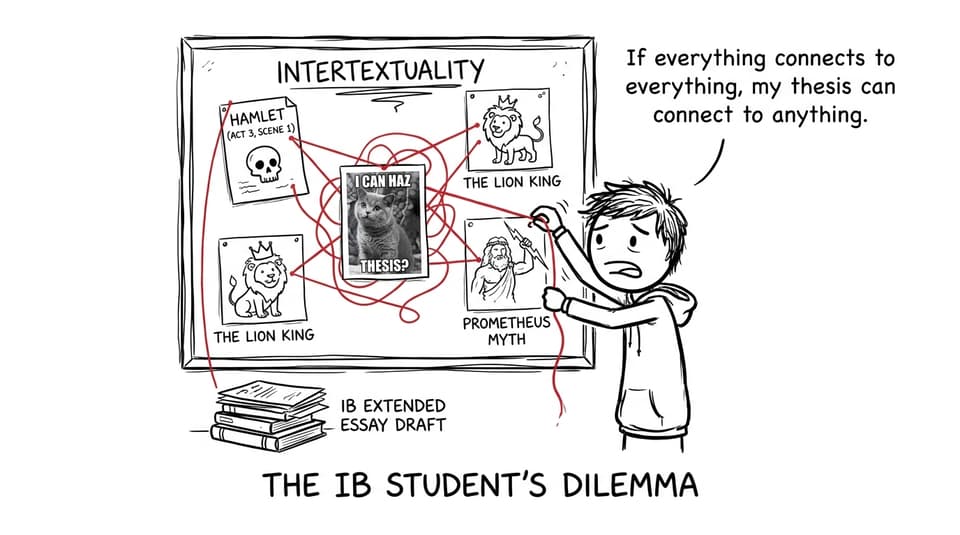
In IB English, intertextuality is the relationship between texts: how one text references, reshapes, answers, or argues with another. A “text” can be a novel, poem, play, film, advertisement, speech, song, or even a recurring cultural story (like a myth or fairy tale).
The key idea is simple: meaning is partly created by what a text reminds us of.
If you want a clean foundation before you build analysis, RevisionDojo’s course hub is a good starting point: IB English A: Lang & Lit Resources.
Intertextuality checklist (use this before you write)
When you notice a possible reference, run this quick checklist:
-
Spot the connection: what earlier text, genre, myth, or cultural script is being echoed?
-
Classify it: is it direct (quotation/allusion) or indirect (theme/structure/style)?
-
Explain the move: is the new text agreeing, challenging, parodying, or updating the older one?
-
Prove it: which technique shows the connection (diction, symbolism, structure, characterization, imagery)?
-
Evaluate the payoff: what new meaning is created for the reader?
That last step is where IB English marks live: not in naming an allusion, but in explaining what the allusion does.
Types of intertextuality (and how to write about each)
Intertextuality shows up in patterns. Once you learn the patterns, you start finding them everywhere, especially in the texts chosen for IB English.
Direct allusion or quotation
This is the obvious kind: a text quotes or clearly points to another.
How to analyse it: explain what the original reference usually means, then show how the new context changes the meaning.
A classic example is T.S. Eliot’s The Waste Land, which layers voices from Dante, Shakespeare, and religious texts to create a collage of cultural exhaustion. Even if you don’t know every source, you can still discuss the effect: authority, fragmentation, and a sense of inherited collapse.
Adaptation, retelling, or re-centering
A newer text reworks an older one, often shifting perspective.
- Jean Rhys’s Wide Sargasso Sea reframes Jane Eyre by giving voice to the silenced “madwoman in the attic.”
How to analyse it: focus on the ethical shift. Who gets agency now? What ideology is being challenged?
Parody and satire
A text copies an earlier form or story to critique it.
- Margaret Atwood’s The Penelopiad revisits The Odyssey with a sharper eye on gender and power.
How to analyse it: track the irony. Show how imitation becomes a tool for exposure.
Thematic or stylistic echo
Sometimes nothing is quoted, but a text feels like it’s in conversation with another through shared motifs, archetypes, or moral questions.
- Frankenstein and Blade Runner both explore creation, responsibility, and the fear of what we make.
How to analyse it: avoid saying “they’re similar.” Instead, say how each text stages the theme differently because of context, form, and audience.
For building those comparisons, this RevisionDojo guide helps: Thematic Comparisons Across IB Prescribed Texts.
A step-by-step method to analyse intertextuality (that works under exam pressure)
If you’re revising IB English for Paper 2, the IO, or the HL Essay, you need a process you can repeat.
Identify the connection quickly
Ask:
-
Is the reference explicit (named, quoted, clearly signposted)?
-
Or implicit (structural echo, archetype, genre pattern)?
If you’re working with a play like Hamlet, it can be useful to anchor your evidence with reliable text knowledge: Hamlet (IB English Lang & Lit).
Explain the relationship in one precise sentence
Try this template:
The writer invokes [source text/genre] to [purpose], reshaping [original idea] into [new meaning] for a [new context/audience].
That single sentence can become the spine of a paragraph in IB English.
Analyse technique, not just theme
Intertextuality is built through craft. Look for:
-
diction that mimics an older register (biblical, Shakespearean, legal)
-
symbolism with inherited meanings (apple, crown, monster, mirror)
-
structure that follows a familiar plot pattern
-
voice that reclaims a previously marginal perspective
To sharpen technique spotting for exam writing, pair this with timed practice: Step-by-Step Guide to Revising IB English Paper 1.
Evaluate the impact
This is the examiner-friendly part: what does the connection make the reader notice?
-
Does it add credibility or authority?
-
Does it create irony (saying one thing while pointing to another)?
-
Does it challenge a dominant narrative?
-
Does it reveal how ideas change across time and culture?
Where intertextuality helps most in IB English assessments
Intertextuality is not a bonus topic. It’s a multiplier: it turns “good understanding” into “insightful interpretation.”
Paper 2 (comparative essay)
Paper 2 rewards students who can show texts as part of a wider conversation. Use intertextuality to make comparisons feel intentional rather than list-like.
Build confidence with targeted practice and prompts via the Paper 2 Lang & Lit Questionbank and the IB English A Lang & Lit English Paper 2 Questionbank.
If you want a clean overview of what Paper 2 actually demands, use: Understanding the IB English A Literature Paper 2 Exam Structure.
Individual Oral (IO)
Intertextuality helps you frame your two extracts as two answers to the same global issue.
Structure support is here: Individual Oral (IO) Resource Page, plus a wider breakdown: Comprehensive Guide to the IB Individual Oral (IO).
HL Essay (HL only)
Intertextuality makes a strong HL Essay feel original because it shows you understand literary conversation: influence, resistance, revision, and cultural context.
RevisionDojo supports this kind of depth with Study Notes, a Coursework Library, and Grading tools that push you beyond plot into argument.
Common mistakes students make with intertextuality in IB English
-
Name-dropping without payoff: “This references Shakespeare” isn’t analysis unless you explain effect.
-
Treating it as simple comparison: intertextuality is dialogue, not a spot-the-similarity game.
-
Over-claiming author intent: you can argue that a connection is meaningful without insisting it was guaranteed intentional.
-
Forgetting context: why that reference, for that audience, in that moment?
A practical fix is to practise writing short, evidence-based paragraphs and get feedback fast. RevisionDojo’s Questionbank plus AI Chat and Essay/IO grading tools make iteration easier than waiting a week for comments.
Closing: make connections, then make them matter
The most memorable IB English essays don’t sound like they were written in isolation. They sound like the student can hear literature thinking out loud across time: a story answered by another story, a genre reused to critique itself, a familiar myth pulled into a new world.
If you want to train that skill deliberately, build a small system: use RevisionDojo’s Study Notes to secure text knowledge, Flashcards to lock in key terms, the Questionbank to practise under pressure, Predicted Papers and Mock Exams to simulate exam conditions, and the Grading tools plus AI Chat to improve each draft faster. Intertextuality becomes much less mysterious when you practise spotting it, naming it, and explaining what it changes.
And that’s the goal: in IB English, don’t just find connections; use them to create insight.