


When you read a line that feels like it was written about you, it rarely announces itself as a theme. It arrives as a small jolt: a character correcting their voice, a narrator policing their own desire, a society deciding what a body is “for.” In IB English, those jolts are often your best evidence. Gender and identity aren’t just topics to name-drop; they’re patterns authors build through language, perspective, and representation.
This guide shows you how to turn those patterns into exam-ready analysis for the IO, Paper 2, and HLE, without drifting into vague “this shows inequality” conclusions. In IB English, precision is kindness: to your reader, and to your future self under time pressure.
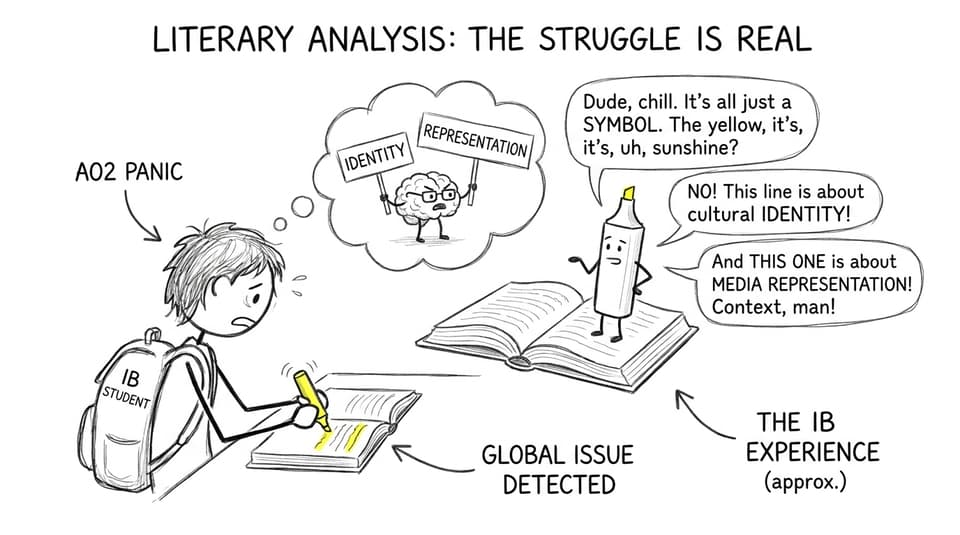
Quick checklist for gender and identity analysis (save this)
Use this when you annotate or plan an outline in IB English:
-
Define the identity pressure in the text (social role, expectation, label, stereotype).
-
Track who gets to speak and who is edited, silenced, or translated.
-
Identify 2-3 recurring techniques (imagery, diction, narrative voice, structure, symbolism).
-
Connect technique to power (who benefits from the definition of gender/identity?).
-
Add one layer of intersectionality (race, class, sexuality, disability, culture, age).
-
Write a thesis that answers: So what does the text suggest about identity under constraint?
If you want a structured place to practise this, RevisionDojo’s IB English A Lang & Lit Resources organizes skills by assessment and gives you tools to drill technique-to-effect writing.
What “gender and identity” means as a global issue in IB English
A global issue in IB English needs reach: it matters across places, cultures, and time periods. Gender and identity fit because they sit at the intersection of representation and freedom, how people are seen, what roles they’re offered, and what happens when they refuse.
Instead of treating the issue as “men vs women,” frame it as a tension:
-
identity as performance vs identity as truth
-
gender as social regulation vs gender as self-definition
-
the self as stable vs the self as fluid
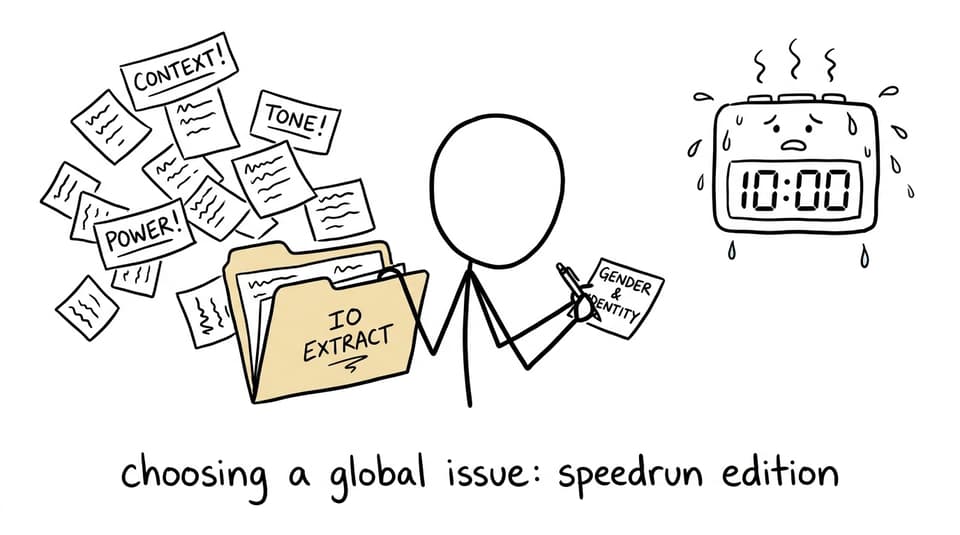
For IO planning, the “global issue” language matters. If you need help choosing a clean, defensible issue statement, use IB Fields of Inquiry Explained with Examples and build your wording from Field 1 (Culture, Identity & Community).
How to analyse gender and identity in IB English texts (a reliable method)
Start with representation, not morals
In IB English, you’re not grading characters’ choices. You’re showing how the text constructs gender and identity.
Ask:
-
Which traits are coded as “acceptable” masculinity/femininity?
-
Who is allowed complexity, and who is reduced to a type?
-
When a character resists a role, does the narrative reward or punish them?
This is where you earn Criterion A and B marks: interpretation that stays close to textual choices.
Move to technique: language, imagery, structure, voice
Once you’ve identified the pattern, prove it through craft.
Look for:
-
Diction that frames bodies and roles (purity language, ownership language, softness/hardness binaries)
-
Imagery like confinement, mirrors, clothing, light/dark contrasts
-
Narrative perspective that limits or expands identity (unreliable narration, free indirect discourse)
-
Structure that fragments the self (shifts in time, interrupted syntax, repeated motifs)
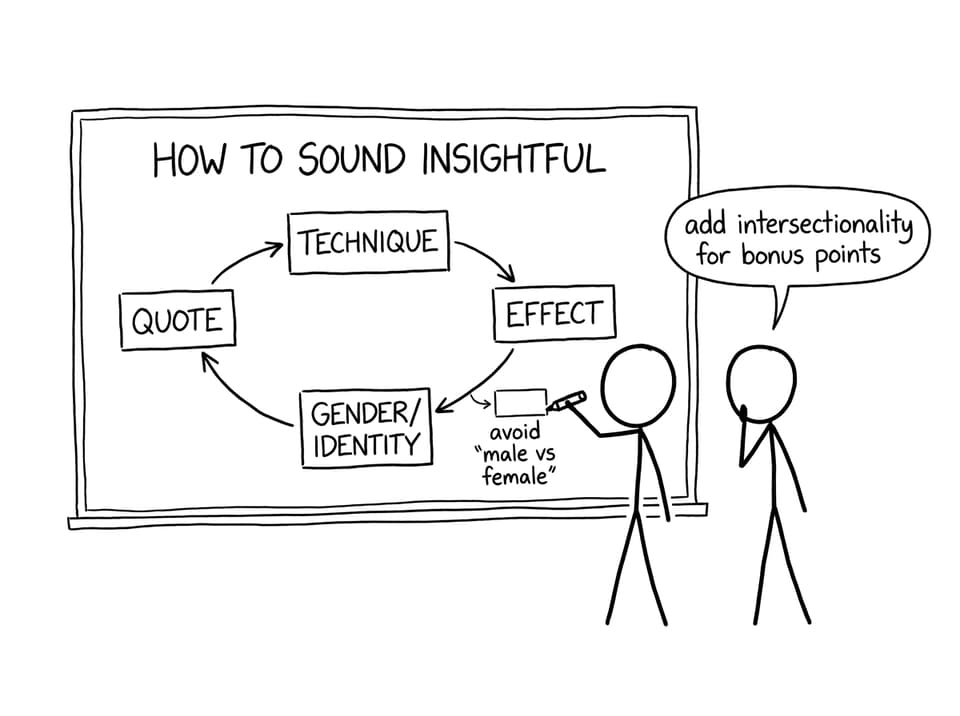
A strong IB English sentence often follows this rhythm:
Through [technique], the writer [creates effect], which frames gender/identity as [interpretation], revealing [wider implication].
To practise that rhythm with real exam-style prompts, use RevisionDojo’s Theme 6 Questionbank: Gender / Control over Women.
Add context and audience without overgeneralising
Context in IB English is not a history essay. It’s a way to explain why a representation matters.
Try:
-
“Written in a context where…”
-
“For audiences shaped by…”
-
“The text assumes that…”
Keep it specific. “Patriarchy exists” is true but too broad to be useful.
Finish with evaluation: what does the text do to the reader?
This is where your analysis becomes memorable.
Ask:
-
Does the text invite empathy, discomfort, critique, or complicity?
-
Are stereotypes exposed, reinforced, or complicated?
-
What changes when a modern audience reads the same representation?
For comparison-driven practice, pair this method with Thematic Comparisons Across IB Prescribed Texts so your IB English Paper 2 paragraphs stay integrated.
Where these themes show up in the assessments
Individual Oral (IO)
Gender and identity work well in the IO because you can trace representation across a literary and non-literary text.
Use Comprehensive Guide to the IB Individual Oral (IO) for structure, then refine your ending with Concluding Your IO Notes.
Paper 2 comparative essay
Paper 2 rewards writers who can compare methods, not just messages. If both texts critique restrictive gender roles, your job is to show how they do it differently.
Build your plan using Structuring Your IB English Paper 2 Essay and keep your comparison tight with How to Structure a Comparative Essay in IB Literature.
HL Essay (HLE)
For the HLE, gender and identity can produce a sharp line of inquiry because you can focus on one recurring technique (voice, symbolism, focalization) across the whole work.
Use How To Master HLE Notes to shape an argument that stays analytical rather than summary-based.
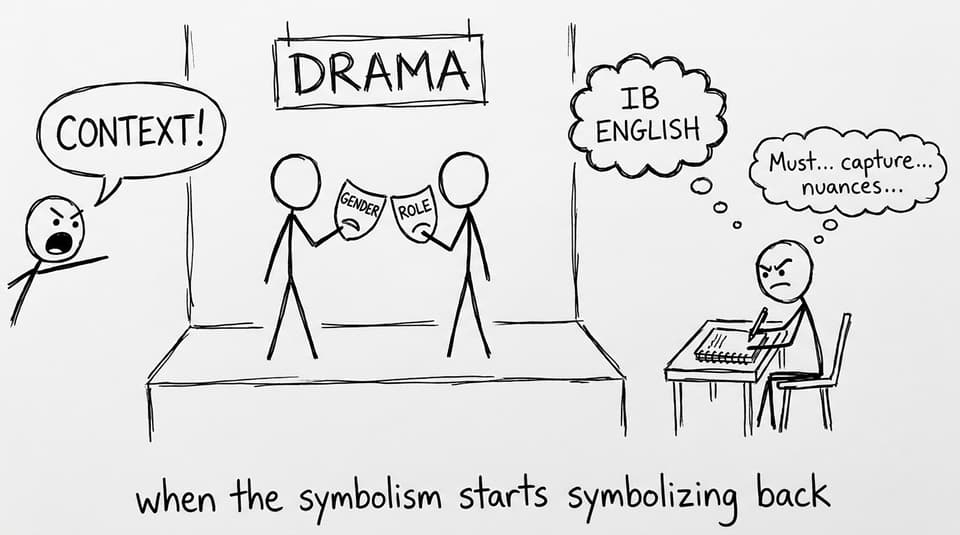
Closing: turn “big themes” into small proof
Gender and identity can feel enormous until you remember what IB English actually rewards: small textual proof connected to a clear idea. One verb choice, one image, one shift in perspective, and suddenly you can show how a text builds (or breaks) a social role.
If you want a single home base for practising that skill across IO, Paper 2, and essay writing, start with RevisionDojo’s IB English A Lang & Lit Resources and use the Questionbank plus Study Notes to turn your next annotation session into marks.


