



If you have ever looked at a graph that starts off calm, then suddenly shoots upward like it remembered an exam is tomorrow, you have already met exponential growth. In IB Math, this idea shows up because it is one of the cleanest ways to model “growth that feeds on itself”: the bigger something gets, the faster it can grow.
In this post, we will walk through one simple, exam-friendly IB Math example of exponential growth, tie it to the core formula you need, and show where it appears in real life and in typical exam questions.

What exponential growth means in IB Math
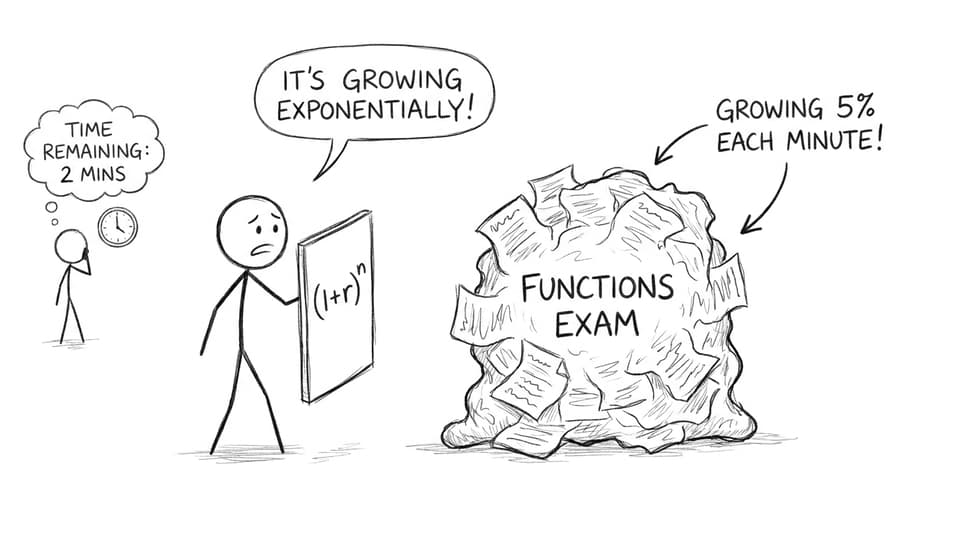
Exponential growth happens when a quantity increases by a constant percentage (or constant factor) each equal time step. The key signal in IB Math is this: the change is multiplicative, not additive.
In other words:
-
Linear growth: add the same amount each step.
-
Exponential growth: multiply by the same factor each step.
If you want a focused syllabus-aligned place to revise this, start with SL 2.9 Exponential and logarithmic functions and the matching SL 2.9 Notes.

A simple exponential growth example (compound interest)
Here is a classic IB Math exponential growth example: money in a savings account with compound interest.
Suppose you deposit $100 and the account grows by 5% per year, compounded yearly.
That means each year you multiply by 1.05.
-
After 1 year:
(100 \times 1.05 = 105) -
After 2 years:
(105 \times 1.05 = 110.25) -
After 3 years:
(110.25 \times 1.05 = 115.7625 \approx 115.76)
The amount grows faster over time because the 5% is taken from a bigger and bigger base.
The formula you should memorize
In IB Math, the standard model is:
Where:
-
(A) is the amount after (n) time periods
-
(P) is the initial value (principal)
-
(r) is the growth rate (as a decimal)
-
(n) is the number of periods
If exponent rules ever slow you down mid-solution, revise them with Laws of Exponents Explained for IB Maths (AA SL and HL).
Quick checklist: how to spot exponential growth fast
Use this mini-checklist when you are modelling in IB Math:
-
Does the question mention a percentage change each interval (e.g., “increases by 5% per year”)?
-
Can you rewrite the change as a constant factor (a = 1+r)?
-
Is the variable in the exponent when you form the equation?
-
Does the graph have a horizontal asymptote for decay cases?
For more intuition about why these graphs behave so differently than polynomials, read Why do exponential functions behave so differently in IB Maths.
Where exponential growth appears in exam-style questions
In IB Math, exponential growth questions typically test one of these skills:
-
Build the model from words (identify (P), (r), (n)).
-
Solve for time (n) (often needs logs once rearranged).
-
Interpret parameters (what does (r) mean in context?).
-
Compare models (linear vs exponential, or two different rates).
To practice in the exact style you will be assessed on, use:
And if you want a broader home base for your course, bookmark IB Math AA Resources.
How RevisionDojo helps you master IB Math exponential growth
The hardest part of exponential growth is rarely the formula. It is staying calm while translating words into math under time pressure. RevisionDojo is built for that.
Use the Questionbank to drill exponential models with instant feedback, then reinforce the patterns with Flashcards. When you are revising, pair the topic notes with AI Chat for quick “why is this step valid?” moments, and use grading tools to check whether your working would earn marks. Predicted Papers and Mock Exams help you rehearse pacing, while Study Notes and the Coursework Library keep your understanding structured. If you need a human nudge, Tutors can help you fix the one misconception that keeps repeating.
For a practical workflow, see How to use the Questionbank for targeted math revision and The ultimate IB Math study routine for busy students.
Conclusion: keep the IB Math story simple
Exponential growth is just “the same percentage, repeated.” In IB Math, once you recognize the percentage language, you can translate it into (A = P(1+r)^n), compute values, and explain what the parameters mean.
If you want to get fast and confident, do a short set of exponential growth questions today in RevisionDojo’s Questionbank, then lock the model in with Flashcards. That small routine is how IB Math stops feeling mysterious and starts feeling predictable.