
The moment your Comparative Study stops feeling "artsy" (and starts scoring)
Most IB Visual Arts students begin the Comparative Study with a mood: a theme, a vibe, a few screenshots saved at 2 a.m. Then the reality hits: the rubric wants clarity. It wants evidence. It wants you to show you can see like an analyst, not just look like a fan.
That shift is the whole game in IB Visual Arts: turning your taste into a structured, visual argument.
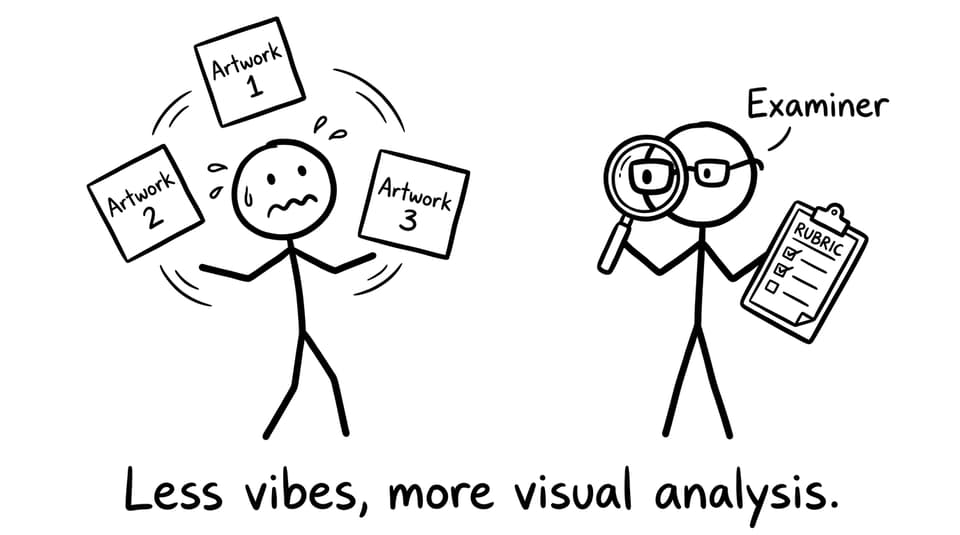
IB Visual Arts Comparative Study: quick checklist
To stay examiner-ready in IB Visual Arts, make sure your Comparative Study includes:
-
At least 3 artworks
-
At least 2 different artists
-
Works from different cultures and/or time periods
-
Formal analysis (what you see and how it’s made)
-
Context (why it was made, for whom, and what shaped it)
-
Comparison (similarities and differences that prove your point)
-
Citations and a bibliography
-
(HL) 3-5 screens connecting the study to your own art-making
For a broader view of the course components, see What is IB Visual Arts? and the IB Visual Arts assessment criteria explained.
How to choose artworks that actually compare well
A strong IB Visual Arts Comparative Study doesn’t pick three works because they’re famous. It picks them because they create productive tension.
Try a shared subject (like self-portraiture) with different intentions. For example, comparing self-portraits by Alice Neel, Frida Kahlo, and Lucian Freud can reveal how identity, psychology, and culture shape representation.
If you want more guidance on selection, use How to prepare for the IB Visual Arts Comparative Study and browse inspiration in Best artists to research for IB Visual Arts.
What to include in your analysis (so it’s not just description)
Formal analysis: make the artwork “mechanical” for a moment
In IB Visual Arts, formal analysis is where you earn trust. Break each work down into choices:
-
Composition and focal points
-
Color, tone, contrast
-
Line, texture, scale
-
Materials and technique
Then connect those choices to meaning: How do these decisions guide interpretation? If you need structure, follow Comparative Study structure explained step by step.
Context: the invisible forces behind the visible choices
Context is not a biography dump. It’s the “why” behind the “what.” In IB Visual Arts, a single contextual detail can turn a weak comparison into a sharp one.
Use How to integrate cultural context into your IB Visual Arts Comparative Study to keep context relevant: politics, patronage, social roles, artistic movements, intended audience.
How to write comparisons that sound like analysis (not a list)
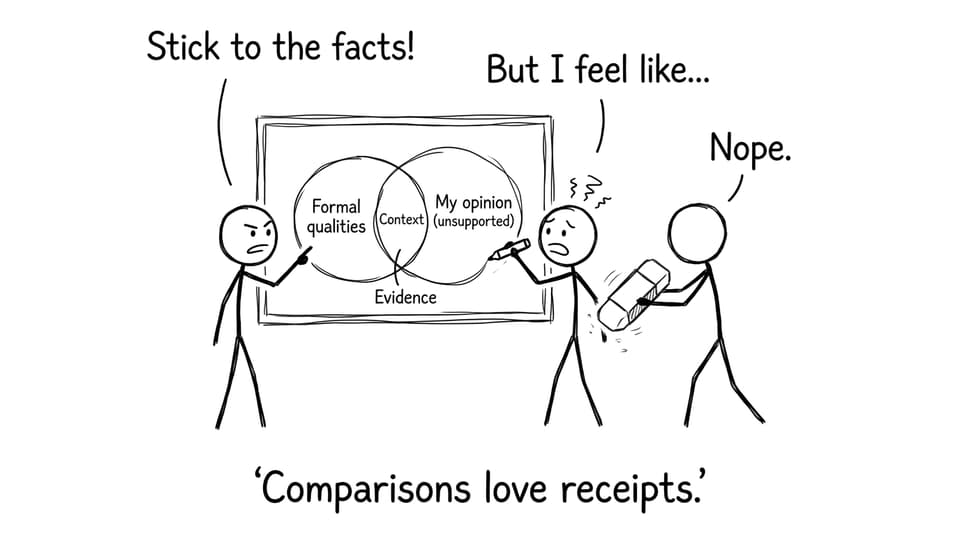
A high-scoring IB Visual Arts comparison doesn’t alternate: “Artwork A has blue. Artwork B has red.” It builds a claim:
-
Similarity (shared theme or visual strategy)
-
Difference (different purpose, audience, or worldview)
-
Reason (context + technique)
-
Impact (what the viewer experiences)
Use Venn diagrams, timelines, or annotated screenshots to make thinking visible. If presentation is a struggle, you’ll like Visual IB study materials.
How RevisionDojo helps you build a stronger IB Visual Arts submission
When you’re deep in IB Visual Arts, the hardest part is staying organized while thinking critically.
RevisionDojo helps by giving you:
-
The Coursework Library for models and benchmarks: IB Visual Arts exemplars
-
Rubric-aligned feedback via the Grading tools: IB Visual Arts Comparative Study (HL) Grader
-
Daily retrieval with Flashcards: IB Flashcards
-
Workflow support across Study Notes, AI Chat, Questionbank, Mock Exams, and Predicted Papers (especially when you’re balancing deadlines)
For common pitfalls to avoid, read Most common mistakes in IB Visual Arts.
Conclusion: make your IB Visual Arts Comparative Study feel inevitable
A great IB Visual Arts Comparative Study feels like a clear argument: your artworks were chosen for a reason, your analysis proves what you claim, and your comparisons reveal something you couldn’t see in a single image.
If you want to move faster with more confidence, use RevisionDojo’s Study Notes, Flashcards, AI Chat, Coursework Library, Grading tools, and targeted practice tools like Mock Exams and Predicted Papers to keep your work sharp, structured, and rubric-aligned in IB Visual Arts.