
Effective nuclear charge is the quiet force behind the loudest patterns in IB Chemistry.
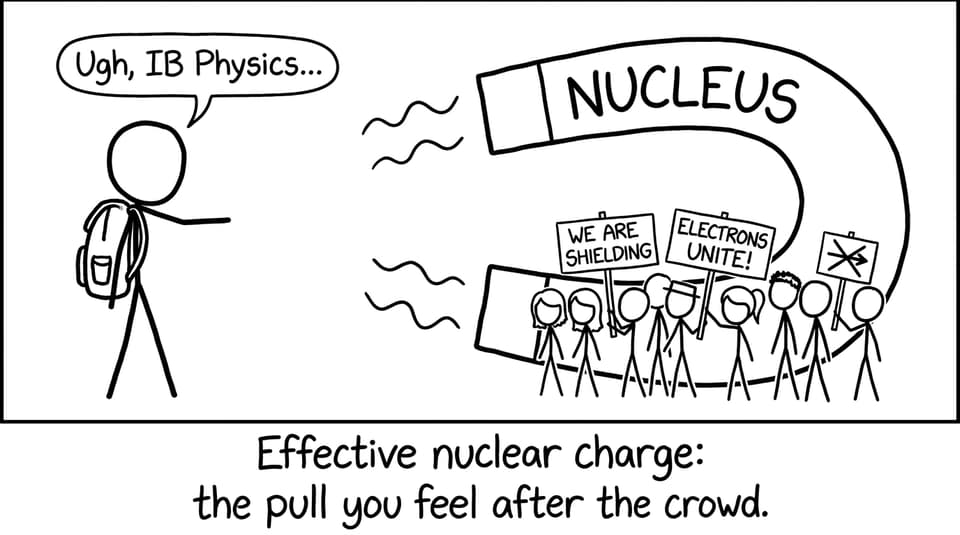
Picture a crowded hallway five minutes before your exam. There’s a teacher at the end calling your name (the nucleus), but a wall of students stands between you (inner electrons). You still hear the teacher, but not at full volume. That reduced, “after-the-crowd” pull is exactly what effective nuclear charge feels like to an electron.
Once you can explain effective nuclear charge clearly, periodic trends stop feeling like facts to memorize and start behaving like consequences you can predict.
Quick checklist (what examiners want)
If you can do these four things, you’re basically fluent in effective nuclear charge for IB Chemistry:
-
Define effective nuclear charge (Zeff) in one sentence.
-
Use Zeff = Z - S at a simple, IB-friendly level.
-
Explain why Zeff increases across a period.
-
Explain why trends down a group are dominated by distance and shielding.
For extra reinforcement, pair this article with RevisionDojo’s Periodicity of properties notes and the IB Chemistry glossary.
What effective nuclear charge means in IB Chemistry
Effective nuclear charge (Zeff) is the net positive charge felt by an electron, after accounting for the repulsion and shielding caused by inner-shell electrons.
In other words:
-
The nucleus has a charge of +Z (Z = number of protons).
-
Inner electrons reduce how much of that charge reaches outer electrons.
-
Valence electrons feel a smaller, “effective” pull: Zeff.
If atomic structure feels shaky, it’s worth revisiting S1.2.1 Atomic Structure notes or S1.2 The nuclear atom before you drill trends.
The IB-level formula (and a clean example)
A simplified, syllabus-friendly relationship is:
Zeff = Z - S
-
Z = nuclear charge (number of protons)
-
S = shielding (roughly: inner electrons)
Example: sodium, Na
-
Z = 11
-
S = 10 (core electrons)
-
Zeff = 11 - 10 = +1
That “+1 feeling” explains why sodium’s outer electron is comparatively easy to remove, which connects straight into ionization energy questions.
To practice the style of explanation IB examiners reward, use RevisionDojo’s S3.1 Questionbank on the periodic table and then ask RevisionDojo’s AI Chat to mark your written trend explanations the way a strict examiner would.
Shielding: why inner electrons change everything
Shielding is mostly electron-electron repulsion.
Inner electrons:
-
repel valence electrons,
-
block part of the nuclear attraction,
-
reduce the pull valence electrons feel.
This is why “more protons” doesn’t automatically mean “much stronger attraction” when you move down a group: you also add whole shells of electrons that shield.
If you want the bigger periodic-trends picture, RevisionDojo’s Trends in atomic radius explained is a great companion read.
Across a period: effective nuclear charge increases
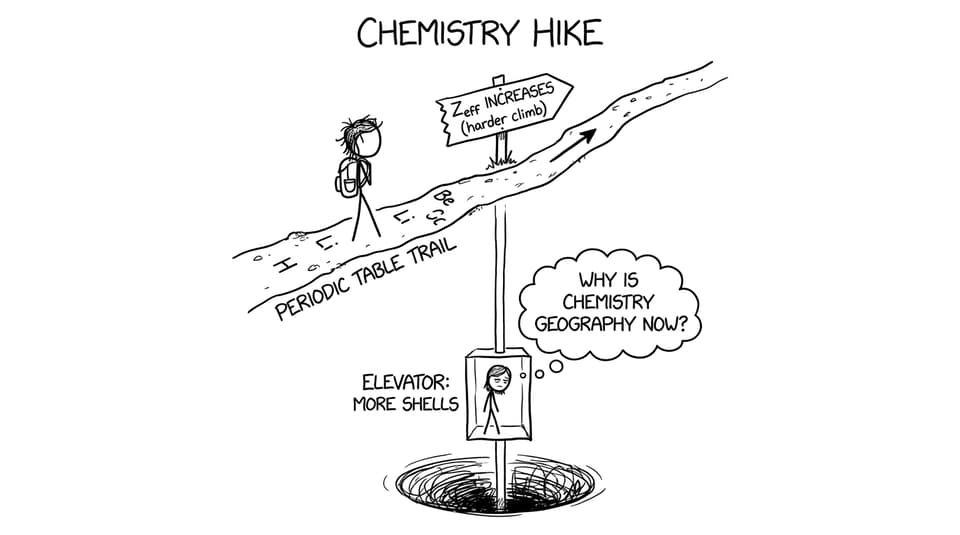
Across a period (left to right):
-
Z increases (more protons each step)
-
electrons are added to the same shell, so
-
shielding changes only slightly
So Zeff increases, and the consequences show up everywhere in IB Chemistry:
-
atomic radius decreases (electrons pulled closer)
-
ionization energy increases (harder to remove an electron)
-
electronegativity increases (bonding electrons are attracted more strongly)
If electronegativity explanations are a common slip for you, keep RevisionDojo’s Electronegativity trend across a period guide open while you practice.
Down a group: shielding and distance overpower Zeff
Down a group:
-
nuclear charge does rise (Z increases), but
-
you also add new shells, which massively increase:
-
shielding
-
distance between nucleus and valence electrons
-
So even if Zeff increases slightly, the outer electron is farther away and better shielded. The net result for trends typically tested in IB Chemistry is:
-
atomic radius increases
-
ionization energy decreases
-
electronegativity decreases
For the “why” behind predictable reactivity shifts, see why reactivity changes across the periodic table.
How Zeff shows up in bonding and reactivity
Zeff isn’t a standalone definition you recite. It’s a lever.
-
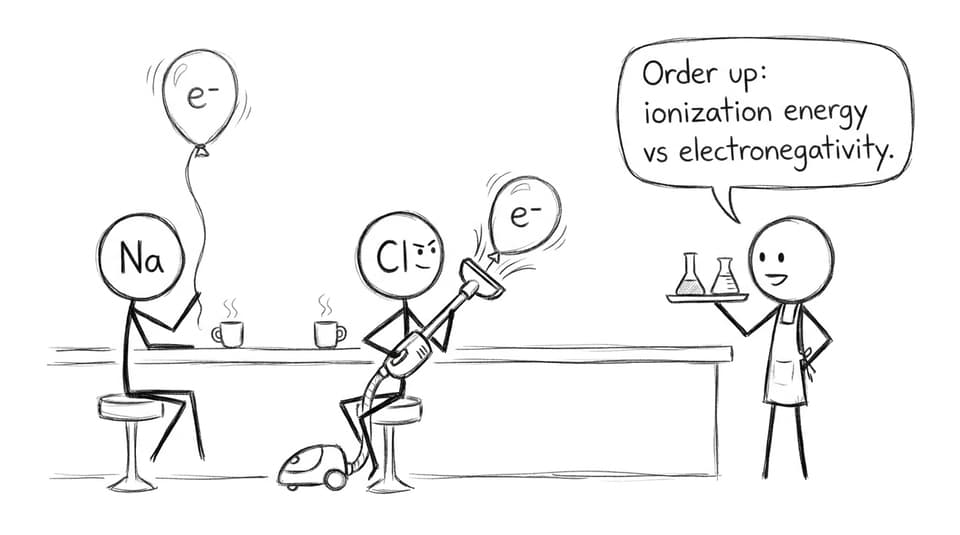
Group 1 metals: low Zeff on the valence electron (plus large radius down the group) makes electron loss easier, so metallic reactivity increases down the group.
-
Group 17 halogens: high Zeff helps attract electrons, but down the group the increased distance and shielding make electron gain harder, so reactivity decreases.
When you’re revising, this is where RevisionDojo shines as an “all-in-one” IB Chemistry setup: read Study Notes, drill with Flashcards, then use Mock Exams and Predicted Papers for timing, and finish with Grading tools to tighten your explanations.
Common mistakes (and how to fix them fast)
Confusing Zeff with nuclear charge
Nuclear charge is just Z (protons). Effective nuclear charge is what’s left after shielding. In IB Chemistry, stating both clearly is often the difference between 1 mark and full marks.
Saying shielding increases across a period
Across a period, electrons enter the same main shell, so shielding is nearly constant. That’s why Zeff rises so reliably left to right.
Using Zeff to explain only atomic radius
Zeff links to radius, ionization energy, electronegativity, and electron affinity logic. It’s a “one cause, many effects” concept, which examiners love.
Conclusion: make Zeff your shortcut concept
Effective nuclear charge is the idea that turns IB Chemistry periodic trends from memorization into prediction. Across a period, Zeff increases because nuclear charge rises while shielding stays nearly constant. Down a group, distance and shielding grow so much that outer electrons are held less tightly, shaping radius, ionization energy, electronegativity, and reactivity.
If you want this to stick under timed conditions, build a tight loop on RevisionDojo: read the Study Notes, drill Flashcards, practise with the Questionbank, then simulate pressure using Mock Exams and Predicted Papers, and finally use Tutors or AI Chat to polish your explanations into mark-scheme language.