
Ecological succession is one of those IB Biology ideas that feels obvious in real life, but slippery in an exam. You can picture a burnt hillside turning green again. You can imagine bare rock slowly becoming a meadow. Yet when the question asks you to explain the stages or compare primary and secondary succession, suddenly everything turns into vague words like “more biodiversity” and “more stable.”
This guide makes ecological succession predictable again, the way exam questions want it.
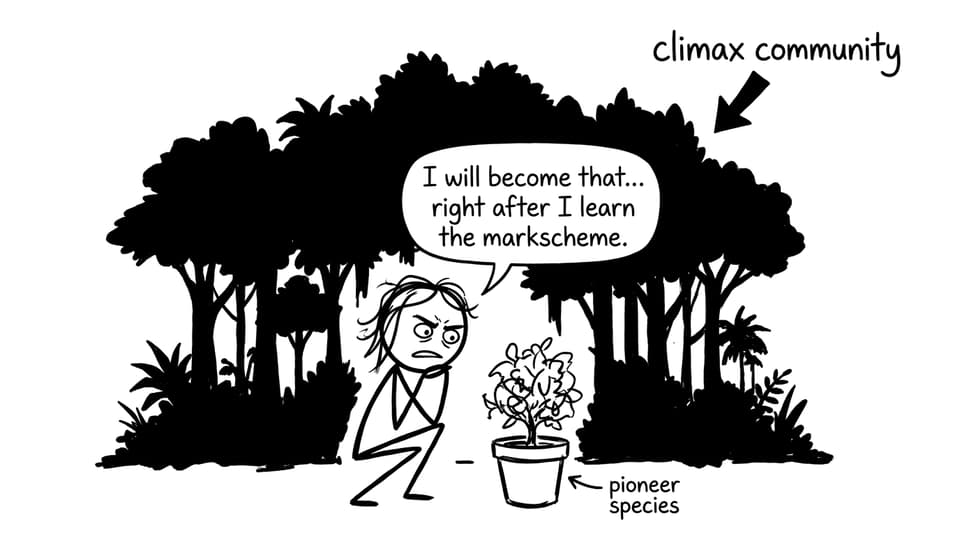
Ecological succession (in one clean definition)
In IB Biology, ecological succession is the gradual, directional change in a community’s species composition over time, usually after a disturbance or on newly exposed surfaces. Think of it as nature’s “rebuild” process: organisms arrive, conditions shift, and new organisms become possible.
If you want the wider foundation first, revise what an ecosystem includes (biotic + abiotic interactions) in What Is an Ecosystem?.
Quick exam checklist (what to mention)
When you see “succession” in IB Biology, aim to include:
-
The type (primary or secondary)
-
The starting conditions (soil present or not)
-
Pioneer species and what they change
-
The trend over time: soil depth, biomass, species diversity, structural complexity increase
-
The idea that disturbances can reset succession
For syllabus-aligned ecology revision, use the IB Biology Ecology hub.
Types of ecological succession in IB Biology
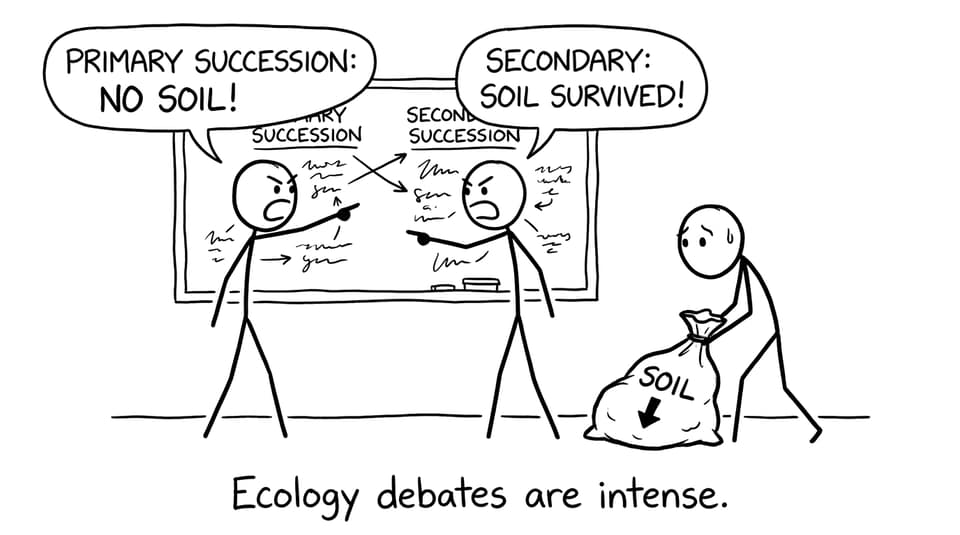
Primary succession (starts with no soil)
Primary succession happens where there’s essentially no soil to begin with: fresh volcanic rock, newly exposed ground after glacial retreat, or a surface scraped down to rock. In IB Biology, the key detail is that pioneer organisms must create soil (slowly) by weathering rock and adding organic matter.
For a deeper HL-aligned explanation, see Changes Occurring During Primary Succession (HL).
Secondary succession (soil remains)
Secondary succession follows a disturbance where soil is already present: after a forest fire, flood, storm damage, or human clearing. Because seeds, nutrients, and microbes remain, recovery is usually much faster than primary succession.
To connect this to how communities are defined and assessed, review Species, Communities and Ecosystems Notes.
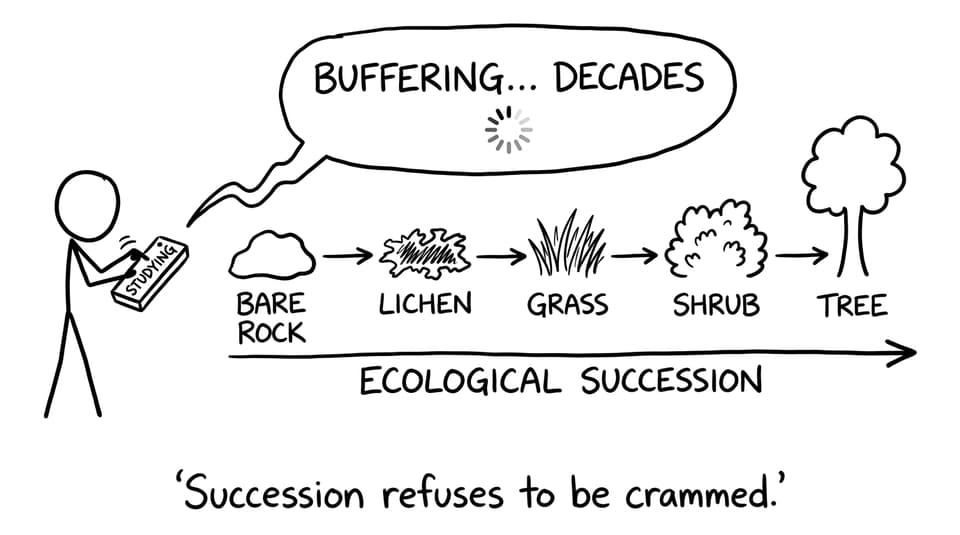
Stages of ecological succession (the storyline examiners love)
Bare surface or disturbed land
At first, conditions are harsh: low nutrients, temperature swings, little shelter, and (in primary succession) no soil. In IB Biology, you can describe this as a low-biomass system with limited niches.
Pioneer stage
Pioneer species are the first colonisers. They’re not “better plants”; they’re simply organisms that tolerate extremes.
-
In primary succession, lichens and mosses are classic pioneers.
-
They help build soil, trap dust, hold moisture, and add organic matter.
Intermediate (seral) stages
As soil depth and nutrients increase, more plant species establish (grasses, shrubs, small trees). More habitats appear, so insects and small animals follow. Food webs become more complex.
This is where the IB Biology language of niches can help: more structure = more available niches. If that part feels shaky, revise Ecological Niches (B4.2).
Climax community (relative stability)
A climax community is a late stage that is relatively stable for that climate and soil type. It does not mean “permanent.” Disturbances can shift the system back to earlier stages.
If you want to tie succession to stability (a common short-answer theme in IB Biology), use Requirements for Stability in Ecosystems.
Concrete examples you can use in exam answers
-
Primary succession: new volcanic rock colonised by lichens/mosses, followed by grasses and shrubs as soil forms.
-
Secondary succession: regrowth after a forest fire where soil remains; seedlings and fast-growing plants return first.
-
Cyclical succession (HL extension): repeated disturbances (like periodic fires) push communities through repeating stages. See Cyclical Succession in Ecosystems (HL).
Wrap-up: turn succession into easy exam marks
Ecological succession is a story of recovery: from bare surface to pioneer species to increasingly complex communities, shaped by whether soil is present. For IB Biology, the goal is not poetic description; it’s a clean, staged explanation with the right keywords and one solid example.
If you want to lock this in, build a quick practice set in RevisionDojo’s Questionbank, review definitions with Flashcards, and use Study Notes plus AI Chat to polish your wording until it sounds like the markscheme. IB Biology rewards clarity, and succession is one topic where clarity is completely learnable.