

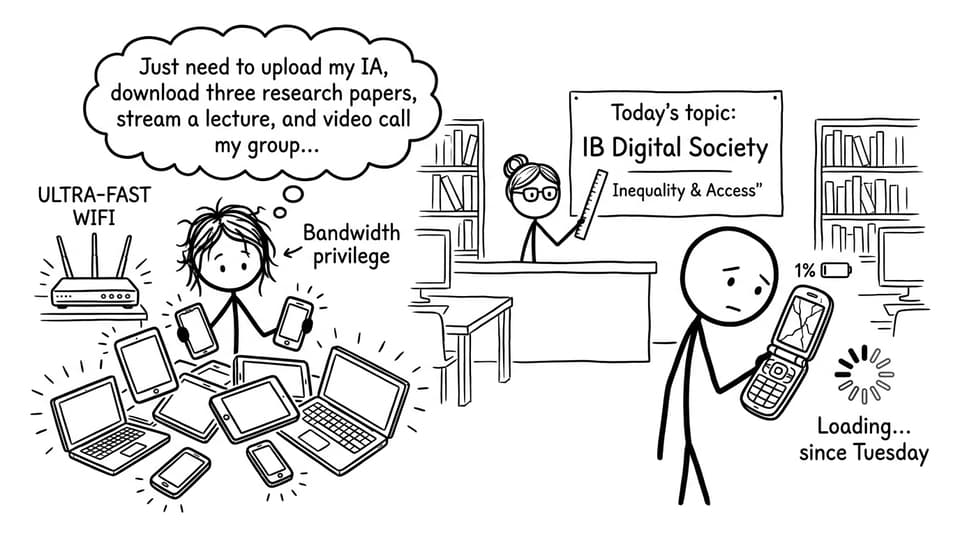
If you have ever watched your class split in two on deadline night, you have already seen digital inequality.
One group uploads coursework in minutes, asks an AI tool for feedback, and double-checks sources in three tabs. Another group is hunting for a charger, borrowing a laptop, or waiting for a connection that drops every few minutes. Both groups are equally capable. But the system around them is not equally supportive.
That gap is exactly why IB Digital Society treats digital inequality and the digital divide as core ideas. In exams, you are not rewarded for saying “some people have less internet.” You are rewarded for showing how digital systems distribute opportunity, who has power, and *why unequal outcomes keep repeating.
A quick checklist for IB Digital Society analysis
Use this mini-checklist whenever you see a prompt about access, education tech, platforms, or public services in IB Digital Society:
-
Identify the type of digital divide (access, quality, skills, meaningful use).
-
Name at least two causes (income, geography, policy, infrastructure, language, disability access).
-
Separate individual impacts from community impacts.
-
Bring in power: who controls networks, prices, data, and rules.
-
Add ethics: fairness, rights, responsibility, and trade-offs.
When you revise, it helps to connect your notes to exam-style practice. RevisionDojo’s IB Digital Society hub makes that loop easy with Study Notes, Flashcards, and a Questionbank you can filter by topic.
What the digital divide means in IB Digital Society
In IB Digital Society, the digital divide is the gap between people or groups who can effectively use digital technologies and those who cannot.
Notice the word effectively. The divide is not only about whether someone has internet at all. It includes:
-
Access: having a device and a connection.
-
Quality: speed, stability, data limits, electricity reliability.
-
Affordability: monthly cost, repair cost, replacement cycles.
-
Skills: digital literacy, confidence, language fluency.
-
Meaningful use: whether the tech actually improves education, work, health, or civic participation.
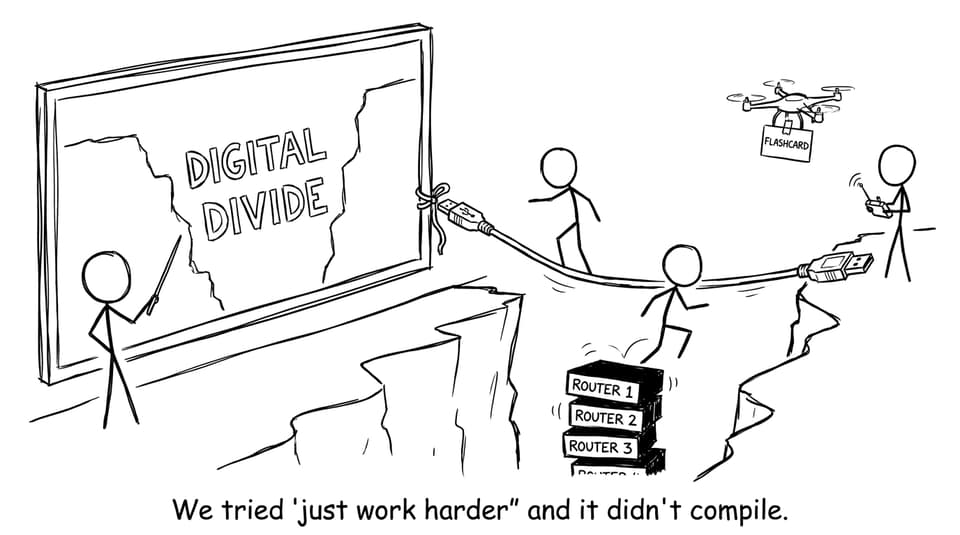
A strong IB Digital Society response frames the divide as structural. It is produced by systems (markets, policies, geography, school funding), not by individual “motivation.”
Digital inequality: the bigger story than access
Digital inequality is the broader pattern of uneven benefits and harms from digital systems. Two people can both be “online,” yet experience completely different digital lives.
Consider online learning. One student has a quiet room, a laptop, and stable Wi-Fi; another shares a phone with siblings and studies on limited data. The platform is the same, but the learning outcome is not.
This is why digital inequality often shows up alongside other IB Digital Society ideas like identity, culture, and change. If you want a clean way to connect concepts in essays, use IB Digital Society: How All the Core Concepts Fit Together.
Causes of digital inequality (and how to explain them)
Examiners like answers that show interaction. Digital inequality rarely has one cause.
Economics and device ecosystems
Income affects the basics (devices, data plans), but also the hidden costs: repairs, upgrades, paid software, and transport to places with connectivity. In IB Digital Society, you can describe this as a feedback loop: limited access reduces opportunities, which keeps income low, which keeps access limited.
Infrastructure and geography
Rural regions may have fewer towers, slower speeds, and higher costs per user. Island states may rely on expensive international cables. Even within cities, connectivity can mirror housing inequality.
Education and skills
Digital literacy is not automatic. Knowing how to search, verify sources, manage privacy settings, and use productivity tools changes what “access” actually produces.
If you are revising digital education, pair this topic with Digital Education and Online Learning in IB Digital Society.
Regulation and market power
Policies shape competition, pricing, censorship, and investment incentives. A monopoly provider can set costs that quietly exclude lower-income households.
Impacts on individuals vs communities
A common exam mistake is to list impacts without specifying the level.
Individual impacts
Digital inequality can mean:
-
fewer learning resources and slower feedback loops
-
reduced employability when applications, portfolios, or training are digital-first
-
exclusion from digital public services (appointments, welfare, banking)
-
weaker agency when people cannot control their data, settings, or visibility
Community impacts
At community level, digital inequality can:
-
concentrate economic growth in connected regions
-
reduce civic participation if public debate moves online
-
widen educational gaps between schools
-
increase dependency on outside platforms and providers
For HL connections, the Topic 5 lens is useful: Challenges and Interventions - Digital Society (HL) notes.
Power: who benefits from the network?
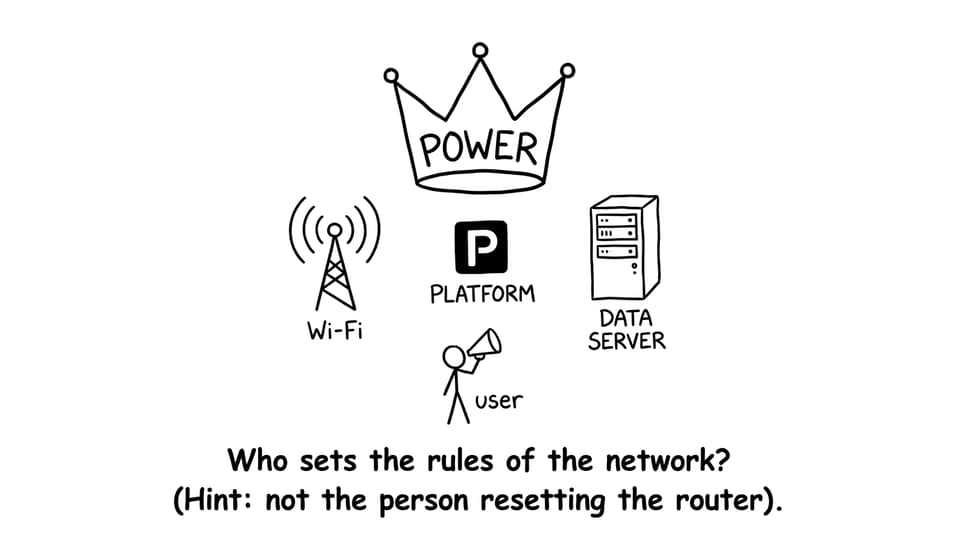
In IB Digital Society, power is a practical question: who sets the terms of participation?
-
Infrastructure owners decide coverage and pricing.
-
Platforms decide moderation, visibility, and algorithmic reach.
-
Institutions decide which services become “digital by default.”
A high-quality response explains that digital inequality is not only absence of tech but also lack of influence over how tech is built and governed.
How to write stronger exam answers in IB Digital Society
When an unseen source shows unequal access, do three things quickly:
-
Define the specific digital divide in that case (quality? skills? affordability?).
-
Use a concept lens (power and ethics are usually strongest).
-
Evaluate: what interventions help, and what trade-offs appear?
To train this, build short timed sets. RevisionDojo’s Questionbank is ideal for drilling exam-style prompts, and Topic 3 - Content - Digital Society helps you map examples to the syllabus.
Also, case studies matter. A flexible way to store them is outlined in Using Case Studies for Better Learning in Digital Society.
Closing: turning the digital divide into marks
Digital inequality is not a side topic in IB Digital Society. It is the moment the course becomes real: the point where technology stops being “cool” and starts being consequential.
If you can explain the digital divide as a system of access, skills, and power--and evaluate ethical responsibility--you will write answers that feel mature and exam-ready. Build that skill with a steady loop: RevisionDojo Study Notes for clarity, Flashcards for recall, a Questionbank for application, AI Chat when you get stuck, Grading tools for feedback, and Mock Exams plus Predicted Papers for timed confidence. That is how IB Digital Society revision turns into consistent marks on exam day.