



A coffee price rises. The fact is simple; the explanation is not. A poor harvest may have reduced supply in the coffee market, or prices may be rising across the national economy. The first problem is microeconomic, while the second is macroeconomic.
That is the central answer: microeconomics studies consumers, producers, and individual markets, whereas macroeconomics studies economy-wide performance, including growth, inflation, unemployment, inequality, and stabilization policy. For IB students, recognizing this difference determines the variables, terminology, policy analysis, and diagram an answer needs.
The official IB Economics course makes the same distinction. Microeconomics examines choices by producers and consumers in individual markets; macroeconomics examines choices involving governments and national economies. They are different lenses, not disconnected subjects.
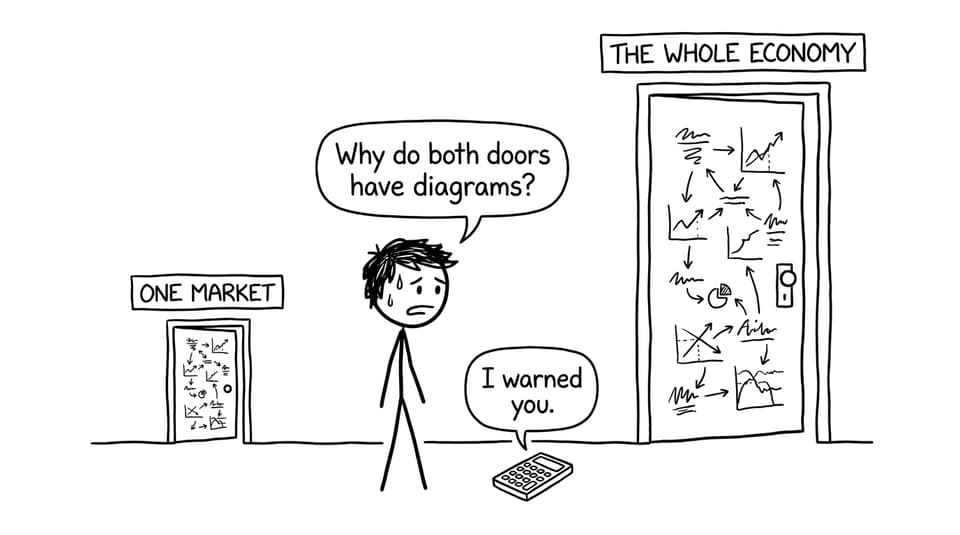
What is microeconomics in IB Economics?
Microeconomics examines how individual economic agents make choices and how those choices interact in defined markets. It explores the allocation of scarce resources through prices, incentives, elasticity, market structures, and government intervention.
The word micro does not mean physically small. The global market for coffee is still a particular product market, so an investigation of its equilibrium price and quantity is microeconomic. By contrast, the unemployment rate of a small country is macroeconomic because it describes an aggregate national outcome.
Typical microeconomic questions ask:
-
Why does a fall in supply increase a product's equilibrium price?
-
How responsive is demand to a price change?
-
Who carries more of an indirect tax burden?
-
Can a subsidy encourage consumption with external benefits?
-
How might market power affect price, output, and welfare?
-
Should a government impose a maximum price?
The IB unit moves from demand, supply, and competitive equilibrium into elasticity, government intervention, market failure, and equity, with additional depth in specified HL areas. The IB Economics resource hub lets students move between syllabus-organized explanations and practice, while microeconomics flashcards strengthen precise definition recall.
The microeconomic diagram test
A conventional market diagram represents one good or service. The vertical axis shows the product's price, and the horizontal axis shows its quantity. Demand or supply can shift because of non-price determinants such as income, preferences, input costs, technology, taxation, or subsidies.
Suppose a government introduces an indirect tax on cigarettes. A complete answer could explain the supply shift, the difference between the price consumers pay and producers receive, the contraction in quantity traded, tax revenue, and welfare consequences. Evaluation might then consider demand elasticity, addiction, enforcement, unintended markets, time, and effects on different stakeholders.
What is macroeconomics in IB Economics?
Macroeconomics studies the economy in aggregate. Rather than following one firm's output or one product's price, it examines measures such as real GDP, economic growth, the average price level, unemployment, and income distribution.
Macroeconomic questions include:
-
Why has real economic growth slowed?
-
What causes demand-pull or cost-push inflation?
-
Why does cyclical unemployment rise in a downturn?
-
How might an interest-rate change influence aggregate demand?
-
Can fiscal policy help reduce a recessionary gap?
-
Which supply-side policies could expand productive capacity?
The IB macroeconomics unit covers the measurement and variation of economic activity, aggregate demand and aggregate supply, macroeconomic objectives, inequality and poverty, monetary policy, fiscal policy, and supply-side policy. RevisionDojo's macroeconomics Study Notes provide a structured route through these connected areas.
Why AD-AS is not a larger market diagram
Although the diagrams look related, their variables have different meanings. A market diagram uses the price and quantity of one product. An aggregate demand and aggregate supply diagram uses the economy's average price level and real output.
Aggregate demand represents planned economy-wide expenditure, commonly expressed as AD = C + I + G + (X - M). If a central bank raises interest rates, borrowing may become more expensive, weakening consumption and investment. Aggregate demand may shift left, reducing inflationary pressure but potentially slowing real output growth and increasing cyclical unemployment.
That final trade-off matters. Macroeconomic analysis rarely ends after identifying a curve shift; it considers competing objectives and the economic conditions shaping the result.
The difference between micro and macro economics in exams
One price versus the average price level
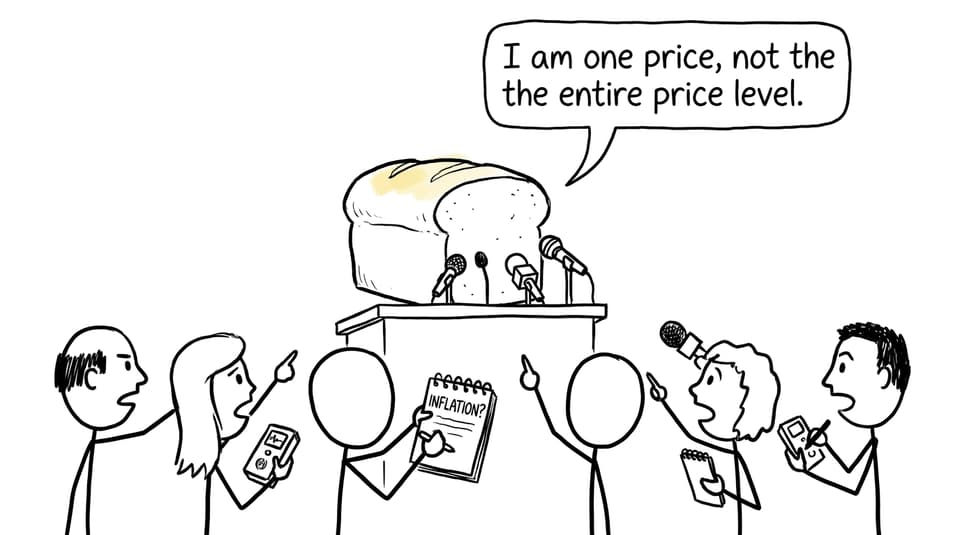
A higher bread price is not automatically inflation. It may result from higher wheat costs or reduced supply within the bread market. Inflation refers to a broad increase in the prices of goods and services across an economy, typically measured using a price index, rather than a change in one relative price.
This distinction determines the diagram. Product price belongs on a market diagram; the average price level belongs on an AD-AS diagram.
Market quantity versus real output
Microeconomics studies how much of a defined product is produced and exchanged. Macroeconomics considers total national output, commonly measured through real GDP when changes in production over time are being examined.
A decline in car production can remain an industry-specific problem. Falling production across many sectors, accompanied by lower real GDP and greater cyclical unemployment, suggests an economy-wide contraction.
Targeted intervention versus stabilization policy
Government involvement does not automatically make a question macroeconomic. A tax on plastic bags, a subsidy for vaccinations, or a maximum rent targets a particular market. The analysis remains microeconomic when it focuses on product price, quantity, externalities, efficiency, or stakeholder welfare.
Fiscal and monetary policies commonly aim to influence aggregate demand, inflation, output, and employment. Supply-side policies can connect both fields: education may improve an individual's productivity while expanding an economy's productive potential over time.
Efficiency versus national objectives
Microeconomic analysis frequently considers allocative efficiency, market failure, equity, and sustainability within a market. Macroeconomic analysis tends to emphasize growth, price stability, low unemployment, equitable distribution, and broader stability.
These objectives can conflict. A contractionary policy might reduce inflation but weaken growth in the short run, so evaluation should explain the conditions and trade-offs rather than declaring a policy simply effective or ineffective.
How the two perspectives connect
The boundary between micro and macroeconomics is real, but it is permeable. Decisions made by households and firms accumulate into aggregate outcomes. In the other direction, inflation, interest rates, and economic downturns reshape individual choices.
Consider an increase in oil prices:
-
Reduced oil supply may raise equilibrium price in that market.
-
Higher transport and production costs may spread across industries.
-
Short-run aggregate supply may fall, raising the average price level while reducing real output.
-
Policymakers may face a trade-off between limiting inflation and supporting economic activity.
This connection improves evaluation. An interest-rate increase may reduce aggregate demand overall, but indebted households, savers, exporters, and interest-sensitive firms can experience different effects. The question remains macroeconomic, while microeconomic consequences explain why its impact is uneven.
How to classify an IB exam question
Students sometimes draw the most familiar diagram before deciding what the question measures. Reverse that order.
-
Identify the object: Is the question about a consumer, firm, product, market, or national economy?
-
Underline the variables: Product price and quantity usually indicate micro; average price level and real output indicate macro.
-
Find the policy target: Does the intervention address one market or aggregate performance?
-
Select the model: Choose demand and supply, an externality model, AD-AS, or another framework only after identifying the variables.
-
Build the causal chain: Explain each link between the initial change and the final outcome.
-
Evaluate conditionally: Consider elasticity, time, stakeholder effects, economic conditions, assumptions, and policy conflicts.
The IB Economics Questionbank is useful for applying this sequence to targeted questions. Pair it with the topic-by-topic revision guide and Economics cheatsheets to move from recall into analysis without confusing familiarity with mastery.
A practical revision method
Take two blank pages and label them micro and macro. From memory, add the agents, variables, objectives, policies, and diagrams associated with each field. Next, classify several economic headlines and justify every decision in one sentence.
Then redraw the appropriate model and write its causal chain. Record precise errors such as “used product price instead of average price level” or “treated a targeted tax as fiscal stabilization.” A specific error creates a repairable task; a vague judgment does not.
After targeted work, use IB Economics Predicted Papers and Mock Exams for timed rehearsal. Treat them as simulations of syllabus skills, not promises about exact questions. If coursework is also demanding attention, the Economics Coursework Library can help you examine how economic concepts, evidence, and structured analysis work together.
Choose the lens before the model
The essential distinction in microeconomics vs macroeconomics is scale. Microeconomics studies individual decision-makers and markets; macroeconomics studies aggregate performance and economy-wide policy. In an exam, identify the object and variables first, select the model second, and develop the causal chain third.
RevisionDojo brings those steps together as the ultimate IB resource. Study Notes establish understanding, Flashcards build recall, the Questionbank develops application, and AI Chat can help locate a broken step in an explanation. Grading tools, Predicted Papers, Mock Exams, the Coursework Library, and Tutors provide deeper feedback as independent practice becomes more demanding. The goal is not merely to remember two definitions, but to see every economic question at the right scale.