
If you have ever walked outside on a scorching day and instantly started negotiating with the sun, you already understand the core problem deserts present. In IB Biology, deserts are a perfect case study because they turn survival into a simple equation: water is limited, heat is relentless, and every trait has to earn its place.
Desert adaptations are not “cool facts.” They are evidence: visible, measurable evidence of of natural selection shaping structure, behavior, and physiology over generations. If you can explain them clearly, you can usually handle the bigger IB Biology themes that sit behind them: selection pressures, homeostasis, and the link between environment and fitness.
Quick checklist for IB Biology revision
-
Define adaptation as an inherited feature that increases survival and reproduction
-
Sort examples into structural, physiological, and behavioral adaptations
-
Tie each trait to a specific selection pressure (water loss, heat gain, intense light)
-
Practice how these show up in data-based questions (graphs, comparisons, “suggest” prompts)
-
Use RevisionDojo to drill the topic with the B4.1 Adaptation to environment hub and the B4.1 questionbank
What adaptation means in IB Biology
In IB Biology, an adaptation is an inherited characteristic that improves an organism’s chances of survival and reproduction in a particular environment. Over time, individuals with helpful traits leave more offspring, so those alleles become more common in the population.
If you want the wider exam framing, connect desert examples back to natural selection language (variation, selection pressure, differential reproductive success). RevisionDojo’s explainer on what natural selection is in IB Biology is a useful anchor for that wording.
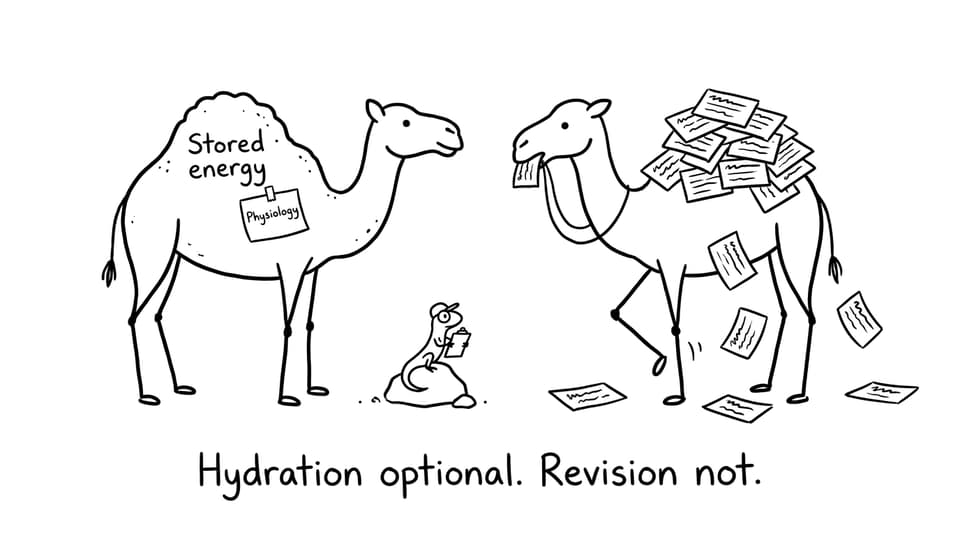
Animal desert adaptations (camel example)
Camels are a classic IB Biology example because they combine all three adaptation categories in one organism:
Structural adaptations
-
Long eyelashes and closable nostrils reduce sand damage during wind storms.
-
Coat distribution helps manage heat exchange: thicker insulation where sunlight hits most, thinner elsewhere.
Physiological adaptations
-
Camels can tolerate body temperature fluctuations of about 6°C, reducing the need for sweating (and conserving water).
-
They can survive losing up to around 25% of body water without fatal effects.
-
Their oval red blood cells help maintain flow and reduce damage during dehydration and rehydration.
Behavioral adaptations
- Resting during the hottest parts of the day lowers metabolic heat production and water demand.
For extra practice phrasing these under exam command terms, run a few targeted questions and review mistakes with RevisionDojo’s AI Chat and Grading tools inside the B4.1 questionbank.
Plant desert adaptations (cactus and CAM photosynthesis)
Cacti make a strong IB Biology plant example because their design is basically a water-saving system.
Structural adaptations
-
Spines replace leaves, reducing surface area and lowering transpiration, while also deterring herbivores.
-
A thick waxy cuticle limits evaporation.
Physiological adaptations
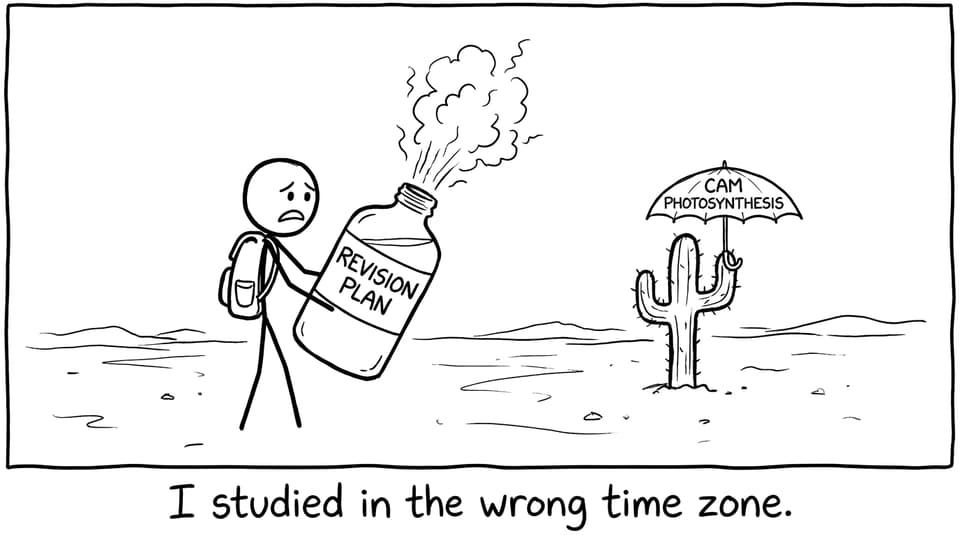
- CAM photosynthesis: stomata open mainly at night to take in CO₂ when temperatures are cooler and humidity is higher, reducing water loss.
Behavioral/ecological angle
- Many desert plants cluster or grow in microhabitats that reduce direct sun exposure and lower water stress.
To deepen this with syllabus-aligned phrasing, use RevisionDojo’s notes on B4.1.8 Adaptations to life in hot deserts and the broader B4.1 notes.

Why desert adaptations are a high-value IB Biology topic
Deserts force you to explain “why this trait matters” with no distractions. Water scarcity becomes the limiting factor; heat becomes the constant selection pressure. That clarity makes deserts ideal for linking ecology to evolution.
If you want to strengthen those links, pair desert adaptations with the bigger ecology ideas in What is an ecosystem? and then revise definition-heavy content using the IB Biology cheatsheets and B4.1 flashcards.
Conclusion: turn desert facts into IB Biology marks
Desert adaptations are memorable, but the real win in IB Biology is using them to explain selection pressures and survival logic with clean, exam-ready wording. If you want to lock it in quickly, revise the B4.1 Adaptation to environment content, test yourself on the questionbank, and reinforce key definitions with flashcards. Then use RevisionDojo’s Study Notes, AI Chat, Predicted Papers, Mock Exams, and Tutors to turn understanding into consistent exam performance.