


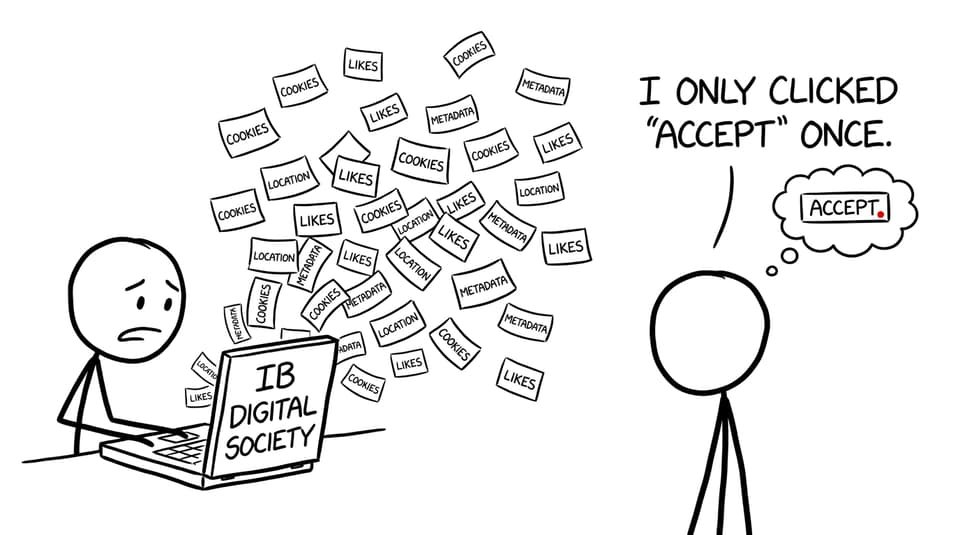
In the middle of revision, it’s easy to think your biggest problem is time. Then you open an app, tap “Accept,” and realise something else is racing ahead of you: your data.
That tiny click is the quiet opening scene of IB Digital Society: data collection happens fast, often invisibly, and it shapes who gets seen, sorted, targeted, and trusted. If you can explain that calmly in an exam, you’re already writing like a top scorer.
IB Digital Society quick checklist: what to spot
Use this mini-checklist whenever you analyse a scenario in IB Digital Society (especially for exam-style questions):
-
What data is collected? (personal data, behavioural data, inferred data)
-
How is it collected? (active input vs passive tracking)
-
Who collects and who benefits? (platform, school, employer, government, third party)
-
What kind of surveillance is involved? (commercial, institutional, governmental)
-
What are the impacts? (individual + community)
-
What are the ethics? (consent, proportionality, transparency, accountability)
For extra practice applying this structure, you can pair it with the IB Digital Society Topic 2 Questionbank and train yourself to write answers that move beyond “privacy is bad.”
Data collection in IB Digital Society: more than what you type
In IB Digital Society, data collection is the systematic gathering of information about people, devices, and environments through digital systems. Some of it is obvious: your name, email, or school login. The more powerful layer is what gets collected without you noticing.
Think in three layers:
-
Provided data: what you knowingly submit (profiles, forms, messages)
-
Observed data: what systems record as you act (clicks, watch time, location, device IDs)
-
Inferred data: what algorithms conclude about you (interests, risk level, predicted choices)
If you want syllabus-aligned terminology for this, RevisionDojo’s 3.1 Data hub and the 3.1 Data lessons are useful for tightening definitions and examples.
Surveillance in IB Digital Society: the “so what” of data
Data collection is the fuel. Surveillance is what the system does once it has fuel: monitoring, analysing, and using data to observe, predict, or influence behaviour.
A strong IB Digital Society answer shows that surveillance is often:
-
Automated (dashboards, risk scores, recommendation engines)
-
Continuous (always-on tracking rather than one-time checks)
-
Embedded (built into normal tools, not added as a “spy” feature)
To go deeper, RevisionDojo’s explainer on understanding surveillance in IB Digital Society is a good model of what “analysis” looks like rather than just description.
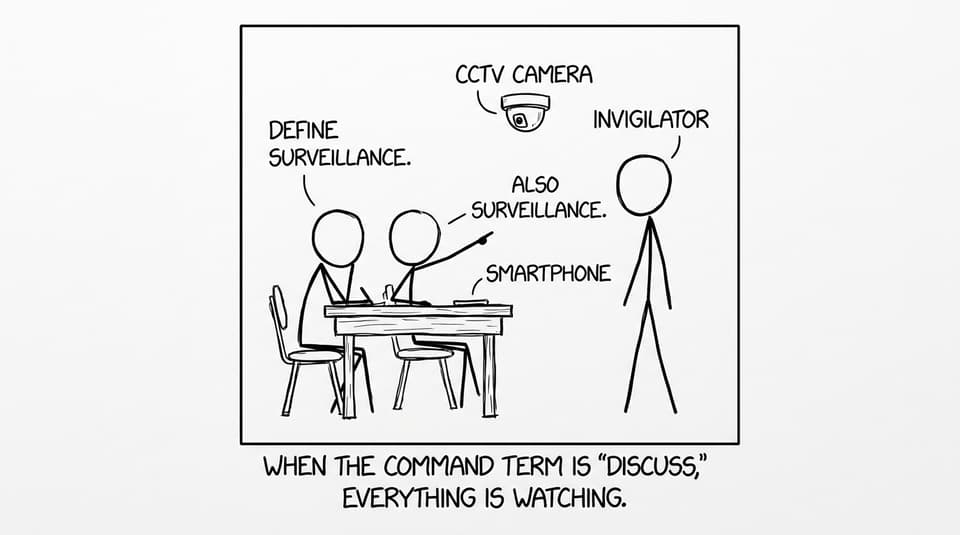
Why data collection and surveillance matter: power changes shape
The reason this topic sits at the centre of IB Digital Society is simple: data changes the balance of power.
When an organisation can track behaviour at scale, it gains three advantages:
-
Visibility: it sees patterns individuals can’t see
-
Decision power: it can sort, rank, approve, flag, or exclude
-
Behaviour influence: it can nudge choices through design (feeds, notifications, friction)
This is why “privacy” in IB Digital Society is not just a personal preference. It’s a social condition shaped by system design and governance. If you want to sharpen this angle, read understanding privacy in IB Digital Society.
Impacts on individuals: convenience with a cost
At the individual level, data collection can feel helpful. Your maps app predicts traffic. Your streaming app knows what you like. Your school platform remembers your progress.
But IB Digital Society expects you to weigh benefits against risks. Common risks include:
-
Loss of control (you can’t realistically track where your data goes)
-
Profiling (systems categorise you into boxes that may be wrong)
-
Chilling effects (people self-censor when they suspect monitoring)
-
Stress and uncertainty (not knowing what is recorded, retained, or shared)
A practical exam tip: don’t stop at “this invades privacy.” Add the mechanism: what data, collected how, used to do what.
Impacts on communities: uneven surveillance is still surveillance
In IB Digital Society, community-level analysis is often what separates average answers from high-scoring ones.
Surveillance does not land evenly. Some communities are monitored more intensely (or face harsher consequences) due to:
-
institutional priorities (schools, workplaces, law enforcement)
-
historical bias embedded in data and models
-
unequal ability to opt out or challenge decisions
A clear example context is monitoring inside institutions. RevisionDojo’s article on digital surveillance in schools and workplaces helps you frame stakeholders and power relationships quickly.
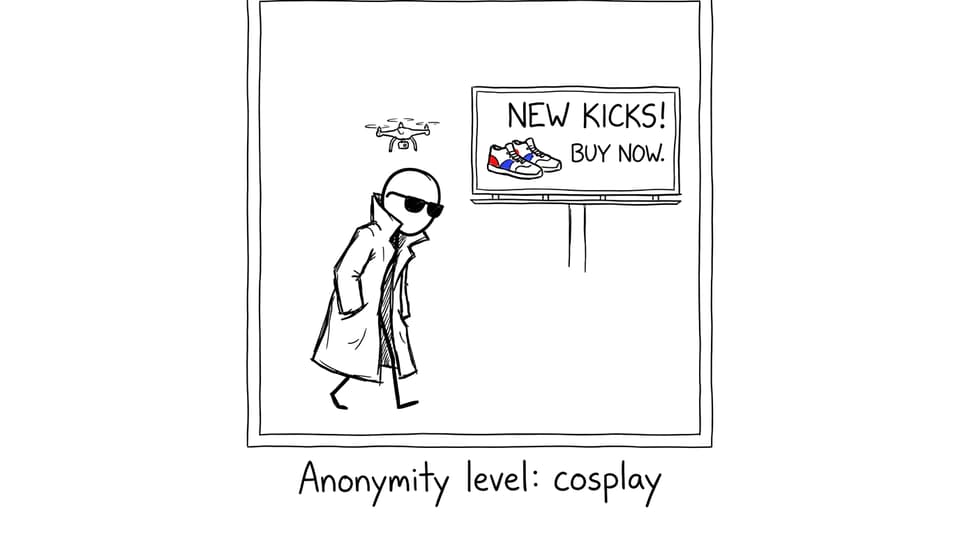
Ethics in IB Digital Society: the questions examiners reward
Ethics in IB Digital Society is not a rant. It’s a reasoned judgement.
Try these four examiner-friendly questions:
-
Consent: Is it informed, specific, and meaningful?
-
Transparency: Can users understand what happens to their data?
-
Proportionality: Is the surveillance justified by the goal, or excessive?
-
Accountability: Who is responsible when harm occurs, and can decisions be challenged?
To connect ethics to the broader course, you can also skim how all the core concepts fit together and see how privacy, power, systems, and inequality reinforce each other.
Exam technique: turning a scenario into a top-scoring paragraph
A reliable IB Digital Society paragraph structure looks like this:
-
Identify the digital system and the data practices (specific, not vague).
-
Explain the surveillance mechanism (monitoring, profiling, nudging, scoring).
-
Analyse impacts on individuals and communities (short-term + long-term).
-
Evaluate ethically using consent, proportionality, transparency, accountability.
Then practise under time pressure using RevisionDojo’s Questionbank feature and the IB Digital Society resources hub (Notes, Flashcards, AI Chat, Grading tools, Predicted Papers, Mock Exams, Coursework Library, and Tutors all help you iterate faster).
Closing: make the invisible visible
The best IB Digital Society students don’t panic about surveillance. They slow down and describe what the system is doing: what it collects, how it processes, who it empowers, and who carries the risk.
If you want to build that skill quickly, use RevisionDojo to rotate through Study Notes, Flashcards, AI Chat, and examiner-style practice in the Questionbank, then check your progress with Grading tools, Predicted Papers, and Mock Exams. Data collection and surveillance stop feeling abstract when you can explain them clearly -- and clarity is the most underrated advantage in IB Digital Society.
