


Tragedy and comedy look like opposites until you sit in an exam and realise they both do the same thing: they corner human behaviour and make it confess.
That is why IB English students who learn to compare tragedy and comedy in the prescribed list often write sharper essays. Not because they memorise definitions, but because they notice craft: how a playwright builds pressure, releases it, and guides an audience toward judgement. In Paper 2-style comparisons, that awareness becomes your advantage.
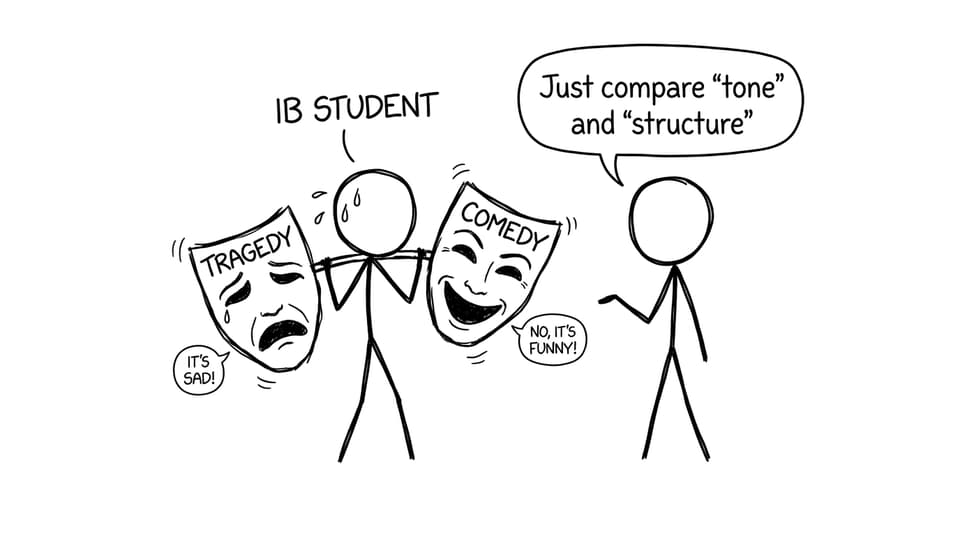
A quick IB English comparison checklist
Use this as a 2-minute pre-plan before you draft any comparative paragraph in IB English:
-
Name the genre signals: tragic downfall vs comic restoration.
-
Track tone shifts (seriousness, irony, satire, absurdity).
-
Compare how conflict escalates (fate, error, social friction, misunderstanding).
-
Analyse character design (tragic complexity vs comic types, and where they overlap).
-
Link choices to audience effect (catharsis, discomfort, laughter, recognition).
-
End with purpose: what human truth is revealed, and why this form suits it.
If you want a ready structure for that planning, bookmark How to Structure a Comparative Essay in IB Literature and pair it with Structuring Your IB English Paper 2 Essay.
Tragic conventions that matter in IB English essays
In IB English, tragedy is less about “sad ending” and more about inevitability. The play persuades us that consequences are not random; they are engineered by character, society, and pressure.
Look for these high-yield tragic conventions:
Downfall and the logic of consequence
A tragic protagonist is usually written with enough agency that their choices matter, but enough limitation that those choices trap them. That tension gives you an analytical lane: not “what happens,” but why it could not have happened differently.
Dramatic irony and foreshadowing
Tragedy often feeds the audience knowledge the character lacks. In IB English comparison, this is gold because it lets you discuss audience positioning: we watch harm approach, and the waiting becomes the point.
Catharsis and moral pressure
Whether the ending is death, exile, rupture, or irreversible insight, tragedy aims to leave the audience altered. You can compare what each text wants the audience to feel responsible for.
For drama-focused revision across forms, Unpacking the IB Syllabus: Prose, Poetry, Drama Essentials helps you keep form at the centre of your argument.
Comic conventions that matter in IB English essays
Comedy in IB English is rarely “just funny.” It is a way of telling the truth while keeping the audience’s guard down.
Misunderstanding as structure
Comic plots often run on mistaken identity, misread intention, or social confusion. That isn’t filler. It is a system that exposes fragile norms: class, gender roles, reputation, power.
Wit, timing, and escalation
Comedy builds momentum through language and pacing. Compare how one playwright uses quick exchanges, interruptions, and reversals while another uses longer set pieces or farce-like repetition.
Restoration (or the performance of restoration)
Classic comedy tends to end with harmony. Modern comedy may end with a question mark: order returns, but it feels suspicious. In IB English, that’s a strong comparative claim: comedy can resolve the plot while refusing to resolve the problem.
The best comparison angles: tone, character, structure
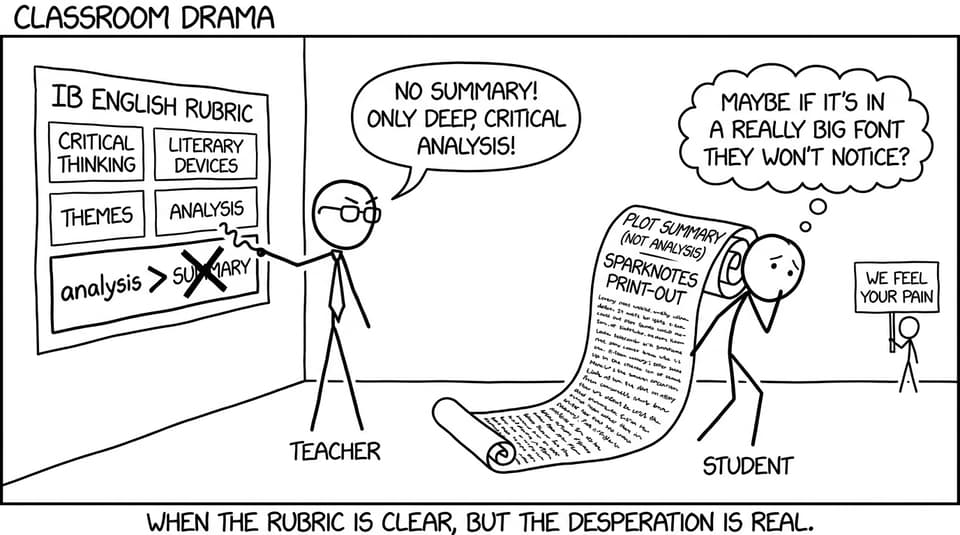
Most students compare tragedy and comedy by listing features. High-scoring IB English essays compare effects.
Tone: how the play teaches the audience to feel
Tragedy often sustains seriousness and dread; comedy leans into lightness, irony, or satire. But the most exam-friendly insight is this: both genres manipulate emotion to create judgement.
A useful sentence frame:
- Both playwrights direct audience judgement through tone; however, tragedy uses sustained gravity to make consequences feel inevitable, while comedy uses irony to expose how avoidable those consequences were.
Character: complexity vs types (and why the line blurs)
Tragic characters usually carry interior conflict and moral weight. Comic characters can be exaggerated types (the fool, the miser, the romantic optimist), but that exaggeration is often a method of critique.
In IB English comparisons, ask:
-
Who is allowed self-awareness?
-
Who is trapped by social performance?
-
Whose flaw destroys them, and whose flaw merely reveals the world’s hypocrisy?
Structure: collapse vs release
Tragedy tends to narrow toward collapse. Comedy tends to widen into chaos and then “snap” into resolution. Compare how each structure shapes meaning:
-
Tragedy: pressure accumulates, exits close off, consequences land.
-
Comedy: complications multiply, truth is delayed, and recognition repairs (or pretends to repair) the social order.
For exam execution under time constraints, How to Prepare for the IB English Paper 2 Exam Under Time Pressure is a practical complement to this genre work.
How to turn this into a Paper 2-ready thesis
A strong IB English thesis does two things: it answers the prompt and states the relationship between the texts.
Try building it with this template:
- While both plays explore [shared theme], the tragedy presents [theme] as a force that culminates in irreversible consequence through [technique], whereas the comedy frames [theme] as socially constructed and therefore negotiable through [technique].
Then choose one structure and stick to it. The integrated method is often the cleanest for comparison. Use Step-by-Step Guide to Comparative Literary Essays (Paper 2) and, if you need a refresher on expectations, Understanding the IB English A Literature Paper 2 Exam.
Closing: make genre do the heavy lifting
Comparing tragedy and comedy is not about proving you can name conventions. It is about showing, in IB English, that you understand how form shapes meaning: how downfall teaches responsibility, how laughter exposes power, and how both genres can reveal the same truth from different angles.
When you are ready to practise this the exam way, RevisionDojo is built to support the full loop: Study Notes for conventions and terminology, Flashcards for quick recall, a Questionbank for exam-style prompts, AI Chat for feedback on thesis clarity, Grading tools to check your paragraphs against criteria, and Mock Exams plus Predicted Papers for realistic timing. If you want more targeted help, the Tutors and Coursework Library make the next draft less lonely.
For more IB English support across topics, explore all IB English posts and keep your comparisons purposeful, not panoramic.


