
Sometimes revision feels like watching a reaction that refuses to start. You’ve got reactants (your brain and the syllabus), you’ve got time (barely), and yet nothing seems to happen until the night before the exam.
That frustration is basically IB Chemistry kinetics in disguise. Reactions don’t happen just because particles exist in the same beaker. They need the right moment, the right energy, and the right alignment. That’s the entire heart of collision theory, and it’s one of the most reliable “explain why” tools you can bring into any IB Chemistry exam.
Collision theory in one exam-ready definition (IB Chemistry)
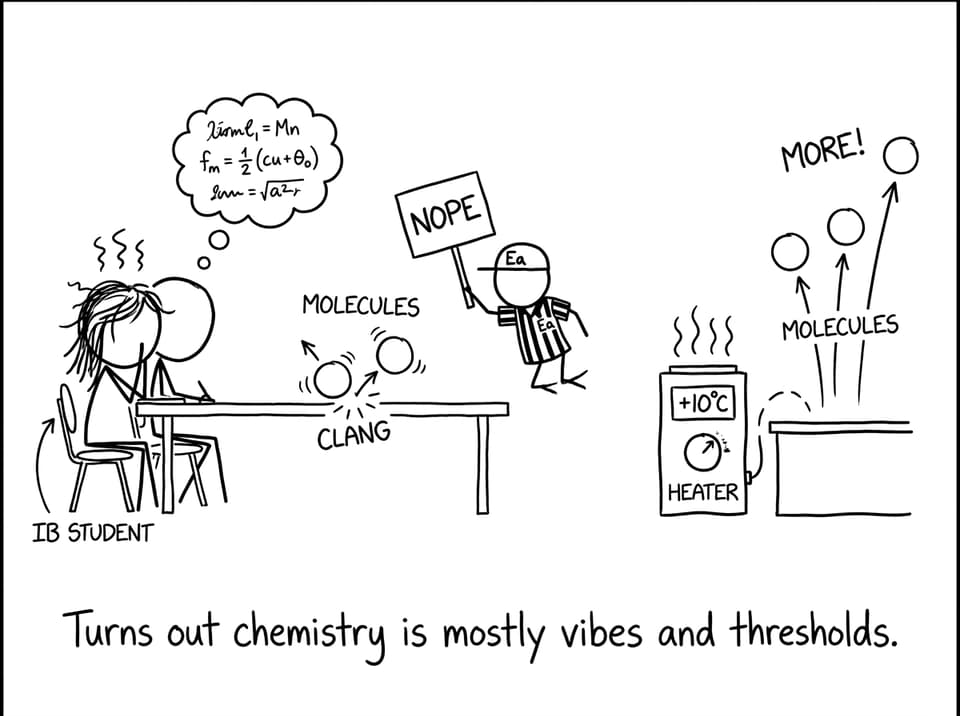
Collision theory says a reaction only occurs when particles collide and the collision is successful. In IB Chemistry, “successful” has three conditions:
-
Collision happens (particles actually meet)
-
Energy is enough to overcome activation energy (Ea)
-
Orientation is correct (particles line up in a way that lets bonds break and form)
A useful mental model for IB Chemistry essays and 2-mark explanations:
Rate depends on how many collisions happen per second and what fraction of those collisions are successful.
If you want a syllabus-aligned walkthrough of this exact subtopic, use 6.1 Collision theory and rates of reaction and the matching 6.1 study notes.
Quick checklist: how to write collision theory explanations fast
When an IB Chemistry question says “use collision theory to explain…”, run this checklist:
-
What factor changed (temperature, concentration, pressure, surface area, catalyst)?
-
Did it increase collision frequency, fraction above Ea, or orientation success?
-
Link to rate: “therefore more successful collisions per second, so rate increases.”
For rate basics and graph language, keep Rate of Reaction Explained Simply open while you practice.
Condition 1: collisions must happen (frequency)
No collisions, no reaction. In IB Chemistry, collision frequency rises when:
-
Concentration increases (more particles per volume in solution)
-
Pressure increases for gases (more particles per volume in a compressed container)
-
Surface area increases for solids (more exposed particles)
-
Reactants are in a state where movement is easy (solutions often react faster than solids)
This is why “more crowded” systems tend to react faster: the odds of contact go up.
To practice the wider “factors affecting rate” toolkit, use Factors affecting the rate of reaction notes.
Condition 2: collisions must have enough energy (activation energy)
Here’s the part that makes IB Chemistry feel surprisingly human: effort matters, but only above a threshold.
Activation energy (Ea) is the minimum energy needed for particles to reach the transition state. If a collision has energy lower than Ea, particles bounce apart and nothing permanent changes.
-
Energy (\ge Ea) -> possible reaction
-
Energy (< Ea) --> ineffective collision
If you want a clean definition you can quote in your own words, read What Is Activation Energy? IB Chemistry Explained.
Condition 3: collisions must have the correct orientation
Even with enough energy, particles can collide “wrong.” In IB Chemistry, this explains why some reactions are slower than you’d expect from Ea alone.
A classic displacement-style idea:
A-B + C -> A-C + B
C has to hit the right side of A-B to form A-C. If it strikes from an unhelpful angle, bonds don’t rearrange effectively.
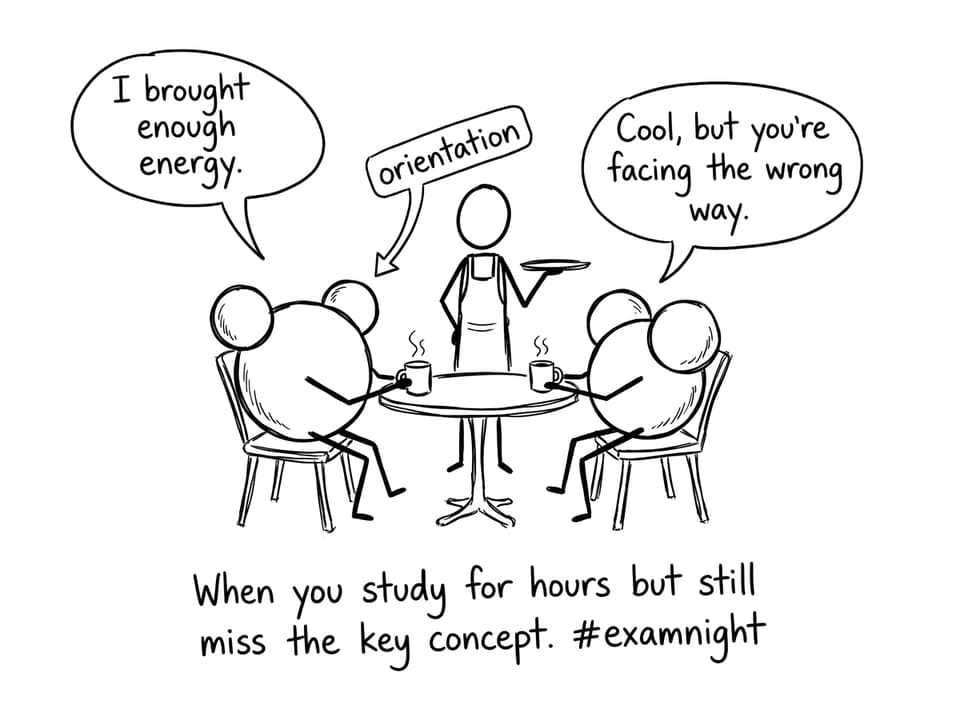
Orientation is also where examiners quietly reward precision: mentioning orientation shows you understand collision theory beyond “more collisions = faster.”
How temperature increases rate (the most tested IB Chemistry storyline)
Temperature boosts reaction rate in IB Chemistry for two reasons, but one matters far more:
-
Particles move faster -> more collisions
-
Energy distribution shifts; many more particles have energy (\ge Ea)
That second point is why rate often rises dramatically, not just a little. Even a small temperature increase can produce a much larger fraction of particles able to climb the Ea barrier.
For a dedicated exam-style explanation, see How does increasing temperature affect the rate of a reaction?.
Concentration, pressure, and surface area (easy marks if you stay specific)
These factors mainly change collision frequency in IB Chemistry:
-
Higher concentration means more particles per volume, leading to more collisions per second and a faster rate
-
Higher pressure (gases) means particles are closer together, leading to more collisions and a faster rate
-
Greater surface area (solids) means more exposed reactive sites, leading to more collisions at the surface and a faster rate
Students often lose marks by forgetting the “per second” logic. Collision theory is about probabilities per unit time.
Catalysts: faster without “more collisions”
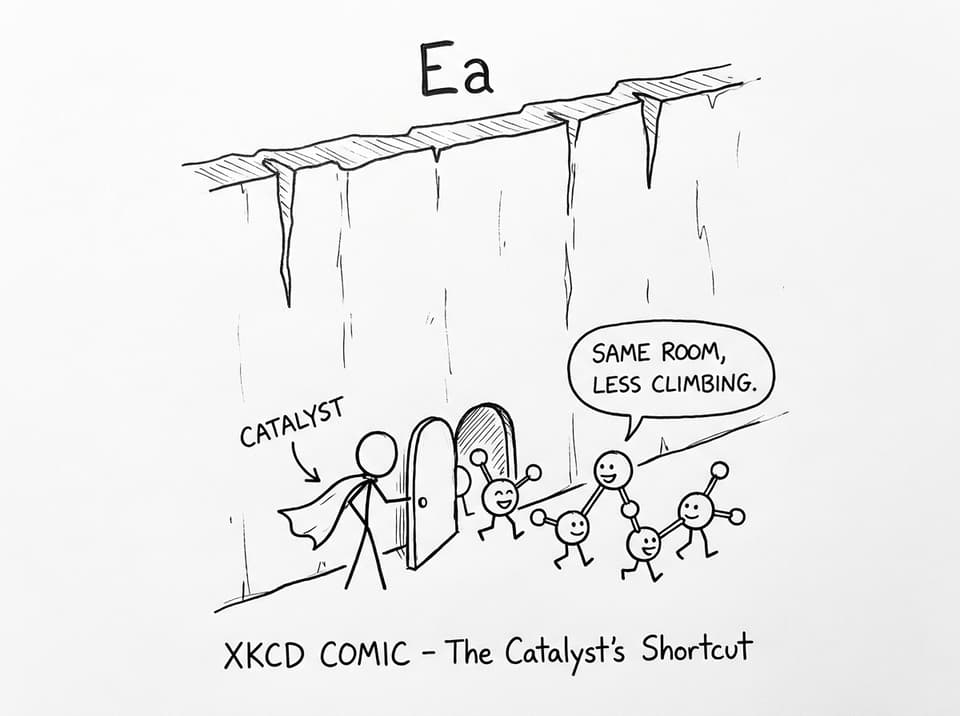
A catalyst is the quiet cheat code in IB Chemistry kinetics: it provides an alternative pathway with a lower activation energy.
Collision theory translation:
-
At the same temperature, a larger fraction of particles now have energy (\ge Ea)
-
So the proportion of successful collisions increases
-
Rate increases, even if collision frequency is similar
This is also why catalysts don’t change (\Delta H) of the reaction profile (they change the route, not the start and end energies).
To strengthen your HL connections, pair this with Arrhenius Equation Explained for IB Chemistry, where the “frequency factor” and Ea ideas become mathematical.
How to turn collision theory into exam points (with RevisionDojo)
Understanding collision theory is step one. Scoring marks is step two.
On RevisionDojo, you can drill kinetics with:
-
The IB Chemistry resources hub to stay aligned with the syllabus
-
The free Questionbank feature for exam-style practice with instant feedback
-
Study Notes and Flashcards to lock in definitions like activation energy and successful collisions
-
AI Chat to test your explanations and tighten wording
-
Grading tools to make “2 marks vs 3 marks” painfully clear
-
Predicted Papers and Mock Exams when you want timed pressure without panic
-
Tutors when you need a human to debug how you explain kinetics
Closing: learn the story, then practice the sentences
Collision theory is one of those IB Chemistry topics that feels almost too simple until you realize it powers half the explanations in kinetics: temperature, concentration, pressure, surface area, catalysts, and reaction profiles.
If you want this to become automatic, don’t just reread notes. Use RevisionDojo’s Questionbank to practice writing collision-theory sentences under time pressure, then refine them with AI Chat and the Grading tools. The goal is calm clarity: “more collisions,” “more particles above Ea,” “better orientation,” and marks that follow naturally.