
You know the feeling: you open an extract and it looks innocent. Then you read the first sentence and your brain does that quiet little exit.
That moment is basically a rite of passage in IB English. The good news is that challenging passages aren’t “hard” because you lack talent. They’re hard because they’re dense: compressed meaning, subtle tone, structural turns that don’t announce themselves. Close reading is how you slow the world down enough to see what the writer is doing on purpose.
This guide gives you a calm, repeatable close reading method for IB English exams (especially Paper 1) so you can move from “I don’t get it” to “I can prove it.”
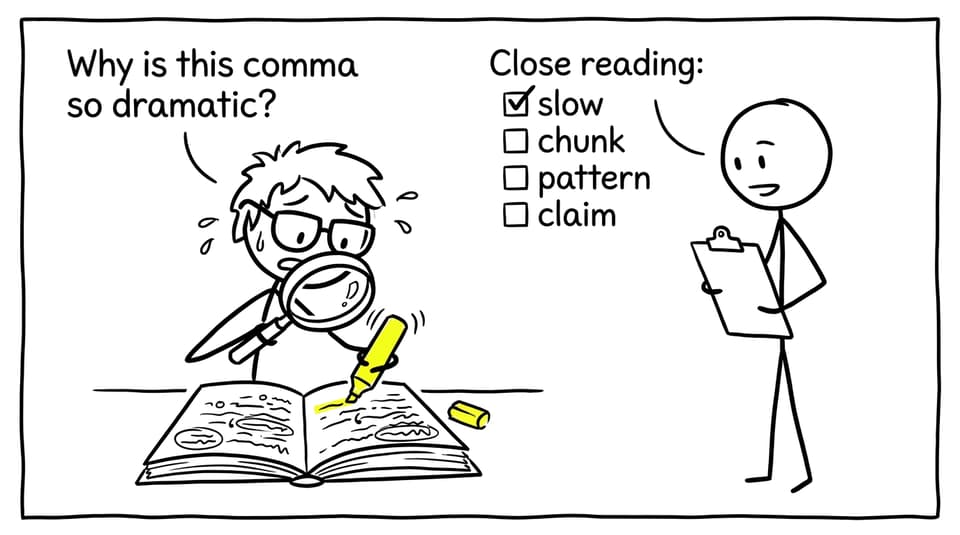
Close reading in IB English: a quick checklist
When time is tight, you want a routine that doesn’t depend on inspiration.
-
Read once for situation and emotional temperature
-
Read again for patterns (repetition, contrast, shifts)
-
Chunk the passage where something changes (tone, pace, viewpoint, imagery)
-
Turn annotations into claims (what) + evidence (quote) + effect (how/why)
-
Build a line of argument that follows the text’s movement
If you’re revising specifically for commentary writing, pair this with RevisionDojo’s breakdown of Paper 1 expectations: Mastering IB English Paper 1.
Start with an “open reading” (before you hunt techniques)
In IB English, students often sprint straight to device-spotting. But close reading works best when you first notice the passage’s basic shape.
On your first read, ask only:
-
Who is speaking or focalizing?
-
What seems to be happening on the surface?
-
What is the dominant mood (tense, amused, bitter, mournful, triumphant)?
This matters because tone is usually the doorway into meaning. A passage can be “about” a walk to school, but spoken with dread, which changes everything you later argue.
For a stronger foundation in what close reading includes across prose and poetry, use: Close Reading Techniques for Prose and Poetry.
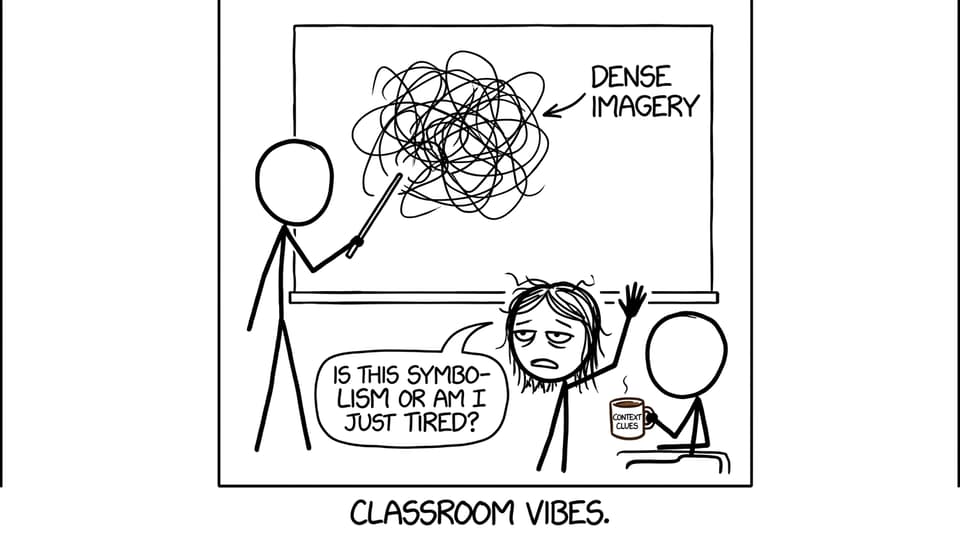
Chunk the passage: make the difficult text smaller
A challenging extract becomes manageable when you stop treating it like one giant wall.
In IB English close reading, “chunking” means drawing lines where the passage changes gear. Look for:
-
A turn in tone (warmth to sarcasm, calm to panic)
-
A shift in imagery (nature to machinery, light to darkness)
-
A structural pivot (short sentences after long ones, a sudden fragment, a question)
-
A change in focus (external description to internal reflection)
Each chunk gives you a mini-purpose. Instead of writing an essay that wanders, you can write paragraphs that track development.
If you want a Paper 1 structure that naturally follows these shifts, RevisionDojo’s commentary guide lays it out clearly: Writing a Commentary for IB English A.
Hunt patterns, not isolated “cool quotes”
Examiners reward interpretation built from evidence. Evidence becomes persuasive when it’s patterned.
When close reading in IB English, try to find 2–3 patterns that repeat or evolve:
-
Repetition: recurring words, images, sounds
-
Contrast: light/dark, inside/outside, innocence/experience
-
Progression: imagery intensifies, syntax tightens, pacing accelerates
-
Tension: literal meaning conflicts with tone (polite words, sharp edge)
A single metaphor can be interesting; a chain of metaphors is an argument.
To connect this with exam success, you can also revise how Paper 1 and Paper 2 differ in what they reward: Best way to study for Paper 1 vs. Paper 2.
Zoom in on diction, syntax, and imagery (the “microscope trio”)
Challenging passages often hide meaning in small choices.
Diction: connotation and emotional charge
In IB English, “word choice” only matters when you explain why this word, not another. Pay attention to verbs and adjectives: they usually carry the passage’s attitude.
Ask:
-
Does the diction sound clinical, violent, childish, ceremonial?
-
Are there words that imply judgment, shame, longing, disgust?
Syntax: how the sentence makes you feel
Syntax is mood engineering.
Ask:
-
Do long sentences create drift, overwhelm, or intimacy?
-
Do short sentences create certainty, shock, or refusal?
-
Do interruptions (dashes, fragments, parentheses) suggest anxiety or irony?
Imagery: the passage’s subconscious
Imagery reveals what a narrator can’t say directly.
Ask:
-
Which senses dominate (sound, touch, sight)?
-
Is imagery concrete (grain, metal, sweat) or abstract (mist, blur, echo)?
-
What theme does the image-world keep returning to?
Turn notes into claims: the evidence -> effect habit
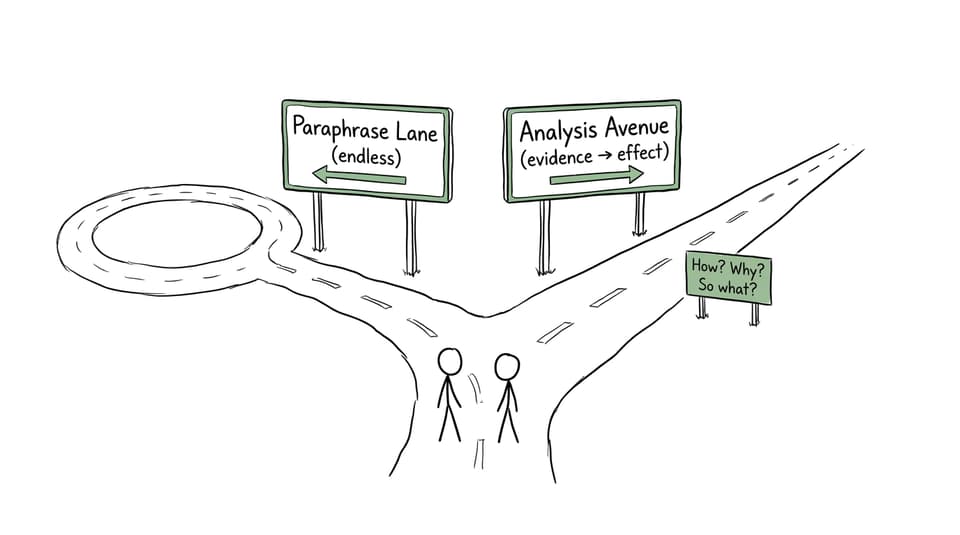
The fastest way to level up IB English close reading is to stop listing techniques and start making claims.
Use this micro-template in your planning:
-
Observation (quote)
-
Method (device/feature)
-
Effect (tone, meaning, reader response)
-
Purpose (what it suggests about character/theme/context)
If you want more guided practice, RevisionDojo’s Step-by-Step Guide to Revising IB English Paper 1 is designed for exactly this shift from spotting to explaining.
Practice like an examiner (with RevisionDojo tools)
Close reading gets easier when you repeatedly do it under realistic conditions.
RevisionDojo helps you train the exact muscles IB English demands:
-
Use the Questionbank to practice unseen-style extracts and get targeted repetition
-
Use Study Notes to refresh technique vocabulary without drowning in theory
-
Use Flashcards for quick recall of literary terms and analytical verbs
-
Use AI Chat to test interpretations and get alternative readings to consider
-
Use Grading tools to check whether your paragraphs are analysis-heavy or summary-heavy
-
Use Mock Exams and Predicted Papers to simulate exam pacing and build calm stamina
-
Use the Coursework Library and Tutors when you need feedback that’s specific, not generic
Explore the broader IB English hub here: English A: Language & Literature resources.
Closing: make the hard passage feel smaller
A challenging extract stops being terrifying when you approach it like a series of small, solvable decisions: open read, chunk, pattern, microscope trio, then evidence -> effect. That is close reading you can repeat under pressure. And once you can repeat it, you can trust it.
If you want to turn these IB English close reading strategies into consistent exam marks, use RevisionDojo to practice with the Questionbank, tighten paragraphs with the Grading tools, and build confidence through Mock Exams and Predicted Papers. The goal isn’t to never feel stuck. It’s to know exactly what to do when you are.
