

Can teachers change your IA mark?
The moment your IA comes back, time does something strange.
A number appears at the top of the page, and suddenly you can remember every sentence you wrote, every late night, every shortcut you didn't take (and the one you did). And your brain runs the same loop: Can my teacher change my IA mark?
It's a fair question. It's also one of the most misunderstood parts of the IB.
The truth is calm but slightly uncomfortable: yes, a teacher can change an IA mark in some situations. But not in the magical, last-minute way students usually imagine. The IA mark is part marking, part procedure, part paperwork, and part moderation ecosystem that doesn't care how badly you want a higher number.
This post explains what teachers can change, what they can't, and how to respond in a way that actually improves your outcome.
Quick checklist: what you should do before asking about your IA
Before you send the message that starts with "Hi, I was wondering if you could…" use this checklist. It protects your relationship with your teacher and increases the odds you get a helpful answer.
- Re-read the IA rubric and highlight the criteria where marks were lost.
- Identify one concrete disagreement (not "I worked hard").
- Find evidence in your IA that matches the descriptor language.
- Ask whether the mark is provisional (draft/internal) or final (submitted).
- Decide what you're actually requesting: a remark, clarification, or feedback.
If you want a rubric-aligned second opinion before you talk to school, run your draft through a criterion breakdown like the IB Psychology IA Grader or the IB Design Technology SL IA Grader. Even if your subject differs, the experience of seeing criterion-by-criterion language changes how you argue your case.
How IB IA marking works (the part students don't see)
A useful mental model is to treat your IA like a passport photo.
You can take it again before you submit it. You can fix lighting. You can adjust posture. But once it's printed and filed, your feelings about the result don't change the system.
In IB schools, teachers typically:
- supervise the IA process,
- provide limited feedback (within IB rules),
- mark the final IA using the official criteria,
- submit marks and/or samples to the IB,
- and then the IB may apply moderation.
That last point matters. Moderation means the IB compares teacher marking standards across schools using a sample of student work. If they believe a school's marking is consistently too generous or too harsh, they can shift marks up or down for the cohort.
So when you ask "Can teachers change my IA mark?", what you're really asking is:
- Can my teacher change the number they entered?
- Can the IB change the number after moderation?
- Can I do anything at this stage to change my result?
Those are three different questions.
When a teacher can change your IA mark
Before the IA is submitted to the IB
If your IA mark is still internal and not submitted, teachers can usually change it. This isn't a favour. It's just normal assessment workflow.
Common reasons a teacher might legitimately change an IA mark pre-submission:
- Arithmetic or data-entry errors (wrong total, wrong criterion sum, wrong candidate number).
- Rubric misapplication (they applied the wrong descriptor, or mixed old/new criteria).
- Standardization adjustments within the department (teachers align marking across classes).
- New evidence that a section meets a descriptor more clearly than first judged (rare, but possible if there's genuine ambiguity).
But notice what's missing: "I need this for a 7." Need is not a criterion.
If you want to approach this calmly, bring the rubric language with you and talk in descriptors, not emotions. A sentence like this works:
"In Criterion B, the descriptor mentions justification of method choices. On page 6 I justify X and Y. Could we look at whether that meets the top-band wording?"
That's a professional question about the IA, not a negotiation.
If the mark is still being moderated internally
Some schools run internal moderation where a second teacher samples scripts. If a second marker flags inconsistency, the original teacher might revise the IA mark.
This is another scenario where teachers can change your IA mark, but it's driven by consistency, not persuasion.
If the school finds a procedural problem
Occasionally, schools discover that feedback rules were not followed or an academic honesty procedure was mishandled. In these cases, schools may need to review how the IA was handled. That doesn't guarantee a higher mark, but it can trigger corrections.
For teachers, platforms that reduce procedural chaos matter. That's one reason schools use workflows like How RevisionDojo Enhances IB Internal Assessment (IA) Feedback and Moderation -- fewer missing steps, clearer rubrics, cleaner evidence.
When a teacher cannot realistically change your IA mark
After final submission (in the way students mean)
Once the school has submitted the IA marks to the IB, your teacher can't simply "edit" the number because you asked nicely or because you made a good speech. The system is built to prevent exactly that.
There may be limited administrative pathways for corrections if there was an error, but that's not the same as a discretionary remark.
After IB moderation happens
Moderation can shift marks for the cohort. A teacher cannot override moderation outcomes for one student. If moderation moves your IA mark, it moves because the IB's process determined your school's marking standard needed adjustment.
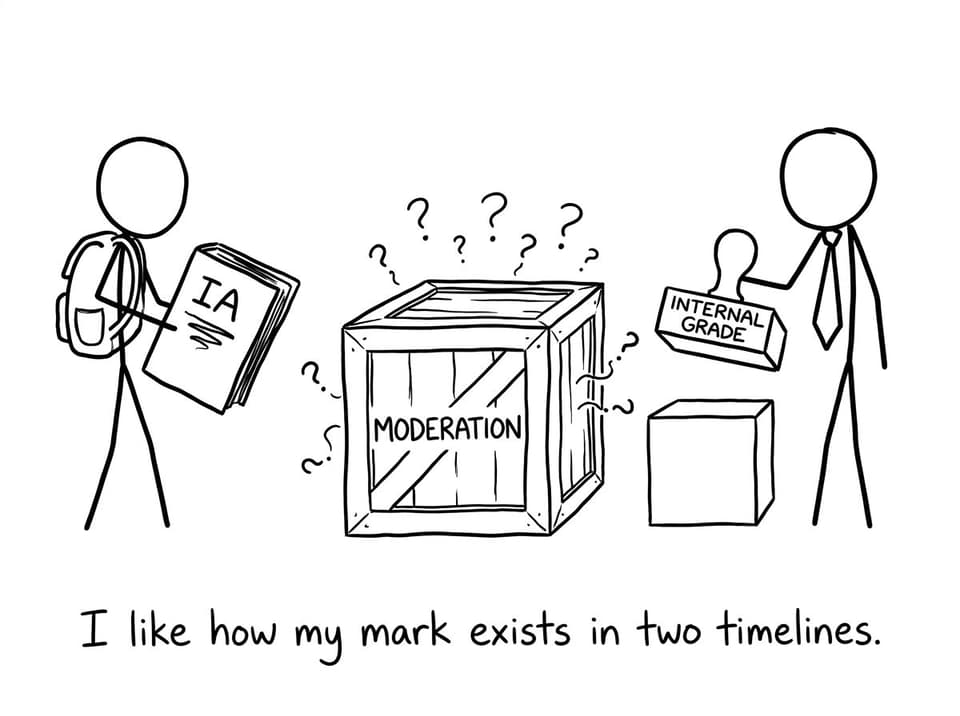
This is why an IA can feel like it lives in two timelines: the teacher's mark and the IB's final version.
If your request is really "Can you ignore the rubric?"
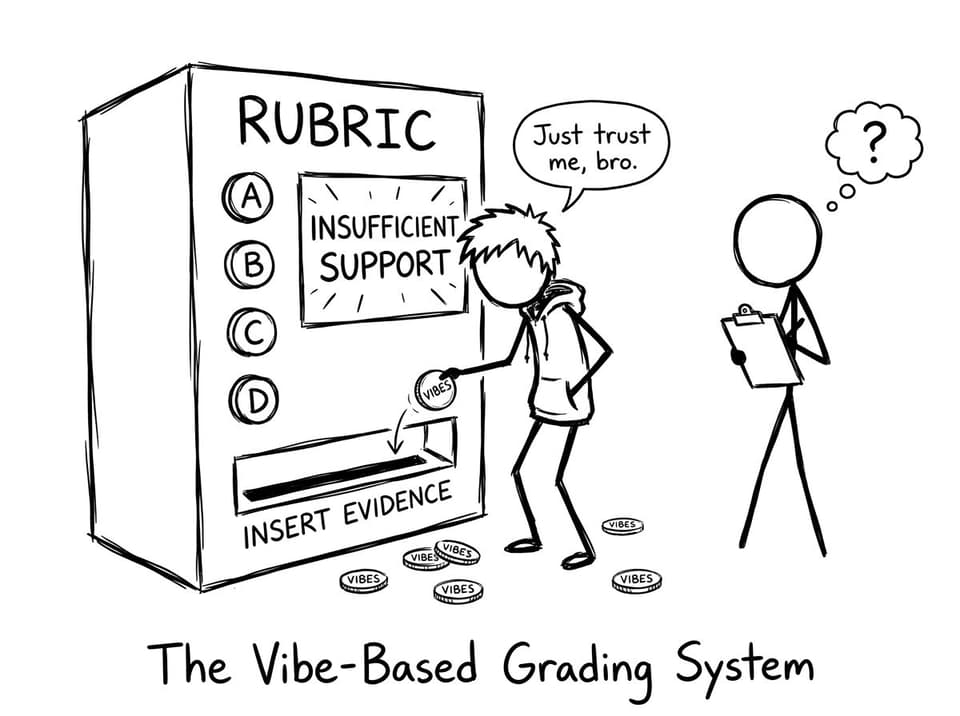
Teachers can't award marks that the IA doesn't evidence. The IB descriptors are the only language that matters in formal marking.
Your job is to make the evidence obvious.
The better question: "What can I do to protect my IA score?"
Students ask about changing an IA mark because it feels like the last lever left.
But the highest-leverage work usually happens earlier, when you can still improve the actual IA.
Here's a more useful approach: build a feedback loop where you can see what top-band evidence looks like and iterate quickly.
Use exemplars to calibrate your instincts
If your internal mark shocked you, there's a decent chance you miscalibrated what "good" looks like.
Use high-quality exemplars to reset your expectations:
The point isn't to copy. It's to notice structure: how claims are supported, how evaluation is written, how methodology is justified, how limitations are specific rather than decorative.
If you want a broader jumping-off point, use the IB Coursework Exemplars Index (IA, EE, TOK) to find models by subject and score band.
Get rubric-aligned feedback faster than school timelines
Teacher feedback is limited and time-bound. Your stress isn't.
RevisionDojo's Grading tools help because they translate rubric language into actionable next steps. You can submit a draft, see criterion-by-criterion gaps, revise, and repeat. That iteration speed is often what separates an average IA from a strong one.
For a concrete example of how detailed criterion feedback can look, explore the IB ESS (new) IA Grader.
Keep your exam prep moving while the IA feels unresolved
A strange trap: students let IA anxiety spill into exam season and derail everything.
When you can't control the IA mark anymore, control what you can: your paper performance.
RevisionDojo is built for that loop:
- Study Notes to rebuild shaky understanding quickly
- Flashcards for daily recall and spaced repetition
- Questionbank for exam-style practice with feedback
- AI Chat when you're stuck and tempted to spiral
- Mock Exams and Predicted Papers to simulate real pressure
If you want a simple structure, start with Notes + Flashcards + Question Bank (Free), then graduate to a timed workflow like IB Mock Exams with Timer & Mark Schemes once your basics are stable.
How to ask your teacher about an IA mark (without making it worse)
Most students ask the question in a way that signals panic, not precision.
Try this instead.
Ask for clarification first, not a change
- "Can you help me understand where I lost marks in Criterion X?"
- "Could you point to one example of what top-band evidence would look like here?"
Clarification often reveals whether you disagree with the mark, or whether you misunderstood what the IA criteria reward.
If you disagree, argue with descriptors and evidence
Bring:
- the rubric,
- page references,
- and one focused claim.
Not ten claims. Not a speech. One.
A teacher is far more likely to reconsider an IA mark if you can show that your work clearly matches descriptor language.
Accept the reality of timing
If the IA is already finalized and submitted, the conversation shifts. It becomes:
- "What should I do differently next time?"
- "How can I protect my exam grade now?"
That's not giving up. That's reallocating effort to where it still produces points.
Overview: the three 'marks' students confuse
The teacher's mark (internal assessment mark)
This is the number your teacher awards your IA using the rubric.
The submitted mark (what gets sent)
This is the mark your school submits. It may be the same as what you saw, but sometimes internal standardization shifts it.
The moderated mark (finalized after moderation)
This is where moderation can adjust the cohort. It may match your teacher's IA mark, or it may shift.
Understanding these layers removes a lot of unnecessary fear.
Closing: the calm way to think about your IA mark
Your IA mark can sometimes change. But the conditions for change are usually procedural: timing, criteria, consistency, and evidence.
So if you're staring at a disappointing IA score, don't gamble on persuasion. Build proof. Use exemplars to calibrate. Use rubric-aligned feedback to iterate. Then, when the IA is out of your hands, shift your energy to the exam work that still compounds.
If you want one place to do that without juggling tabs, RevisionDojo is built as an IB control panel: Questionbank for daily practice, Study Notes for quick clarity, Flashcards for recall, AI Chat for the stuck moments, Grading tools plus the Coursework Library for IA improvement, and Mock Exams with Predicted Papers to make exam day feel familiar.
Your IA isn't just a mark. It's a skill test in evidence, clarity, and structure. Those same skills win marks everywhere else too.