



The quiet truth about scholarships is that they’re rarely awarded for one single thing.
A committee doesn’t open your file and think, “Ah yes, one student chose Film. Here’s the money.” What they look for is signal: proof you can sustain effort, produce high-quality work, and communicate meaning under pressure. Done well, IB Group 6 Arts can be a strong signal.
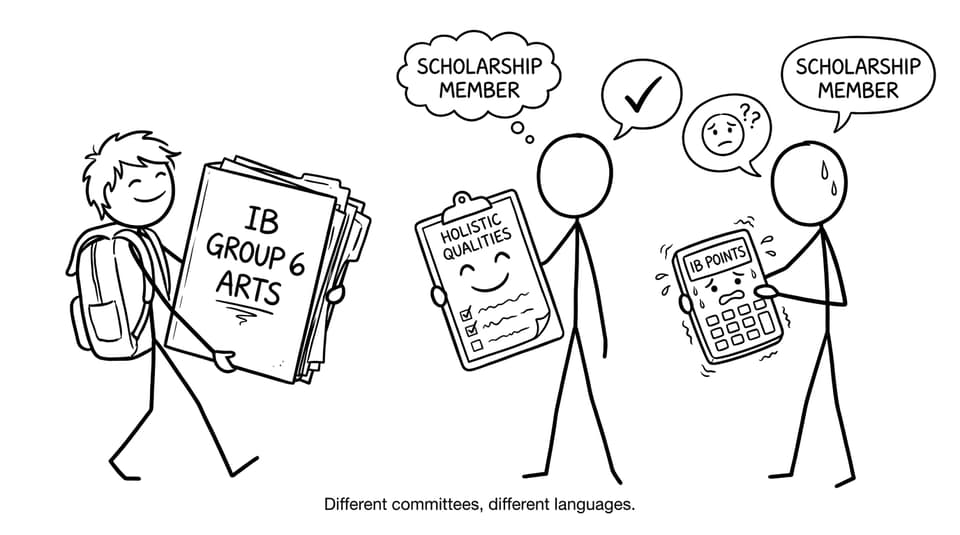
Still, it helps to know where that signal counts most, and how to translate it into the language scholarship readers understand.
What counts as IB Group 6 Arts (and why it’s different)
In the IB Diploma Programme, IB Group 6 Arts includes subjects like Visual Arts, Music, Theatre, Film, and Dance. These courses reward a mix of creative output and thoughtful reflection. You’re not just learning content; you’re building a body of work.
If you want a quick refresher on what these classes involve, see What Is a Group 6 Class in IB? and browse All IB Group 6 Arts posts.
A quick checklist: when IB Group 6 Arts helps most
Use this as a fast filter:
-
You’re applying for an arts-focused degree, faculty award, or creative scholarship.
-
Your IB Group 6 Arts work is excellent (not just “I took it”).
-
You can explain your process clearly (reflection, intention, improvement).
-
Your overall IB score and key HL subjects are still strong.
-
Your arts work connects to CAS, leadership, or community impact.
How IB Group 6 Arts can strengthen a scholarship application
It shows breadth without feeling like “extra”
Some applications read like a spreadsheet: grades, ranks, awards, repeat. IB Group 6 Arts can add dimension. Not “I’m well-rounded” as a slogan, but as evidence: long-term projects, creative risk, iteration, and critique.
This overlaps naturally with the IB core too. If your arts work feeds into CAS reflection and commitment, scholarship readers often see coherence instead of randomness. A good place to sharpen that reflective voice is 10 Powerful Tips to Write a CAS Reflection That Stands Out in 2025.
It provides proof of excellence that isn’t just test-taking
For arts-aligned scholarships, your portfolio, performance, or production work becomes concrete proof. Strong marks help, but high-quality documentation and clear artistic intention often do more.
If you’re in Visual Arts, build this evidence deliberately: What to Include in an IB Visual Arts Portfolio and Comparative Study Structure Explained.
It signals “real-world” skills scholarship committees like
A lot of scholarship criteria are coded versions of the same traits: discipline, initiative, leadership, communication. IB Group 6 Arts trains these quietly.
You plan big tasks, handle feedback, and keep moving even when inspiration disappears. If you need a playbook for that last part, read How to Deal With Creative Blocks During IB Group 6 Projects.
The limitation: scholarships often prioritize your HLs and total score
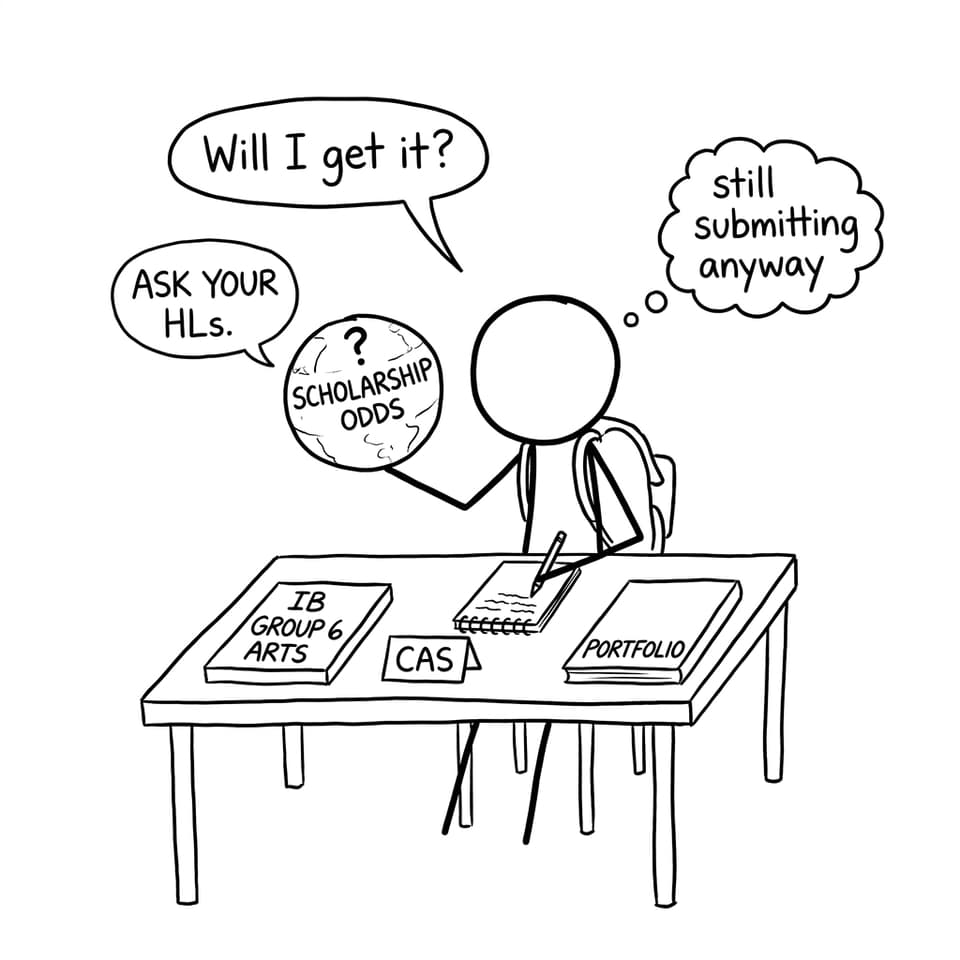
Here’s the part students deserve to hear plainly: many merit scholarships start with thresholds. They may care most about your overall points and the subjects tied to your intended degree.
So IB Group 6 Arts usually works best as a multiplier, not a substitute. Your arts subject can elevate an already strong academic profile, but it rarely rescues a weak one.
If you’re trying to understand how totals and expectations work, start with How Do IB Points Work? and What Is a Good Score in the IB Diploma?.
How to present IB Group 6 Arts so committees “get it”
Translate your work into outcomes
Instead of listing tasks (“made 12 pieces”), describe what changed:
-
The problem you solved (creative or logistical).
-
The constraint you worked under (time, resources, collaboration).
-
The feedback you received and what you did next.
If reflection is part of your course, treat it like your advantage. Start with The Role of Reflection in IB Group 6 Assessment and How to Get Feedback on Your IB Group 6 Work.
Keep your exam prep stable while you build your arts profile
Scholarships still care about results, and results come from systems.
RevisionDojo helps you protect both sides of the equation: you can use Study Notes and Flashcards to keep content tight, the Questionbank to train accuracy, AI Chat (Jojo) when you’re stuck, and Grading tools to turn feedback into next steps. When exam pressure rises, Predicted Papers and Mock Exams help you practice under realistic timing without panic.
Closing: make IB Group 6 Arts a clear advantage
Think of IB Group 6 Arts like a strong personal essay: it won’t matter if it’s unclear, but it’s unforgettable when it’s specific, disciplined, and honest. The arts can strengthen scholarship outcomes by showing creativity, reflection, and sustained excellence, especially when your overall points and key HL performance stay strong.
If you want your arts work and exam prep to reinforce each other, build one calm system: RevisionDojo’s Questionbank, Study Notes, Flashcards, AI Chat, Grading tools, Predicted Papers, Mock Exams, Coursework Library, and Tutors are designed to keep you improving without guessing. In scholarship season, that steadiness is its own kind of advantage--and it’s one you can control.