


A calmer way to expand in IB Math
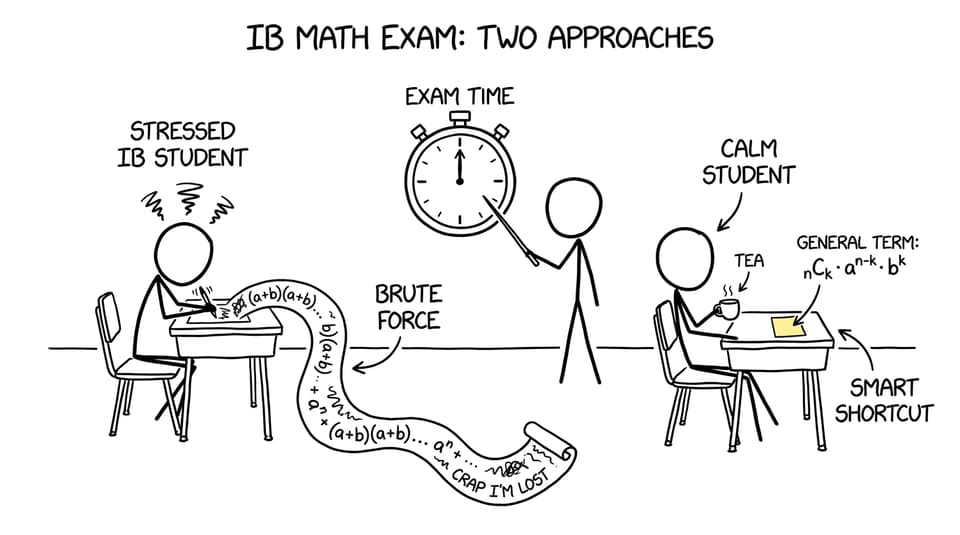
In IB Math, the binomial expansion can feel like a trap: the moment you start expanding, the expression gets longer, your handwriting gets smaller, and somehow the coefficient you needed vanishes into a forest of terms. But IB exam questions rarely want the whole forest. They want one tree: the term containing a certain power, the coefficient of a specific term, or the constant term.
That is why the general term is such a high-value skill in IB Math AA SL and HL. It is not just a formula to memorize; it is a time-saving habit that keeps your algebra clean when time is not.
If you want the bigger picture first, pair this with Binomial Expansion Explained for IB Maths (AA SL & HL) and Binomial Theorem Formula in IB Math.
Quick checklist (before you touch the algebra)
-
Write the general term in one line before substituting anything.
-
Decide whether the question means kth term or (k+1)th term.
-
Track powers: one part decreases, the other increases.
-
Use combinations carefully (and exploit symmetry).
-
Sanity-check by looking at nearby terms.
For targeted practice, the SL 1.9 binomial theorem topic hub is a solid map of what the syllabus expects.
The general term in IB Math (the one line that saves minutes)
For an integer power, the binomial theorem is:
So the general term (term-by-term form) is:
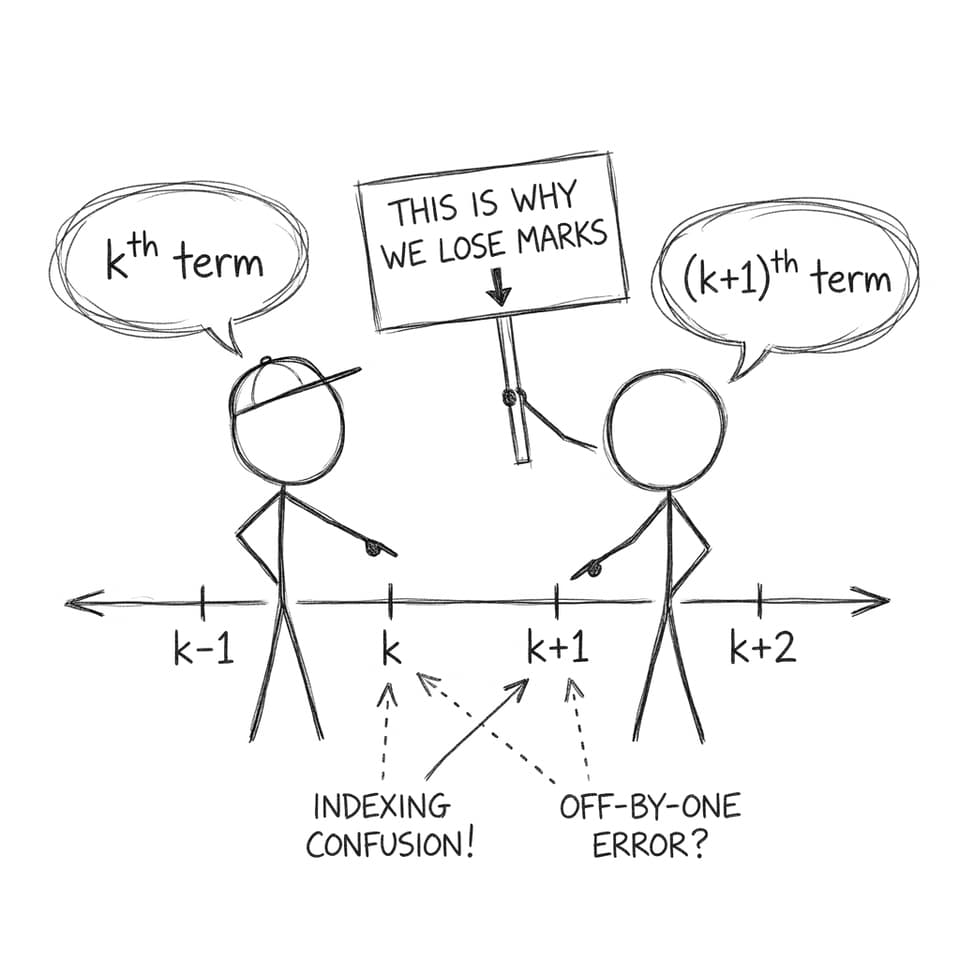
In IB Math, the indexing is where most marks disappear. The expansion starts at (k=0), which produces Term 1. That is why the formula is (T_{k+1}), not (T_k).
To make this feel less abstract, keep this mental picture:
-
Coefficients come from (\binom{n}{k})
-
Power of (a) goes down: (n-k)
-
Power of (b) goes up: (k)
Want coefficient-focused drills? Try Question Type 11: Finding coefficient using the general binomial term.
How to find a specific term (the exam pattern)
Most IB Math questions follow the same storyline: “Find the term containing (x^m)” or “Find the constant term.” The method is consistent.
Step 1: Write the general term
Example structure: ((p+qx)^n)
Step 2: Match the power of (x)
Because (x) only appears in ((qx)^k), the power of (x) is simply (k). So if you need the (x^7) term, you set (k=7) (as long as that’s within (0\le k\le n)).
Step 3: Substitute and simplify
Now compute coefficient and term cleanly. This is where neatness pays.
If you are extending to HL-style fractional or negative indices, build up using Exercises for using binomial theorem for fractional powers and AHL 1.10 binomial with negative and fractional indices questionbank.
Common mistakes (and how IB Math marks them)
Off-by-one indexing
Students often treat “the kth term” as if it means (k) in (\binom{n}{k}). In the general term, (k) is the exponent index, while the term number is (k+1). If the question says “the 6th term,” you set (k+1=6\Rightarrow k=5). This one slip can wreck an otherwise perfect solution.
Confusing term number with power
The 5th term does not automatically correspond to (x^5). It depends on where the variable sits inside the binomial. In IB Math, always derive the power from the term expression rather than guessing.
Expanding when you only need one term
Full expansion invites arithmetic errors and wastes time. IB questions are often designed so the general term is the intended method.
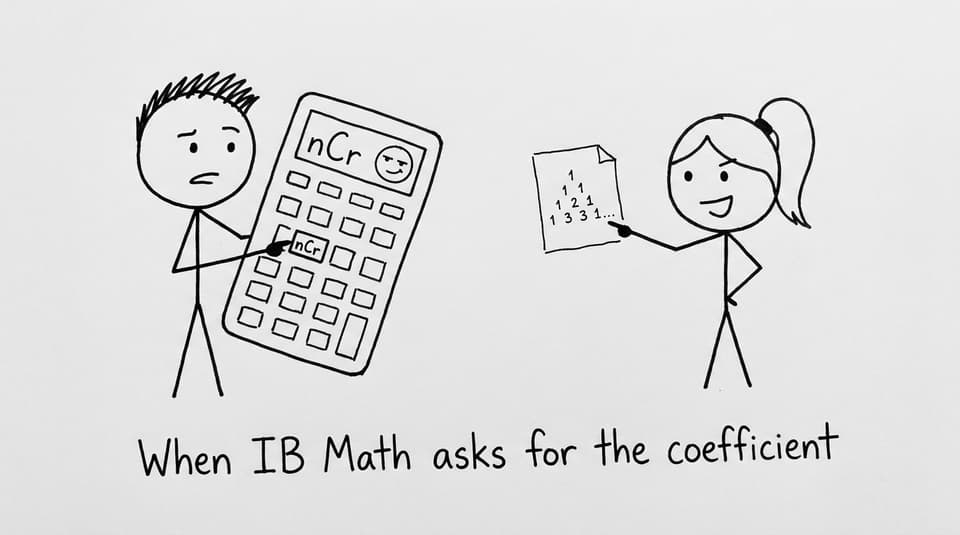
For more coefficient intuition, Pascal's Triangle Explained for IB Math Students is a surprisingly efficient companion.
Bring it home with RevisionDojo
The general term is one of those IB Math skills that feels small until you realize it saves you minutes across an entire paper. When you can jump straight to the correct term, you are calmer, faster, and far less likely to drop marks to messy algebra.
On RevisionDojo, you can turn that into a system: hit the Questionbank for exam-style repetition, use Study Notes to keep the formula and indexing rules tight, drill common errors with Flashcards, and check steps with AI Chat when a solution path feels unclear. Add Grading tools, Mock Exams, and Predicted Papers to simulate pressure (without panic), and you get what most students are missing: practice that actually resembles exam thinking. If you want one upgrade this week, make it the general term, and practice it until it feels like a shortcut you deserve.