



Binomial approximations are one of those IB Math skills that feel like a party trick: you take something ugly, shave off the complicated parts, and suddenly you can compute a sensible estimate faster than your calculator can wake up.
But the exam doesn’t reward the trick. It rewards the judgement behind it: why the approximation is allowed, what you’re ignoring, and how accurate your final number really is.
The binomial approximation idea (in one sentence)
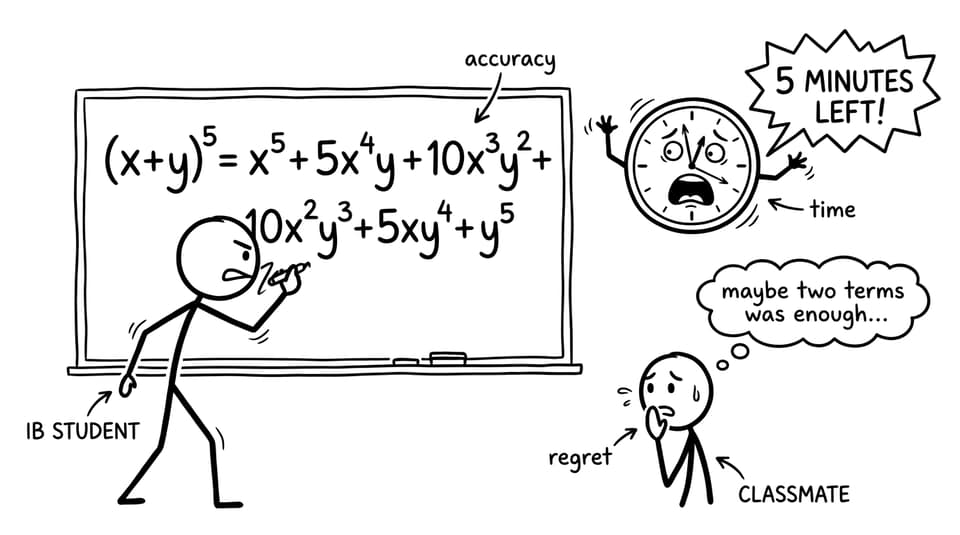
In IB Math AA HL, a binomial approximation means using the first few terms of the expansion of ((1+x)^n) (or something you rewrite into that form) to estimate a value when (|x|) is small.
If you want a quick refresher on the broader technique, keep Binomial Theorem Formula in IB Math open beside you as a reference.
Quick checklist before you approximate
Use this as a 20-second pre-flight check in your IB Math exam:
-
Rewrite into ((1+x)^n) form.
-
State the validity condition clearly (usually (|x|<1)).
-
Truncate sensibly (2 terms, 3 terms, maybe 4 if demanded).
-
Communicate “(\approx)” and round to the required accuracy.
-
Mention why later terms are negligible.
For targeted drills, the SL 1.9 Binomial theorem questionbank is excellent even for HL students who want clean repetition under exam-style wording.
When binomial approximations are valid in IB Math
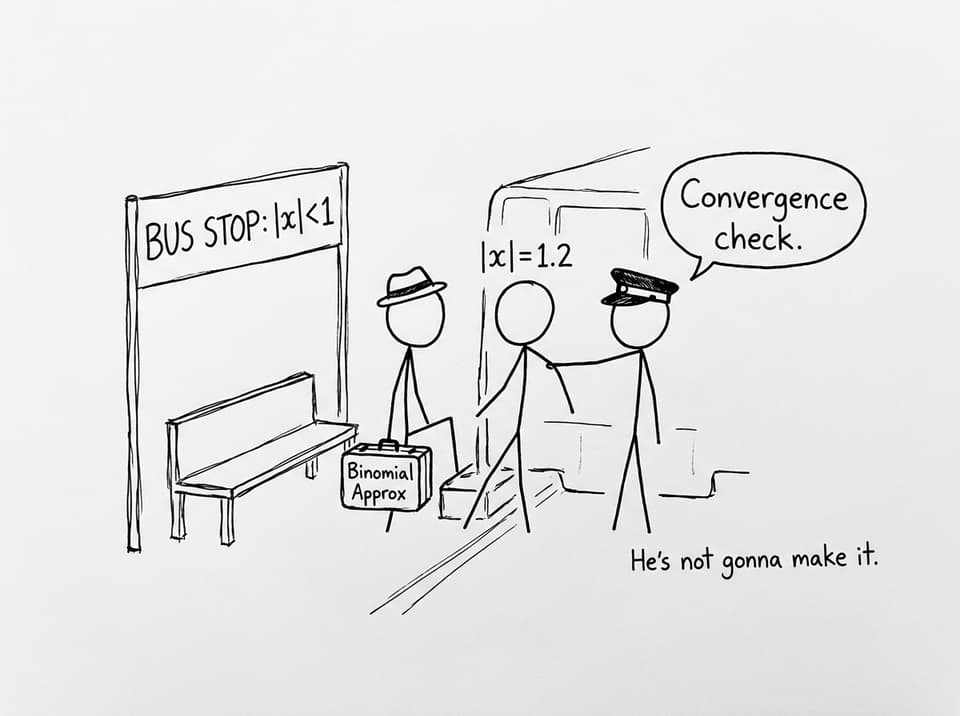
The binomial series only behaves nicely when the variable part is small enough that higher powers shrink quickly. In most HL questions, the examiner expects you to explicitly check that the expression fits (|x|<1) after rewriting.
That one line of reasoning is easy to skip when you’re rushing, but it’s also a common place where marks quietly disappear.
If your algebra is rusty, review the supporting content in the Number and Algebra notes and then practise the setup with Question Type 6: Expanding binomials using binomial theorem.
How truncation connects to accuracy (the examiner’s mindset)
A binomial approximation is basically you saying: “The first few terms do most of the work.” That’s true when (x) is small, because (x^2), (x^3), (x^4) drop off fast.
In IB Math, you’re often told something like “give your answer to 3 significant figures” or “use the first three nonzero terms.” Translate that instruction into a decision:
-
Two terms (up to (x)) gives a linear approximation: fast, rough.
-
Three terms (up to (x^2)) is the sweet spot: still quick, usually accurate enough.
-
More terms only when the question demands precision or when (x) isn’t that small.
To see exactly how IB-style prompts are phrased, work through Question Type 9: Using binomial theorem for fractional powers (Exercises).
The fastest way to build the approximation (without getting lost)
Most HL binomial approximation questions follow the same rhythm:
-
Factor out a constant to create a “1 plus something” structure.
-
Identify (x) and confirm it’s small (state (|x|<1)).
-
Apply the first few terms:
If you want a guided pathway through AA topics around this, start from the Mathematics Analysis and Approaches (AA) hub and use RevisionDojo’s Study Notes to keep each method in one place.
Common mistakes IB Math students make
Even strong students miss marks here because they treat approximations like expansions.
-
Forgetting the validity condition: You must show why you’re allowed to approximate.
-
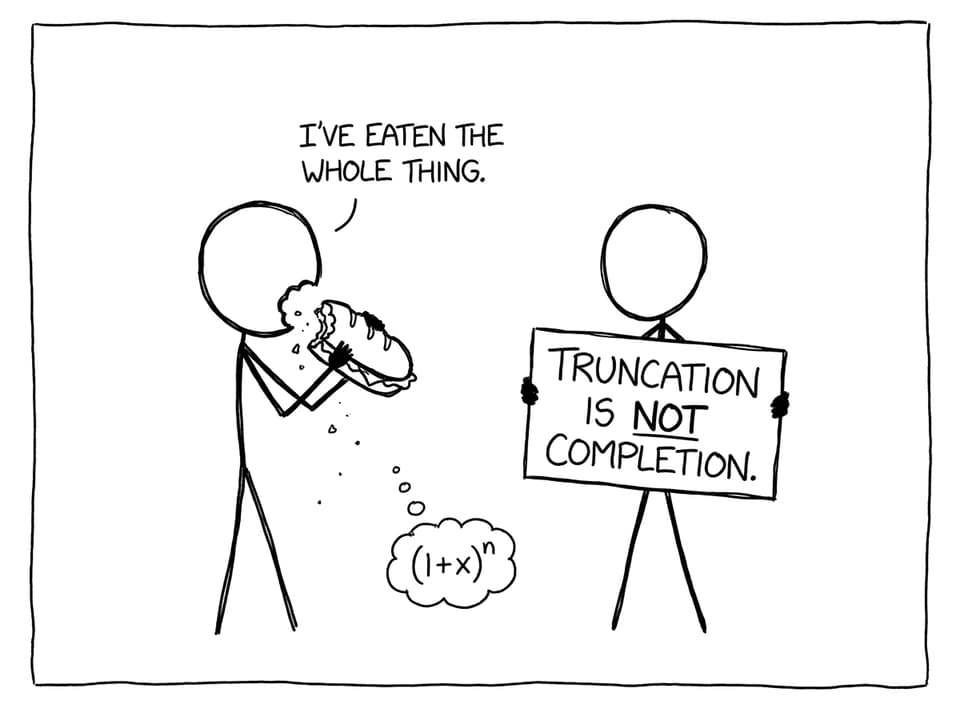
Expanding too far: Extra terms raise the risk of algebra mistakes with little reward.
-
Reporting an approximation like it’s exact: Use (\approx), and round correctly.
-
Not matching the requested accuracy: If the question says 4 d.p., make sure your truncation can support it.
A practical way to fix this is to practise under feedback. RevisionDojo’s Questionbank plus AI Chat is ideal: attempt, submit, then ask why a certain number of terms was chosen and how the markscheme expects you to justify it.
Bringing it home: make IB Math approximations feel automatic
Binomial approximations are less about memorising a series and more about developing calm exam judgement: check (|x|<1), choose the minimum effective truncation, and communicate accuracy like a mathematician.
If you want that judgement to show up on command, build a tight loop with RevisionDojo: learn the method from Study Notes, drill it in the Questionbank, lock in the pattern with Flashcards, then test it under timed pressure using Mock Exams and Predicted Papers. When you’re stuck, use AI Chat or book Tutors to fix the exact step where your logic breaks.
That’s how IB Math stops being a collection of tricks and becomes a tool you can trust in the final minutes of an exam.