


Arithmetic series questions in IB Math have a special talent: they look like free marks until the moment you rush. You see a neat pattern, your brain says “easy,” and then you accidentally use the nth-term formula when the question asked for a sum. Ten minutes later you’re bargaining with your working-out, hoping method marks will forgive you.
The good news is that arithmetic series are one of the most learnable parts of IB Math. They’re structured. They repeat. And once you understand why the formula works, it becomes harder to mix up what you’re doing.
Arithmetic series in IB Math: the quick checklist
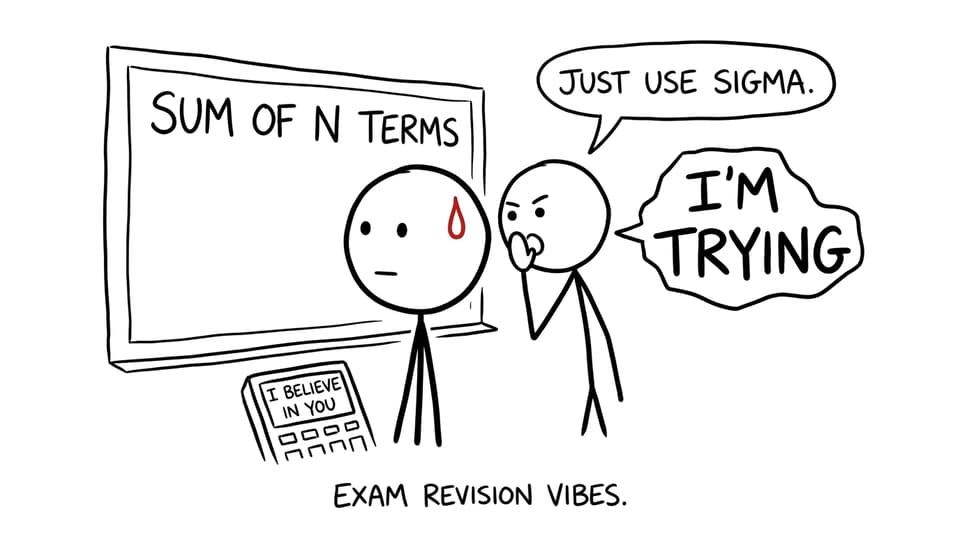
Before you touch any formula, run this 20-second check (it saves more marks than it costs):
-
Are you asked for a term (sequence) or a total (series)?
-
Identify first term (a_1).
-
Find the common difference (d).
-
Confirm the number of terms (n) (watch indexing).
-
Decide whether you know the last term (a_n) or need to calculate it.
-
Only then use the sum formula (and write it down first).
For targeted practice, the SL 1.2: Arithmetic sequences and series hub is the cleanest place to line up notes, questions, and skills in one view.
What an arithmetic series actually is (and what it isn’t)
An arithmetic sequence is about individual terms: 3, 7, 11, 15… where each step adds the same (d). An arithmetic series is what happens when IB Math asks you to total those terms.
So instead of “find (a_{20}),” you get “find (S_{20})” or “evaluate (\sum\limits_{k=1}^{20} a_k).” That shift in wording matters.
If your sequence fundamentals feel shaky, read Arithmetic Sequences Explained for IB Maths (AA SL & HL) first. Series becomes simpler when the sequence is automatic.
The arithmetic series formula you need for IB Math
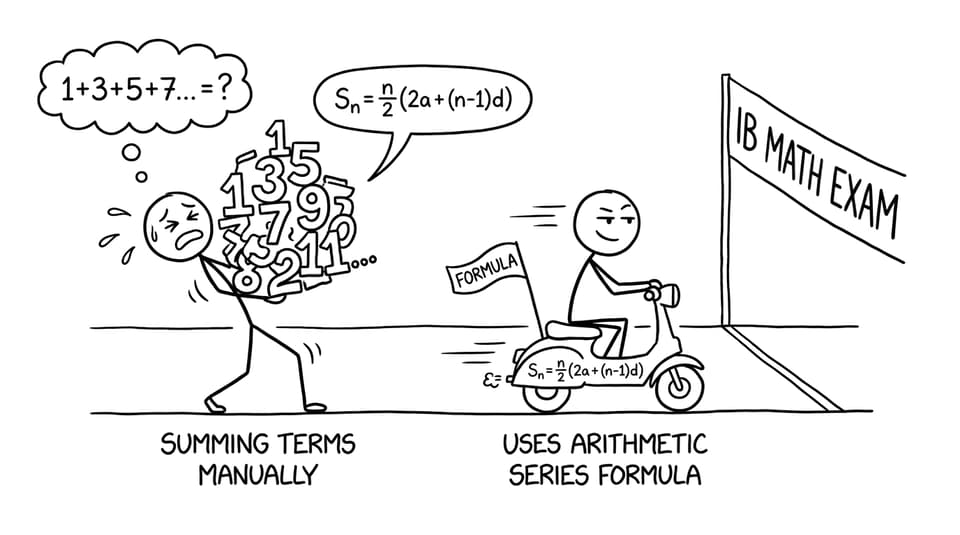
In IB Math, the core sum formulas are:
and, using the common difference (d):
You’ll often start with a messy-looking question that’s actually two tidy steps:
-
Use the sequence relationship (a_n = a_1 + (n-1)d) to find a missing value (usually (a_n) or (d)).
-
Substitute into the sum formula.
RevisionDojo’s SL 1.2 Study Notes lay out both forms clearly, including sigma notation translations that show up constantly in IB Math.
Why the formula works (the idea IB Math wants you to own)
Memorising is fine. But IB Math rewards students who can explain structure when a question is unfamiliar.
The classic reasoning is symmetry: write the series forward and backward.
-
Forward: (a_1 + a_2 + \dots + a_n)
-
Backward: (a_n + a_{n-1} + \dots + a_1)
Pair terms: (a_1+a_n), (a_2+a_{n-1}), and so on. Each pair sums to the same value ((a_1+a_n)), and there are (n) terms total, meaning (n/2) pairs. That’s where (\frac{n}{2}(a_1+a_n)) comes from.
When you understand that story, arithmetic series in IB Math stop feeling like a magic trick and start feeling like accounting.
Common arithmetic series mistakes (the ones examiners quietly count on)
The same errors repeat every session because they’re human errors, not math errors.
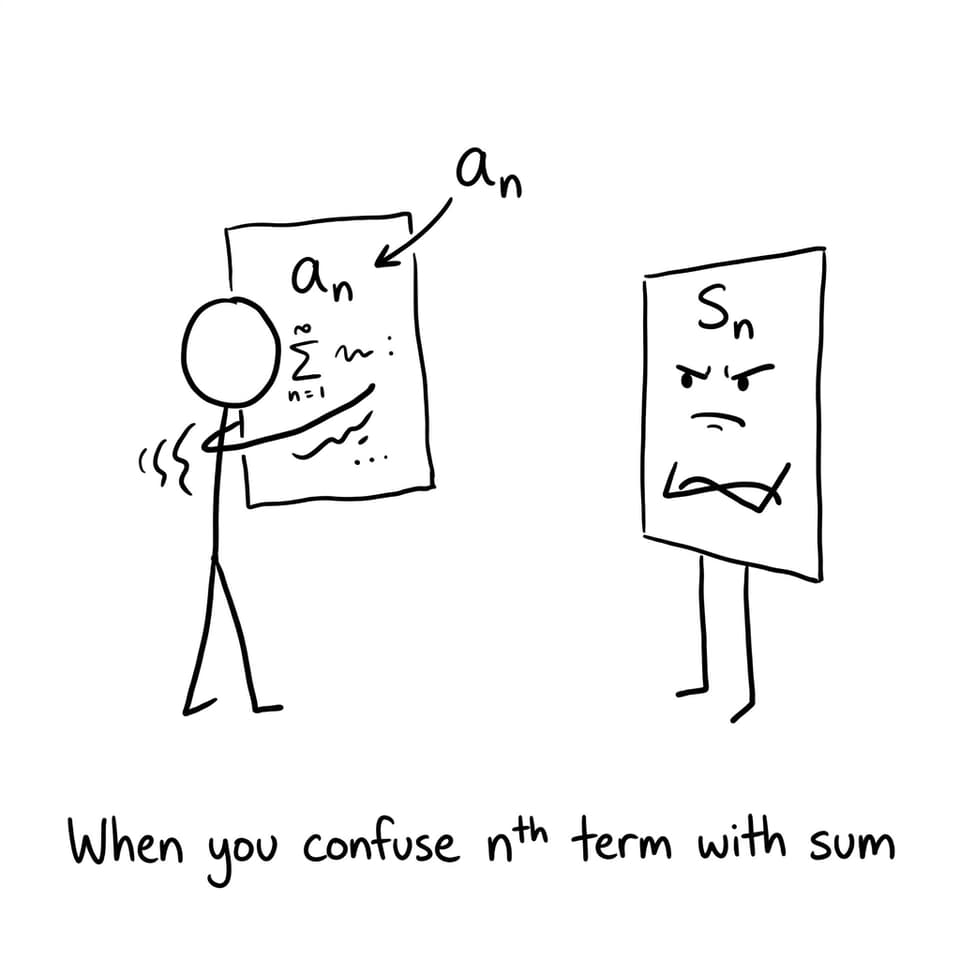
Mixing up (a_n) and (S_n)
This is the big one in IB Math: (a_n) is a term; (S_n) is a sum. If the question says “sum,” “total,” or shows sigma notation, your final line should probably begin with (S_n =).
Miscounting (n)
If the index starts at something other than 1, or you’re summing from (k=3) to (k=20), then (n\neq 20). In IB Math, many lost marks come from correct algebra with the wrong count.
Assuming the last term
Often you’re not given (a_n) directly. You’re expected to find it using (a_n = a_1 + (n-1)d) first, then sum. Don’t skip that step.
For more on why these mix-ups happen under pressure, Why Are Arithmetic Series So Easy to Mix Up in IB Maths? is worth ten calm minutes.
How to practise arithmetic series for IB Math (AA SL & HL)
Arithmetic series gets reliable when your practice is organised.
-
Use the SL 1.2 Questionbank to drill each question type (finding (d), finding (n), using given sums).
-
Review definitions fast with the SL 1.2 Flashcards when you’re short on time.
-
If you learn best by watching method marks unfold, the SL 1.2 Videos help you see the “write this, then this” rhythm.
-
Combine with exam strategy from How to Master IB Math AA Paper 1 so your algebra stays clean when the clock speeds up.
RevisionDojo also ties everything together with features you actually use: Study Notes for clarity, Flashcards for recall, AI Chat when you’re stuck at 11pm, Grading tools to learn from mistakes, Mock Exams for stamina, Predicted Papers for targeted final-week focus, and a Questionbank that keeps your IB Math practice honest.
Final takeaway: make arithmetic series a calm topic in IB Math
Arithmetic series is one of the few IB Math topics where your score improves almost linearly with good habits: identify what’s being asked, count (n) correctly, find (a_n) when needed, and substitute carefully. Then practise until the steps feel boring.
If you want that boredom (the good kind), use RevisionDojo’s IB Mathematics Analysis and Approaches resources to build a repeatable routine: quick recall with Flashcards, deeper understanding with Study Notes and Videos, and exam-ready accuracy with the Questionbank and Mock Exams. Arithmetic series stops being a trap when your process becomes automatic in IB Math.