


The pattern you swear you’ve seen before
Two minutes into an IB Math paper, you spot it: a tidy list of numbers stepping upward like stairs. You feel a flash of confidence… until the question asks for the 50th term, then turns it into algebra, then asks whether a certain value appears at all. That’s the quiet trick of arithmetic sequences: they look friendly, but they reward precision.
Arithmetic sequences are one of the first “formal” patterns in IB Math AA (SL and HL). They show up early because they train you to move between three languages: numbers, algebra, and context. If you can do that smoothly, later topics (series, modelling, proof-style reasoning) stop feeling like separate chapters and start feeling like one connected story.
Quick checklist: what you must be able to do
Before exam week, make sure your IB Math toolkit includes:
-
Recognise an arithmetic sequence by checking for a constant difference
-
Find the common difference quickly and correctly
-
Write the nth term (explicit) formula without mixing up
-
Use two given terms (not necessarily consecutive) to form equations
-
Decide if a number is in the sequence by solving for
For targeted practice, the cleanest place to drill this is RevisionDojo’s SL 1.2 topic hub, then switch to timed sets in the SL 1.2 Questionbank.
What is an arithmetic sequence (in exam terms)?
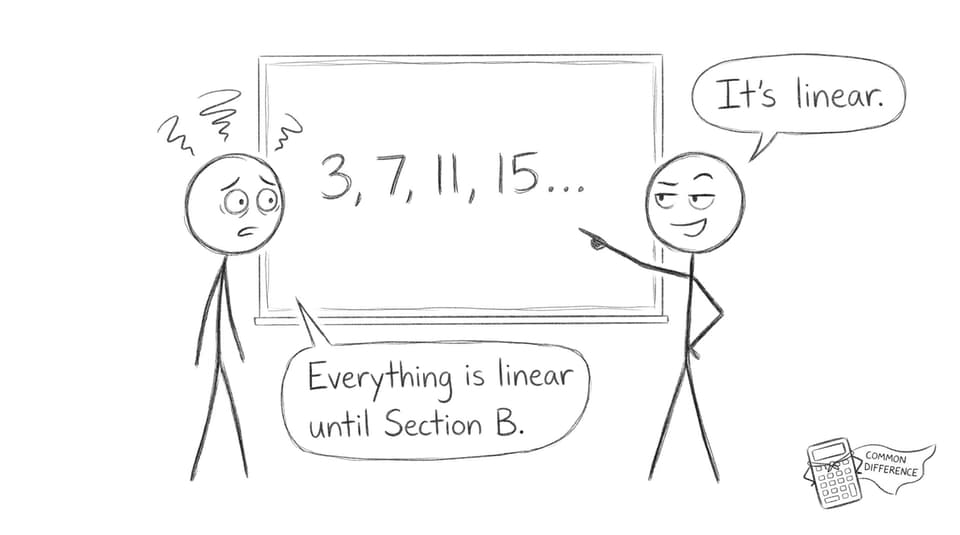
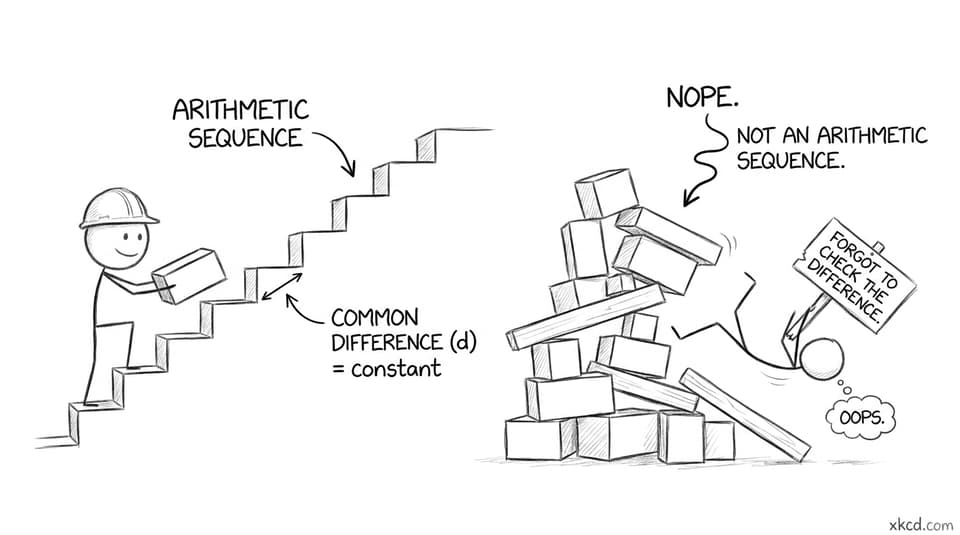
An arithmetic sequence is a list where the difference between consecutive terms is constant. That constant is the common difference, usually written .
Example:
-
Differences: each time
-
So it’s arithmetic with
This matters in IB Math because the constant difference creates a linear relationship between the term number and the value . When exam questions start blending sequences with functions or modelling, that “linear-ness” is the thread you follow.
If you want a syllabus-aligned explanation with examples and notation, RevisionDojo’s Arithmetic sequences and series notes are designed for AA SL/HL pacing.
The nth term formula (and why it’s always )
The explicit formula is:
-
Where:
-
is the first term
-
is the common difference
-
is the position
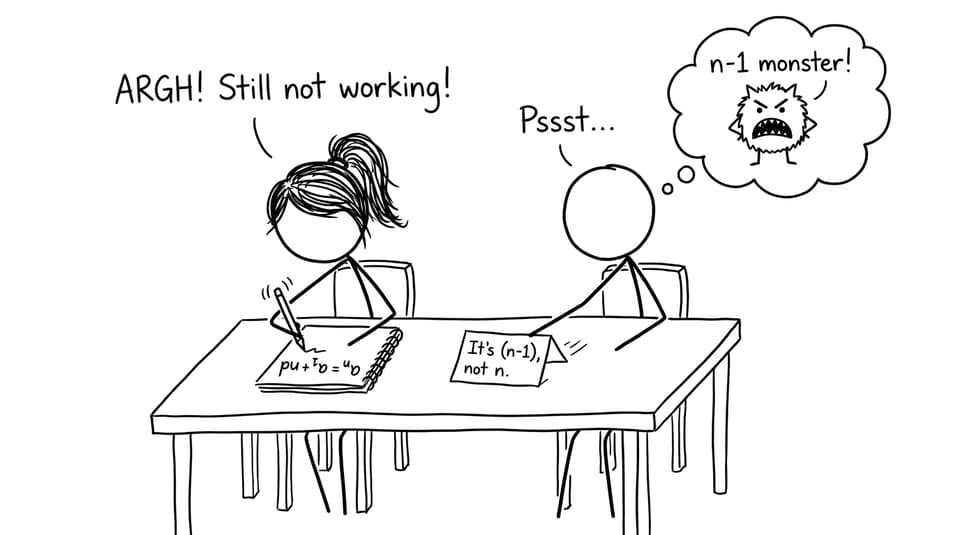
The is there because you take zero “steps” to reach the first term, one step to reach the second, and so on. In IB Math, most lost marks here are not “hard maths” mistakes. They’re indexing mistakes.
Mini-method: finding when terms aren’t consecutive
If you’re given two terms like and , don’t try to invent a shortcut under stress. Use the formula twice:
-
-
Then solve the simultaneous equations.
This is exactly the kind of algebra-meets-sequences move that IB Math examiners like, especially when the question is wrapped in words.
Why arithmetic sequences matter in IB Math (AA SL & HL)
Arithmetic sequences aren’t just a small skill to “get through.” They’re a template for how IB Math builds thinking:
-
Generalisation: turning a pattern into a formula
-
Algebraic control: rearranging cleanly under time pressure
-
Modelling: describing constant change (payments, schedules, linear growth)
-
Series readiness: sequences become sums, and sums become strategy
If series questions tend to blur together for you, pair this article with RevisionDojo’s post: Why arithmetic series are so easy to mix up in IB Maths. It clarifies the “term vs sum vs number of terms” confusion that causes most slips.
Common mistakes that cost easy marks
Forgetting to confirm it’s arithmetic
Students often see a “nice” pattern and assume. In IB Math, you should always check differences before using arithmetic formulas. One quick subtraction line can save an entire question.
Mixing up the first term with a zero index
Sometimes a sequence is described in a way that makes you think the first term is . Unless the question explicitly defines a starting index, standard interpretation uses . That small detail changes every result.
Using the right formula with the wrong
A surprisingly frequent error is calculating from two non-consecutive terms as if they were consecutive. If you jump from term to term , the total change is spread across steps, not 1.
Exam tips for AA SL & HL
-
Write down and before you do anything else. Treat them like “given information,” even if you had to compute them.
-
When asked if a value is in the sequence, set and solve for . In IB Math, you then must check is a positive integer.
-
Use RevisionDojo’s Flashcards for SL 1.2 for the formulas and the common “trap phrases.” Short, daily recall beats one long reread.
-
If you need a quick formula reference under pressure, keep the IB Math AA Data Booklet bookmarked.
For broader strategy (not just arithmetic), the sequences and series flashcard approach is a strong companion piece.
Closing: make the pattern work for you
Arithmetic sequences reward calm thinking: check the difference, name and , write the formula, and let the algebra do the heavy lifting. That’s the mindset IB Math is training, not not speed first, but clarity first.
If you want this topic to feel automatic by exam day, build a tight loop: learn with RevisionDojo Study Notes, reinforce with Flashcards, practise with the Questionbank, and pressure-test yourself with Mock Exams and Predicted Papers. When the sequence question shows up, you won’t “hope” it’s easy; it’s you’ll recognise it, structure it, and collect the marks.