

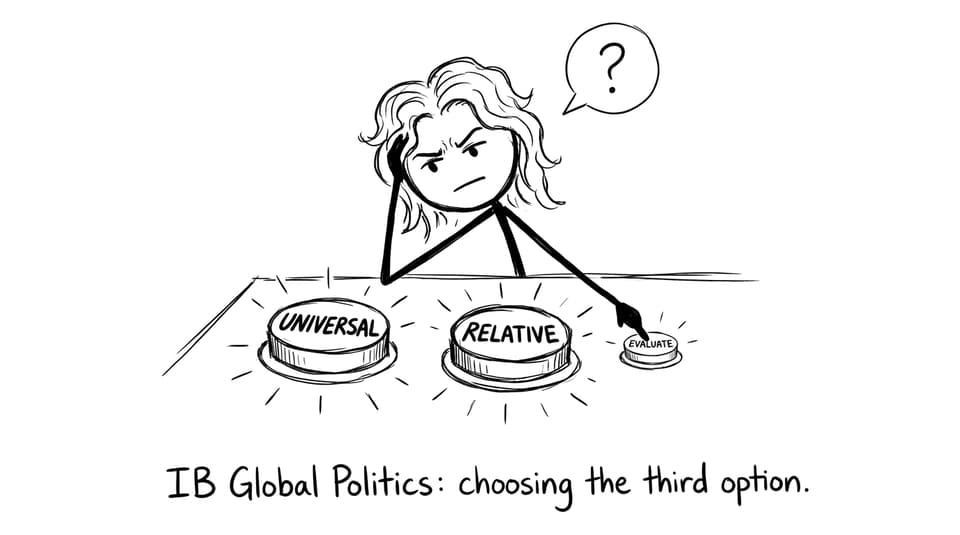
Human rights debates rarely start in a courtroom. They start in a classroom, at 11:48 pm, when you realise the question is not asking what you believe; it is asking what you can evaluate.
In IB Global Politics, “Are human rights universal or culturally relative?” is a classic because it forces you to hold two uncomfortable truths at once: people everywhere deserve dignity, and societies do not agree on what dignity looks like in practice.
IB Global Politics checklist for this debate
Use this quick checklist to build an exam-ready response in IB Global Politics:
-
Define universalism and cultural relativism in one sentence each.
-
Anchor universalism in international frameworks (UDHR and later treaties).
-
Explain relativism as context-based interpretation (culture, religion, history, sovereignty).
-
Evaluate strengths and risks of both (oppression loophole vs cultural imperialism).
-
Conclude with a balanced judgement: universal in principle, variable in implementation.
For clean definitions, keep the IB Global Politics Glossary open while you plan.
The universalist argument in IB Global Politics
Universalists claim human rights belong to individuals simply because they are human. In IB Global Politics, that matters because it sets a moral limit on state power: sovereignty is not supposed to be a free pass.
Universalism is closely linked to the post-1945 human rights project, especially the Universal Declaration of Human Rights (UDHR) adopted in 1948. The UDHR is not legally binding on its own, but it has major moral authority and influenced binding treaties such as the ICCPR and ICESCR. If you need crisp treaty context and examples of rights, RevisionDojo’s Understanding Human Rights Notes are a fast refresher.
Strengths to evaluate:
-
Protects vulnerable groups by setting standards above local politics.
-
Enables global criticism, naming-and-shaming, and international legal pressure.
-
Supports the idea that some harms (like torture) should never be justified.
Common critique: universalism can sound like one culture announcing its values as “neutral.” That critique becomes sharper when enforcement is selective or power-driven.
The cultural relativist argument in IB Global Politics
Cultural relativists argue rights are socially constructed and should be interpreted within local moral frameworks. In IB Global Politics, this links to sovereignty, identity, and the politics of legitimacy: laws that feel imported can lack domestic buy-in.
Relativists often warn that “universal” language can mask Western dominance, especially when civil and political rights are prioritised over economic, social, and collective rights. If you want a direct exam-ready version of that debate, read Are Human Rights Dominated by Western Values?.
Strengths to evaluate:
-
Respects pluralism and avoids simplistic moral ranking of societies.
-
Recognises that implementation depends on local institutions and history.
-
Highlights global power imbalances in who defines and enforces norms.
Major weakness: relativism can become a loophole. Governments may frame repression as “tradition” and label criticism as neo-colonial interference.
A high-scoring IB Global Politics middle-ground
The best IB Global Politics answers often land on a principled compromise: rights are universal in claim, but culturally shaped in expression.
That sounds abstract, so make it concrete:
-
Universality answers “Do rights exist?”
-
Cultural context answers “How are rights prioritised, interpreted, and enforced?”
You can support this with the idea that human rights are “contested meanings” rather than fixed truths. RevisionDojo’s Competing Global Perspectives on Human Rights Notes help you frame that contest without falling into stereotypes.
If you need a quick conceptual link, pair this debate with sovereignty: see What Is Sovereignty in Global Politics?.
How to turn this into marks (not just opinions)
In IB Global Politics, evaluation is not “being balanced.” It is explaining why an argument works in some contexts and fails in others.
Try this exam structure:
-
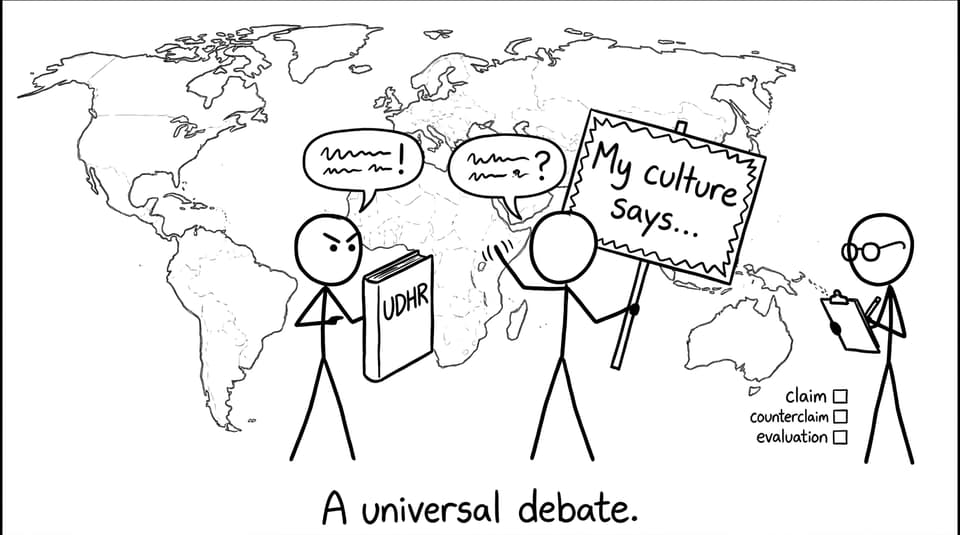
Claim: Universal standards prevent abuse and protect dignity.
-
Counterclaim: Universal standards can ignore local legitimacy and become coercive.
-
Evaluation: The stronger approach is universal minimums (non-derogable protections) plus culturally sensitive pathways to implementation.
To practise the writing muscle, use RevisionDojo’s Rights and Justice Questionbank and the Paper 1 Guide Questionbank to drill both source analysis and argument structure.
Conclusion: the exam wants judgement, not certainty
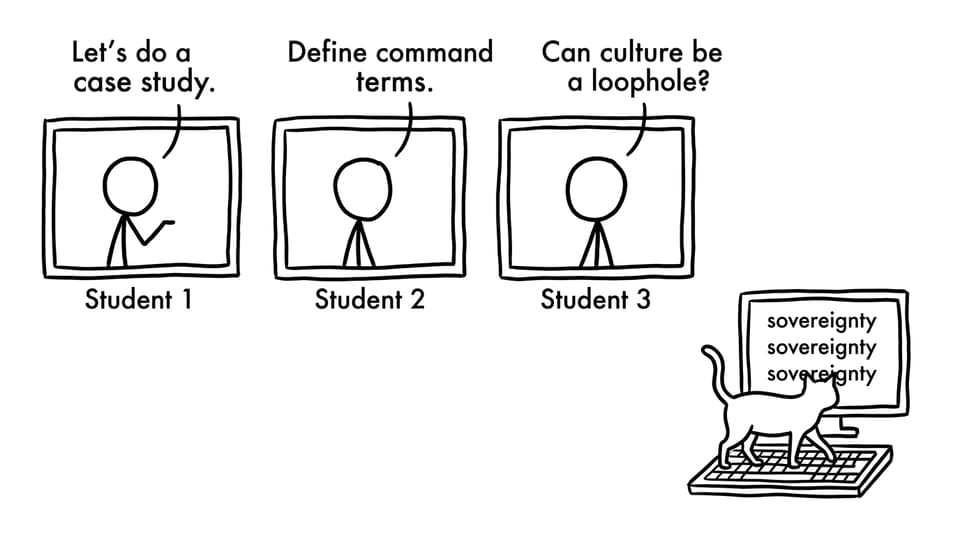
The universalism vs cultural relativism debate is not a trap in IB Global Politics. It is a mirror: it shows how power, identity, sovereignty, and legitimacy collide when we try to protect individuals.
If you want to turn that collision into confident marks, build your toolkit on RevisionDojo: start with the IB Global Politics subject hub, revise concepts with Understanding Human Rights Flashcards, and practise under exam pressure with the Questionbank, AI Chat, grading tools, predicted papers, mock exams, and study notes. In IB Global Politics, the student who evaluates calmly usually wins.