

Tragedy and comedy don’t just feel different. They train you to read differently.
The first time you notice it, it’s almost embarrassing. In one scene, a character pauses, says nothing, and the silence lands like a verdict. In another, a character says far too much, and the audience laughs because the truth slipped out by accident. Same toolset: structure, dialogue, staging. Different emotional math.
For IB English students, that distinction matters because exams reward the ability to explain how playwrights manufacture impact. Not “it’s sad” or “it’s funny”, but why it becomes sad, why it becomes funny, and what that response reveals about theme, power, identity, or morality.
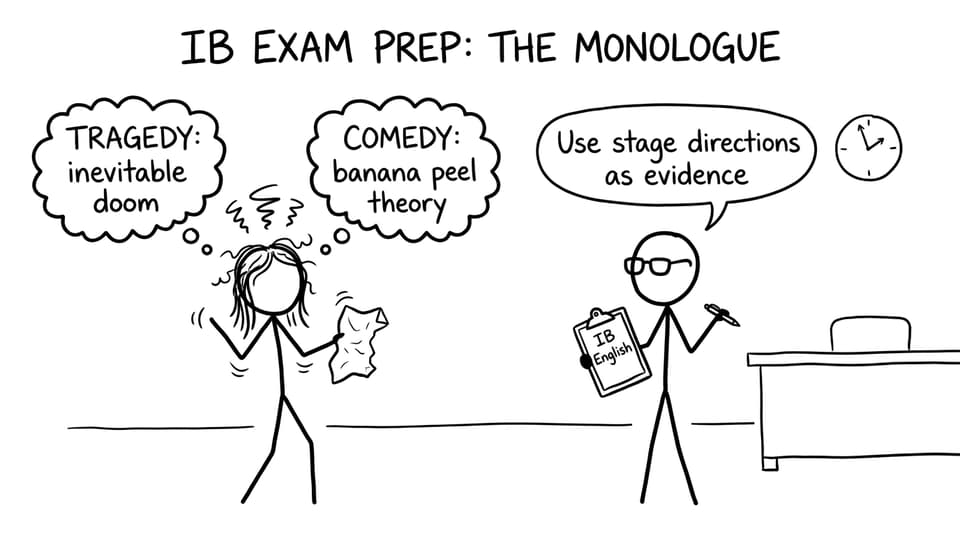
A quick exam checklist for tragedy and comedy (save this)
Before you write a single paragraph in IB English, run this quick scan:
-
What expectations does the genre set (doom vs restoration, pity vs ridicule)?
-
Where does the play turn (reversal, recognition, escalation, misunderstanding)?
-
What does dialogue do: confess, disguise, persuade, destabilize?
-
What do stage directions quietly “argue” about tone and power?
-
How does the ending shape meaning: collapse, consequence, reconciliation, uneasy balance?
If you need a technique refresher, RevisionDojo’s Drama notes for IB are a fast way to rebuild your vocabulary for staging, tension, and characterisation.
Tragedy in IB English drama: how inevitability is engineered
Tragedy is rarely just “a sad ending.” It’s a pattern of pressure.
In IB English drama analysis, tragedy usually shows up as a tightening structure: choices shrink, consequences grow, and language starts to feel like a trap. Classical tragedy often centers on a figure whose status, pride, or moral blindness accelerates their fall; modern tragedy can make the “tragic hero” ordinary, which is sometimes more unsettling because it feels plausible.
Look for these tragic design choices:
Structural compression
Scenes begin to shorten, entrances and exits become more urgent, and revelations arrive later than you want them to. That delay is the point: it manufactures inevitability. In your commentary, name the pacing and connect it to audience response.
Dialogue that foreshadows, even when characters don’t
Tragic dialogue often carries double meaning: a vow sounds like a warning; a joke lands like prophecy. Track repeated phrases, ritualistic language, or the way characters dodge direct answers.
Staging as moral pressure
In tragedy, space can accuse. Isolation on stage, lights narrowing, a prop that becomes symbolic (a letter, a weapon, a doorway) can act like a visual “argument.” If you’re practicing timed analysis, build speed with English Paper 1 tools and the Paper 1 revision guide.
For targeted practice on drama passages, use RevisionDojo’s IB English Literature drama questionbank or the IB English Lang & Lit drama questionbank. They’re ideal for drilling “evidence to effect” under time.
Comedy in IB English drama: how disorder becomes meaning
Comedy is sometimes treated like the “easy” genre, but in IB English it can be harder to analyze well because students summarize jokes instead of explaining mechanisms.
Most comic plots run on engineered misunderstanding: characters misread motives, language slips, social rules collide, and status gets scrambled. Comedy often ends with repair, but that repair can be sincere, cynical, or conditional.
Timing and repetition
Comedy is built on patterns: a repeated insult, a recurring interruption, a phrase that changes meaning each time. The repetition isn’t filler; it’s a structure that trains the audience to anticipate, then rewards or subverts that anticipation.
Wordplay and social exposure
Comic dialogue often “accidentally” reveals hierarchy. Who interrupts? Who corrects? Who performs intelligence? Who is laughed at, and who gets to laugh? Comedy can critique a society while still entertaining it, which is exactly the tension you can write about in IB English.
Stage directions as punchlines
A small note like “pause,” “aside,” or “looks away” can flip a line from sincere to ironic. When you anchor your interpretation in stagecraft, you signal mature dramatic awareness.
To sharpen your overall genre awareness, connect drama techniques to broader course thinking using IB English posts and strategies.
When tragedy and comedy blur: tragicomedy and tonal whiplash
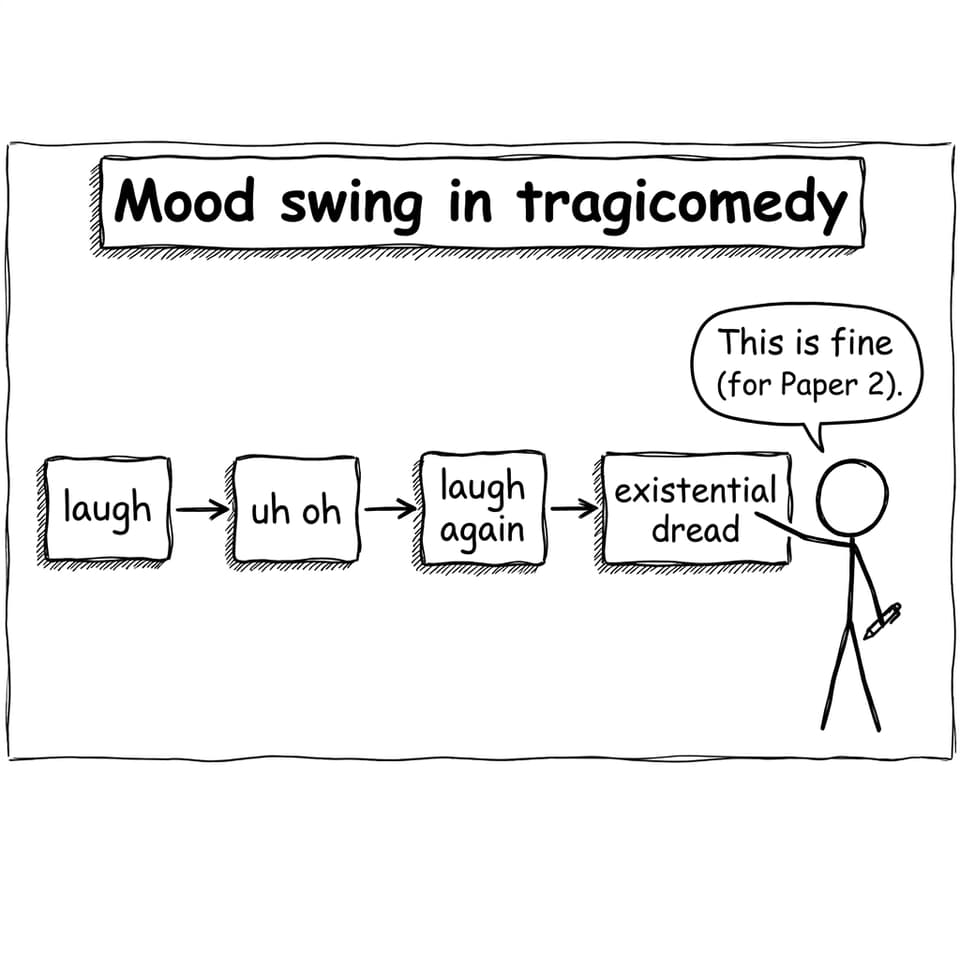
Some plays refuse to behave. They make you laugh, then punish you for it.
That’s not confusion. It’s craft.
In IB English, hybrid forms are an opportunity: you can argue that tonal shifts reveal uncomfortable truths, create emotional contrast, or expose how societies normalize suffering through humor.
Watch for:
-
Comic relief that deepens tragedy (laughter as denial)
-
Tragic beats inside comic structures (the “restoration” feels fragile)
-
Sudden mood shifts that force the audience to re-evaluate character morality
Character arcs: sympathy, ridicule, and the examiner’s favorite word: “effect”
A useful IB English habit is to describe character function, not just character traits.
In tragedy, characters often accumulate moral weight: their decisions carry consequence, and their self-knowledge arrives late (or never). In comedy, characters are frequently exaggerated not because the playwright is shallow, but because exaggeration makes a social pattern visible.
When you write about characters, push beyond “flawed” or “funny.” Try:
-
How does the character control information?
-
How does the character’s language shift under pressure?
-
How does the audience’s relationship to the character change across the play?
For exam preparation, this maps cleanly onto Paper 2 comparison, where you’re rewarded for linking technique to theme. RevisionDojo’s Paper 2 structure guide for IB English and the IB English Paper 2 essentials are strong starting points.
Closing: make your IB English drama analysis feel inevitable
The best IB English drama essays feel like the play itself: each point creates pressure, each quotation earns its place, and the conclusion lands because you’ve made it unavoidable.
If you want a reliable system, build it the way actors do: rehearse small sections repeatedly. Use RevisionDojo’s Questionbank, Study Notes, and Flashcards to automate technique spotting; draft timed responses with Predicted Papers and Mock Exams; then tighten your expression with AI Chat and Grading tools so your analysis stays clear under stress. When you do that, tragedy and comedy stop being labels you memorize, and become levers you can pull on purpose.