Join 650k+ students breezing through the IBReady to breeze through the IB?
In the exam room, poems have a strange talent: they look calm on the page while your brain does the opposite.
You read once, you understand the topic. You read twice, you notice a metaphor. You read a third time, and suddenly the line breaks feel like trapdoors. That moment is where IB English marks are often hiding. Because in IB English, poetic meaning is rarely only in what is said. It is also in the poem’s container, its form.
Form is the poet’s quiet contract with the reader. A sonnet promises control and pattern. Free verse promises flexibility (but never randomness). When you learn to analyze poetic form, you stop “spotting techniques” and start explaining design choices, which is exactly what strong Paper 1 commentary rewards.
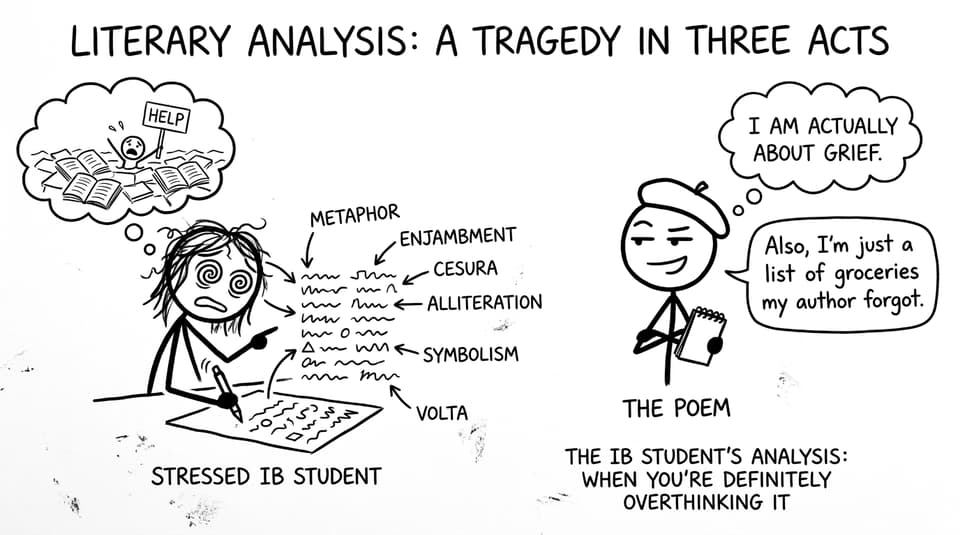
An over-labeled poem vs its real meaning
Poetic form in IB English: a fast checklist
Use this as a 60-second scan before you write anything:
Name the form if it’s clear (sonnet, free verse, elegy, ode, etc.).
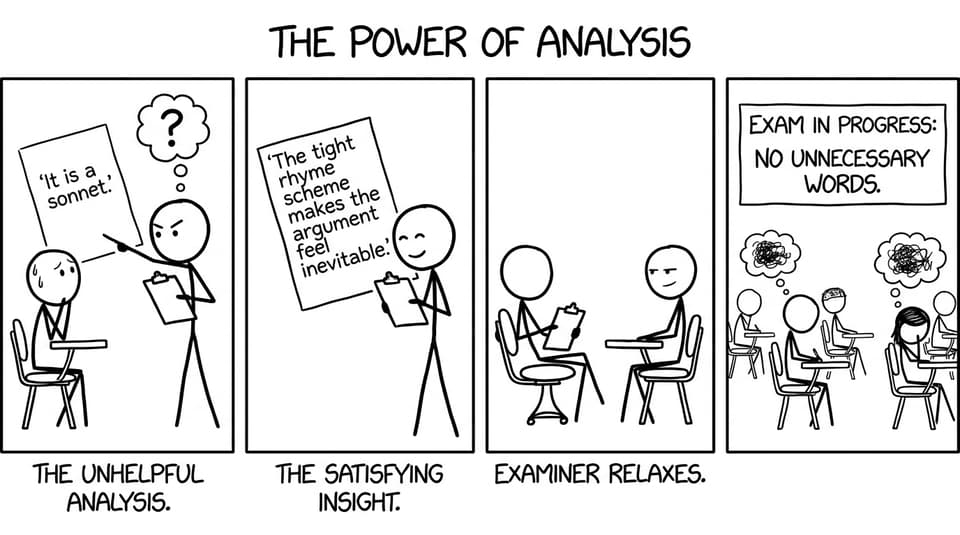
In IB English, examiners can tell when a student treats form like a label. “It is a sonnet” is not analysis. It’s the start of analysis.
Form controls the reader’s experience the way editing controls a film. It decides when we pause, what we notice, and how quickly an idea gathers pressure. A strict form can suggest restraint, tradition, inevitability, even obsession. A loosened form can suggest intimacy, spontaneity, rupture, or resistance.
If you’re building your Paper 1 skills, the bigger skill underneath form is close reading: noticing first, interpreting second. RevisionDojo’s breakdown of Close Reading Techniques for Prose and Poetry is a useful companion when your analysis feels scattered.
Sonnet: when constraint becomes meaning
A sonnet is often recognizable before you understand a single line: it looks compact, deliberate, almost architectural. Most students know the headline facts (14 lines; common rhyme patterns). But IB English essays improve when you describe what that architecture does.
What to look for in a sonnet
The argument’s shape: many sonnets move like a debate: setup, complication, response.
The volta (turn): a pivot in mood or logic that re-frames what came before.
Sound discipline: rhyme and meter can create a sense of control, certainty, or ritual.
Tension with the rules: when the poet strains against the form, the strain is often the point.
A sonnet about love can feel “too neat” on purpose, as if the speaker is trying to tidy messy emotion into a safe box. Or the opposite: the tightness can intensify urgency, like a speaker forcing themselves to stay composed while breaking internally.
For practice, build timed drills with RevisionDojo’s IB English Lit Poems Questionbank and focus on writing one paragraph that links sonnet structure to a single effect.
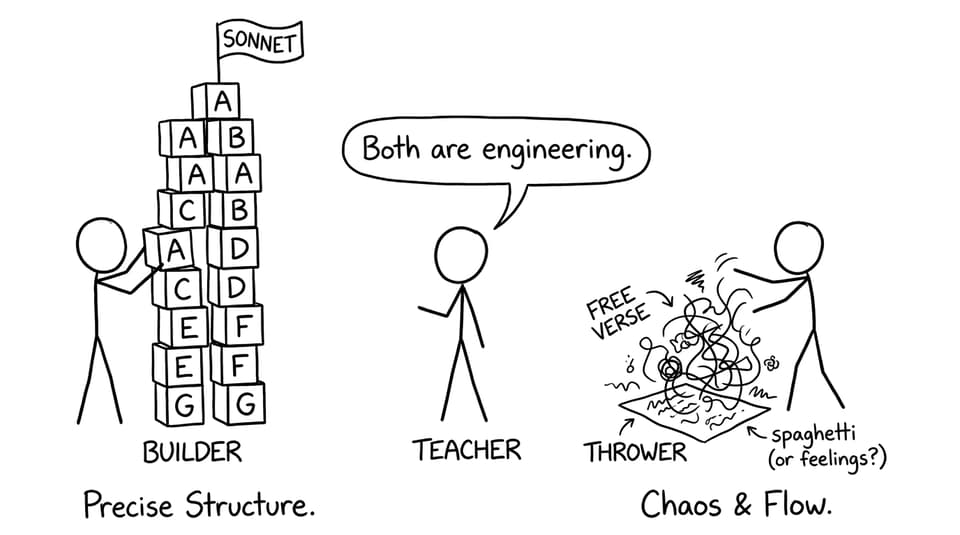
Sonnet blocks vs free verse spaghetti
Free verse: freedom with fingerprints
Free verse is sometimes misunderstood as “no rules.” In IB English, it helps to treat free verse as “rules you must infer.” The poet is still designing your reading experience; the blueprint is just less obvious.
What to look for in free verse
Line breaks as decision points: what word gets isolated? what phrase gets delayed?
White space and silence: pauses can imply reflection, avoidance, shock, or distance.
Repetition: free verse often creates structure through echo instead of rhyme.
Visual pacing: short lines can feel like hesitation; long lines can feel like insistence or overflow.
Free verse can sound conversational while being highly engineered. If the poem’s voice feels intimate, ask how the loosened form helps create that closeness. If the voice feels fragmented, ask how the broken structure mirrors that psychology.
To sharpen technique vocabulary without turning your writing into a checklist, revise selectively with RevisionDojo’s Poems Notes.
Other forms you can mention (without memorizing a dictionary)
In IB English, you don’t need to name every form perfectly. You need to recognize conventions and connect them to meaning.
Elegy
An elegy is shaped by loss. Many elegies move from grief toward reflection, acceptance, or unresolved silence. If the structure feels like stages, write about that emotional progression.
Ode
An ode often feels like elevated attention: praise, wonder, careful address. Notice how form can create ceremony, as if the speaker is building a pedestal out of language.
Narrative poetry
Narrative poems borrow momentum from storytelling: shifts in scene, pacing, or voice. Form here often controls suspense: short lines to speed up, longer descriptive stretches to linger.
Dramatic monologue
A dramatic monologue builds character through voice. Structure matters because the speaker often reveals themselves through what they repeat, avoid, or suddenly “turn” away from.
Conclusion: form is the shortcut to deeper meaning
The quickest way to level up in IB English poetry is to stop treating form as decoration. Form is meaning in motion: it governs emphasis, builds tension, and controls the emotional turn.
If you want to practice this skill systematically, RevisionDojo makes it easier to train under exam conditions: build targeted drills with the Questionbank, tighten terminology with Study Notes and Flashcards, test yourself with Mock Exams and Predicted Papers, and use AI Chat plus Grading tools to refine commentary paragraphs quickly. When you’re ready for extra support, the Tutors and Coursework Library help you turn good observations into consistently high-scoring analysis.
For more exam-focused guidance, explore the full IB English resources hub and keep form at the center of your next commentary.