There’s a quiet moment most students hit in the middle of the IB journey.
It’s not during the big exam countdown. It’s earlier. Usually late at night, when your to-do list has started to look like a personality test: six subjects, Internal Assessments, Theory of Knowledge, the Extended Essay, CAS reflections, and a calendar that feels like it’s closing in.
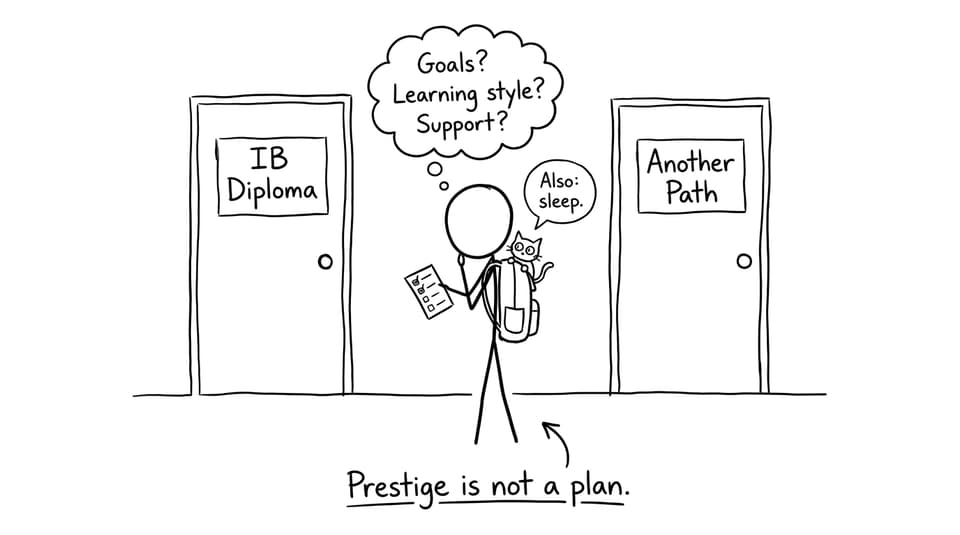
In that moment, a surprisingly mature question appears: Should I actually be doing the IB Diploma at all?
This post is a calm look at why you might choose not to take the IB Diploma. Not because you “can’t handle it,” but because the best academic pathway is the one that fits your goals, your learning style, and your support system.
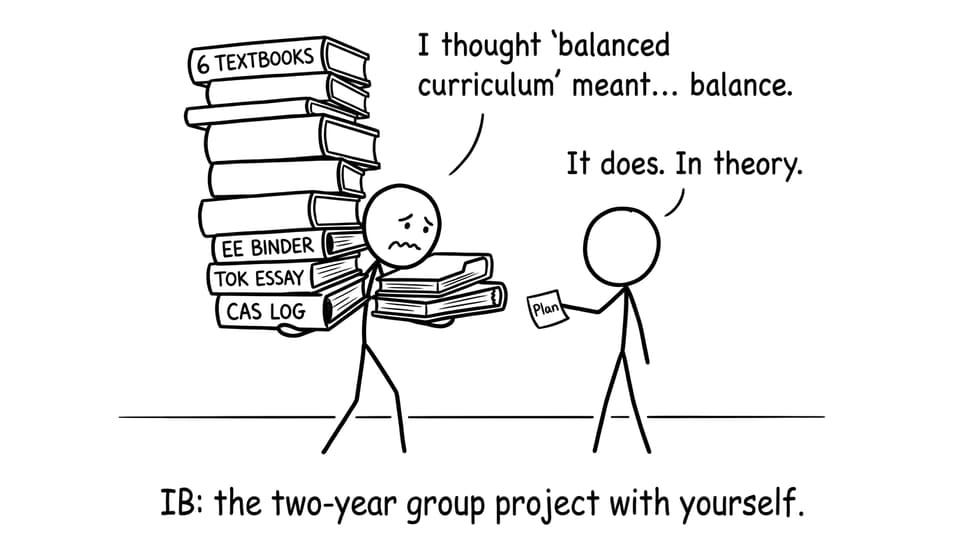
IB: the two-year group project with yourself
A quick self-check before you decide on the IB
If you’re deciding between the IB Diploma and another route, start with this checklist. Answer honestly.
Do you manage long-term deadlines well, even when motivation drops?
Do you want breadth (six subjects) more than early specialization?
Does your school have strong, experienced IB teaching and clear timelines?
Do you learn best through writing, reflection, and research-based coursework?
Can you protect sleep and mental health while keeping steady output for two years?
If you answered “no” to several of these, it doesn’t mean you’re doomed. It might mean the full Diploma isn’t your best tool.
IB
The IB workload is continuous, not seasonal
A lot of students think school systems are like sprint training: study hard, peak at exams, rest afterward.
The IB isn’t built like that.
The diploma rewards consistency: you carry six subjects while producing coursework in parallel, and the stress is often not the exams themselves but the feeling that you’re always behind on something. If you already know you struggle with pacing projects, overlapping deadlines can turn into a permanent hum of pressure.
This is where having a tight revision system matters. Many students reduce that stress by running a simple loop using Study Notes, Flashcards, and a Questionbank so daily work stays small and measurable. RevisionDojo is designed for that kind of calm structure: start at RevisionDojo for IB, then build your routine from there.
The IB breadth can feel like friction if you want to specialize early
The IB is proud of its range. Six subject groups are part of the identity.
But if you’re already certain you want to go deep in a narrow direction, the breadth can feel like a tax.
A student aiming for engineering might resent how much time they spend maintaining high-level writing in another subject. A student committed to humanities might feel forced to keep a science alive just to satisfy the structure. Breadth can build adaptable thinkers, but it can also dilute focus when you crave depth.
If your decision is mainly about “how do I study efficiently right now,” it helps to look at how high-performing IB students actually revise. This guide is a good grounding point: The Ultimate Guide to Revision for IB Students.
The IB depends heavily on school support quality
This one is uncomfortable, but true.
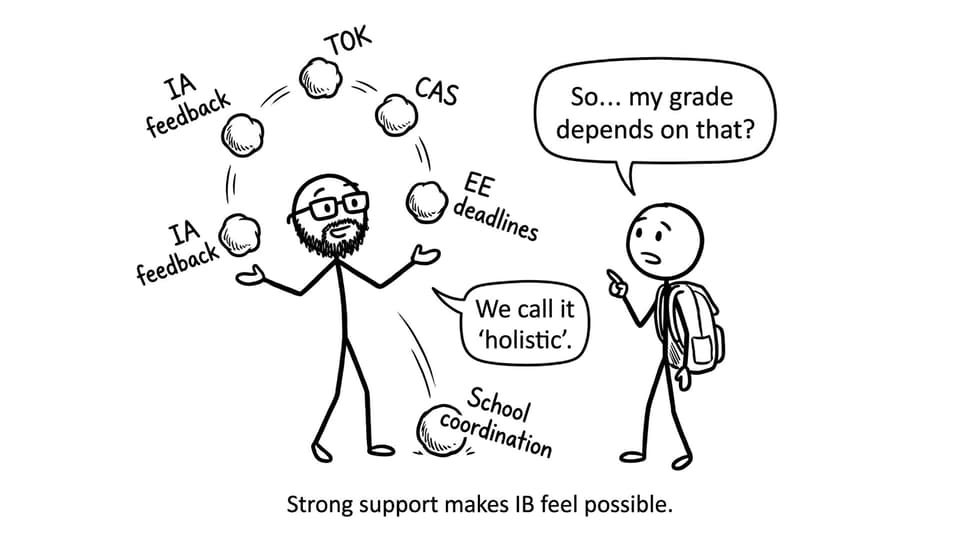
Two students can take the same IB subjects and have wildly different experiences based on how well their school runs the program. Clear IA timelines, strong feedback cycles, and consistent coordination are not “nice extras.” They are part of what makes the diploma survivable.
In a school with limited experience, you may get delayed feedback, unclear internal expectations, or shifting deadlines. The workload doesn’t get smaller. You just carry it with less guidance.
If you’re already enrolled and you’re trying to compensate for inconsistent support, tools that provide fast feedback can make a real difference. RevisionDojo’s Questionbank and Study Notes help you move forward even when external feedback is slow.
Strong support makes IB feel possible
Your learning style might not match how the IB measures success
Some students thrive on essays, reflection, and messy thinking that becomes clear through writing.
Others thrive on tighter, more exam-only systems with more predictable assessment formats.
The IB leans heavily toward analysis, research, and written evaluation. If your strengths are practical, technical, or highly structured, you can still succeed, but you may find the system constantly asks you to perform in a way that drains you.
This isn’t about intelligence. It’s about fit.
If you do stay in the IB, a helpful move is to shift from “I studied” to “I practiced the way the IB rewards.” That’s exactly what RevisionDojo’s exam-prep workflow focuses on in RevisionDojo App: The Smarter Way to Prep for IB Exams.
Costs and access can quietly shape your IB experience
Even when students don’t talk about it, resources matter.
The IB can come with exam fees, technology needs, and uneven access to trained teachers. If your environment makes consistent support hard to access, the diploma can feel less like an academic challenge and more like a logistics problem.
In those cases, you want study tools that reduce friction: fast explanations, reliable practice, and a clear sense of progress. Daily spaced repetition with IB Flashcards plus targeted practice can stabilize your confidence without adding extra cost or confusion.
The IB can crowd out balance unless you protect it on purpose
A lot of burnout isn’t caused by a single hard week. It’s caused by two years of never feeling “done.”
The students who suffer most in the IB are often not the least capable. They’re the ones who treat every task as if it must be perfect, and every evening as if it must be sacrificed.
If you’re choosing not to do the diploma because you want to protect mental health, relationships, sport, art, or sleep, that’s not a weak decision. It’s a strategic one.
If you don’t take the IB Diploma, you can still think like an IB student
Choosing not to do the IB Diploma doesn’t mean choosing not to grow.
You can still take parts of the experience: certificate courses, research projects, and disciplined exam preparation habits. You can also borrow the most powerful IB skill: turning vague effort into a feedback loop.
That’s why RevisionDojo’s ecosystem matters even beyond “the diploma identity.” Students use Questionbank practice to build accuracy, Mock Exams and Predicted Papers to rehearse timing, AI Chat to get unstuck fast, and Grading tools plus the Coursework Library and Tutors when they need sharper feedback.
The IB Diploma is respected for a reason. It can be transformative. But it’s not the only path to a strong future, and it’s not automatically the best path for every student.
If you choose not to take the IB, choose it deliberately, then commit to doing your chosen route well. And if you do choose the IB, don’t rely on willpower alone. Build a system.
When you’re ready, RevisionDojo can be the structure that makes the IB feel less like a constant emergency and more like a series of small wins: RevisionDojo for IB.
Isabel earned her Licenciatura in Filologia Hispanica from the Universidad de Salamanca and is a certified IB Spanish B and ab initio educator with 16 years in the Diploma Programme. Her focus is the IB Spanish B and ab initio assessments: the individual oral, listening, and the Paper 2 writing tasks, building the spontaneous production examiners reward.