


The moment you realise the new IB History course (first assessment 2028) is “global” is usually not in class. It’s later, at your desk, when you try to plan an essay and notice your argument keeps shrinking into a single-country story.
That’s the quiet trap. Many students revise IB History as if it’s still a neat set of regional folders: one case study, one timeline, one national narrative. But the redesigned course isn’t asking you to memorise more places. It’s asking you to think like a historian who notices connections, tensions, transfers of power, and echoes across borders.
If you learn that early, your revision gets simpler. If you learn it late, your essays feel “well-informed” but inexplicably capped.
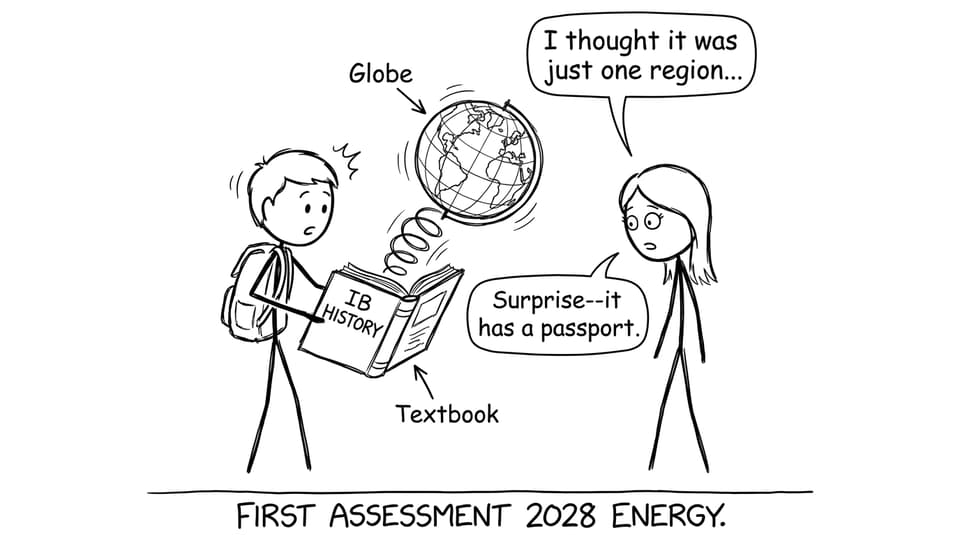
Quick start checklist for global IB History thinking
Use this short checklist before you write any plan, paragraph, or full essay in IB History:
-
Can I place my case study inside a wider international context?
-
Can I compare it to at least one other region or state meaningfully?
-
Can I explain connections (ideas, trade, war, migration), not just events?
-
Can I show multiple perspectives, not one national viewpoint?
-
Can I link short-term triggers to long-term global patterns?
For an overview of the full course structure and what each paper rewards, keep this guide open: IB History Exam Prep: A Comprehensive Guide.
What “truly global” means in IB History (first assessment 2028)
Global IB History does not mean studying every continent equally, or collecting random facts from everywhere. It means your explanation should work in a world where countries don’t develop in isolation.
In practice, “global” shows up when you do at least one of these things well:
-
Contextualise: show how local events are shaped by wider forces.
-
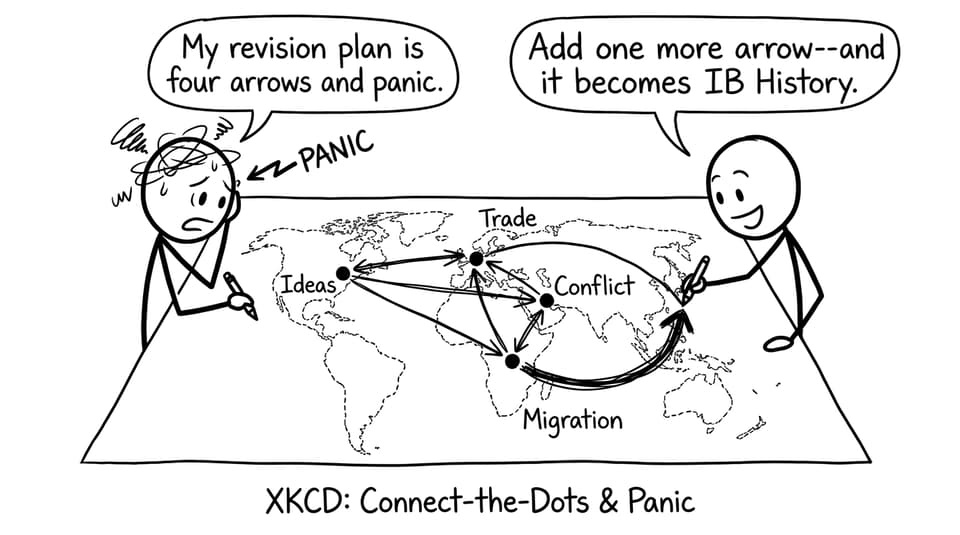
Connect: trace how people, ideas, economies, or conflicts move across borders.
-
Compare: explain why outcomes diverge across different places.
-
Interpret: recognise that perspectives differ depending on position and power.
If you want a fast way to practice this mindset, the RevisionDojo IB History resources hub is built around skills (argument, evidence, comparison) rather than just content lists.
Why IB History shifted toward a global approach
There’s a reason the redesign feels like a “zoom out.” Historians rarely explain change using one lever. Revolutions interact with wars. Economic systems reshape politics. Ideologies travel faster than borders can contain.
The new IB History approach rewards students who can:
-
Identify patterns (authoritarian consolidation, decolonisation pressures, rights movements)
-
Track flows (capital, labour, propaganda, arms, alliances)
-
Evaluate causation beyond a single actor or state
That also makes assessment fairer in a subtle way: you’re not being graded on whether you “picked the right country,” but whether you can reason with evidence inside a larger historical world.
When students struggle with this shift, it’s often not a content problem but a thinking problem. This breakdown helps: Why Students Struggle With IB History (First Assessment 2028).
How global thinking appears in IB History exams
Even when an IB History question looks local, the markbands often reward answers that can do more than narrate. Global thinking tends to appear through three common exam expectations:
Comparison is no longer optional
A strong response doesn’t just list similarities and differences. It explains why those similarities and differences exist.
A useful planning line is:
“Both experienced X, but for different structural reasons: A because…, B because…”
This is exactly where targeted practice helps. RevisionDojo’s Questionbank lets you drill comparative prompts and then fix patterns with feedback loops, not guesswork.
Wider context is a mark multiplier
Your case study becomes more persuasive when it sits inside:
-
international pressures
-
ideological competition
-
economic dependencies
-
regional security dynamics
For Paper 1 style skills and source-driven global context, you can practice directly in topics like Paper 1: Conflict and Intervention or Paper 1: Rights and Protest.
Perspectives are part of analysis, not decoration
Global IB History expects you to notice that “significance” changes depending on who is speaking. A policy can be stabilising for one group and catastrophic for another. A movement can be liberation in one narrative and “threat” in another.
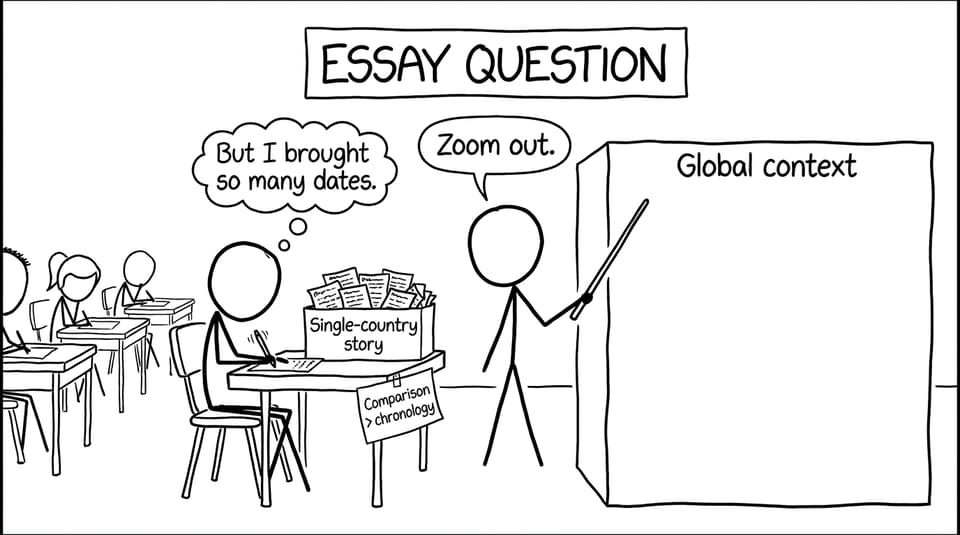
The biggest mistake: the single-country comfort essay
The most common trap in IB History FA 2028 prep is writing an answer that is technically correct but structurally small.
It often sounds like:
-
“First this happened, then this happened…”
-
heavy chronology, light argument
-
one perspective treated as the whole story
Examiners aren’t punishing your chosen country. They’re signalling that history is bigger than the borders you’re writing inside.
A quick fix is to build a “global paragraph habit.” In every body paragraph, include one sentence that does one of the following:
-
connects to an international factor
-
compares to another case
-
evaluates differing interpretations
That one sentence often pulls an essay up a level because it signals control.
How to revise IB History in a global way (without revising “more”)
Global revision for IB History is less about adding content and more about upgrading your organisation.
Build theme cards, not country folders
Instead of separate notes titled “Country A” and “Country B,” build pages titled:
-
Causes
-
Methods of control
-
Opposition and resistance
-
Economic change
-
International impact
Then slot evidence from each case study under the same themes. RevisionDojo’s Study Notes and Flashcards are ideal for this because you can build recall around themes and then swap case studies in and out.
Practice exam performance, not just knowledge
Once your themes exist, you need timed decisions: which evidence to choose, which comparison strengthens the line of argument, which perspective complicates it.
Use History Predicted Papers (Free) to rehearse global thinking under pressure, and pair it with Mock Exams and Grading tools to see where your writing collapses into narration.
Use coursework to learn the “global voice”
Even if you’re thinking mainly about exams, your IA training improves everything: selecting evidence, evaluating sources, sustaining an argument.
These will sharpen that skill set fast:
Closing: make IB History bigger than borders
The new IB History course (first assessment 2028) is truly global because it grades what historians actually do: connect, compare, contextualise, and interpret. The student advantage isn’t “knowing more countries.” It’s learning how to build arguments that travel.
If you want one place to practise that global style of IB History, with a Questionbank, Study Notes, Flashcards, AI Chat, Grading tools, Predicted Papers, Mock Exams, a Coursework Library, and Tutors, use the RevisionDojo IB History hub as your home base. Global thinking is a skill. Train it deliberately, and it becomes your easiest source of marks.